AI giant Broadcom sheds $300bn in market value as outlook misses sky-high expectations
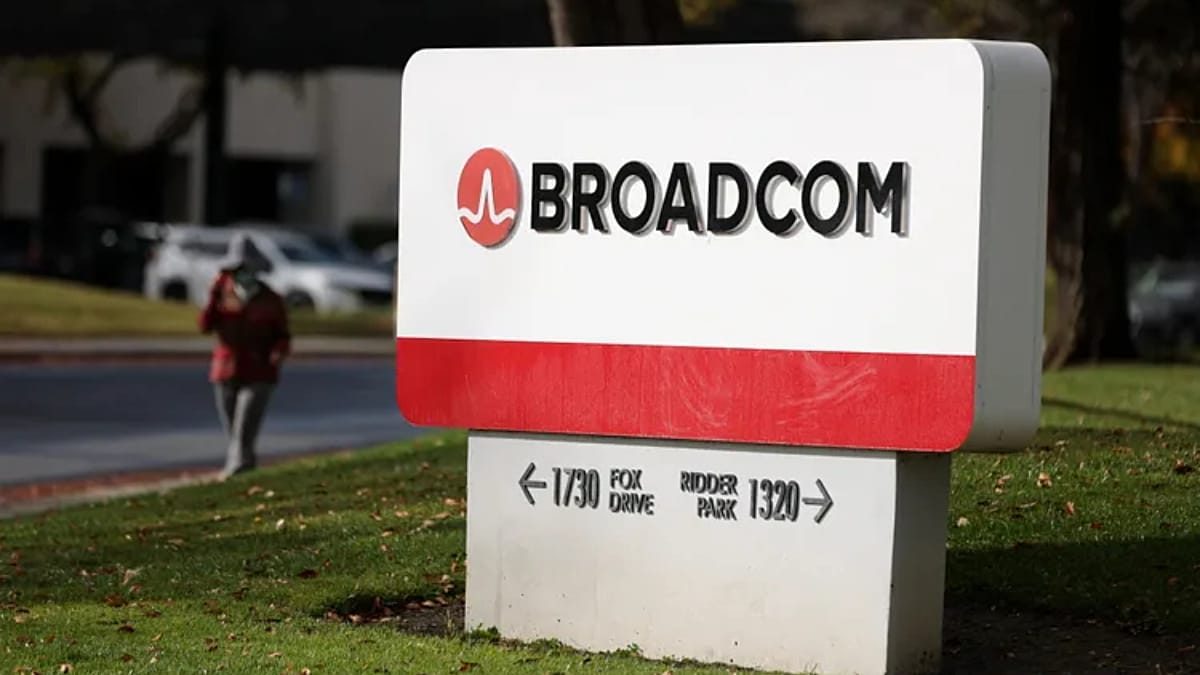
The American chipmaker Broadcom reported a 48% revenue surge and AI semiconductor sales up 143%, but it disappointed investors by not raising its long-term sales target, sending shares tumbling more than 12% in after-hours trading.
Broadcom's second-quarter results were, by almost any standard measure, exceptional.
Revenue climbed 48% year-on-year to a record $22.2 billion (€19.1bn), AI chip sales more than doubled, and adjusted earnings per share rose 54% to $2.44, comfortably beating consensus estimates.
Investors, conditioned to expect not just strong results but results that keep rewriting the ceiling, punished the stock sharply after the California-based semiconductor giant declined to raise its long-term AI revenue target and after its third-quarter AI chip outlook came in below the most aggressive forecasts circulating on Wall Street.
After closing Wednesday's session at an all-time high of $495 per share, Broadcom dropped more than 12% in after-hours trading, wiping out more than $300 billion (€258.3bn) in market value.
According to CEO Hock Tan, who called AI demand "simply insatiable", the trajectory remains firmly intact.
Tan guided third-quarter consolidated revenue to $29.4 billion (€25.3bn), representing 84% year-on-year growth, and raised the full-year AI semiconductor revenue forecast to $56 billion (€48.2bn), up roughly 180% from the last fiscal year.
The impact of Broadcom's results extended well beyond the Nasdaq.
Asian markets opened sharply lower on Thursday, with the sell-off concentrated in semiconductor and technology stocks.
The MSCI index for Asian shares fell 1.6%, snapping a four-day rally that had pushed it to an all-time high, while Nasdaq 100 futures retreated 0.5%.
South Korea's KOSPI, widely regarded as a barometer for global AI investment sentiment given the prominence of its chip industry, fell 1.8%, making it one of the region's worst performers of the day.
Samsung Electronics and SK Hynix, two of the world's leading memory chipmakers, declined between 2% and 4%, while LG Electronics dropped nearly 14%.
In Taiwan, key AI server assemblers Hon Hai Precision and Wistron fell close to 4% and 8%, respectively.
Broadcom is a critical supplier of custom AI accelerators and high-speed networking chips to the world's largest hyperscalers, including Google, Meta and OpenAI, meaning its guidance carries significant weight for investors tracking the pace of AI development.