Scientists flee burning building in Kyiv’s mini-9/11, as Russian drone also explodes 200m from EU embassy (Ukraine Battlefield update, Day 1,678)
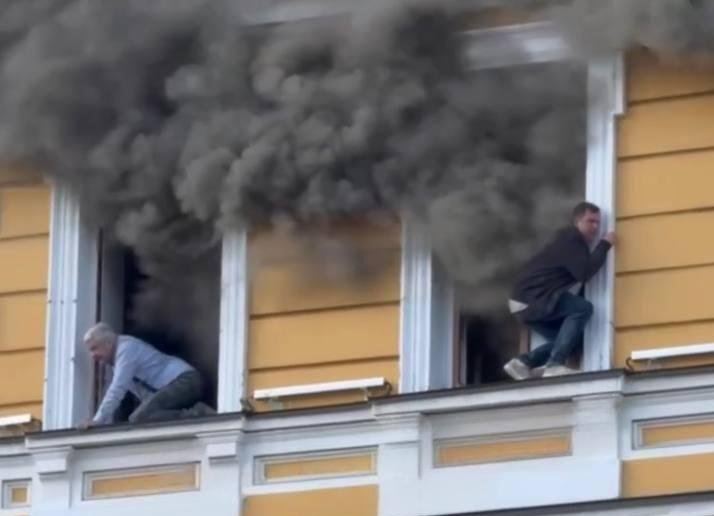
Despite global audiences being numbed to daily Kyiv airstrikes and casualties, Russia's 9/11-type attack on a scientific institute, in a botched assassination attempt, still grabbed world attention.
Kyiv is currently in a worse situation than Kharkiv when it comes to air-raid alerts.
Kyiv has experienced its worst attacks since the start of the war in recent weeks. According to an analysis by French OSINT analyst Clément Molin, the capital was hit by 155 Russian missiles and drones in September, compared with 113 in August and 21 in March.
Even smaller, FPV (first-person view) drones have recently begun flying on Kharkiv’s outskirts, hunting cars, but the number of air-raid alerts and air strikes there has still been far lower than in Kyiv in recent weeks.
Molin added that the Russians had struck the heart of the capital 10 times a day in recent days.
The Russian independent group Conflict Intelligence Team wrote that Kyiv and its surroundings would probably account for the highest number of civilians killed and injured anywhere in Ukraine in September, more than in the Donetsk, Kherson, or Kharkiv regions.
An at a time when attacks causing casualties occur every day, it is becoming harder for foreign journalists to engage readers with reports about an attack on the Ukrainian capital.
During the working day, they struck the historic building of Ukraine’s National Academy of Sciences. It caught fire, and footage of scientists and other employees attempting to climb out through smoke-filled windows circulated around the world.
A Russian strike against the building of the National Academy of Sciences of Ukraine. A rescue operation is underway: crews are putting out the fire and searching for people who may have been trapped inside. All services are deployed. Today in Kyiv, a pharmaceutical company and… pic.twitter.com/ccfIHnGFNg
The images of people standing on a ledge may have recalled those seen after the 11 September attacks, although the terrorists then struck skyscrapers more than 100 storeys high in New York.
Horrific scenes out of Kyiv this morning as Russia used a jet-powered drone to blow up Ukraine’s National Academy of Sciences. People are escaping through windows as the building burns. Just like they target kindergartens and schools, now they are bombing science. pic.twitter.com/yvwzLz9DXe
🚨 BREAKING: Terrifying footage captured people climbing out of windows after a Russian attack struck the National Academy of Sciences in central Kyiv in broad daylight. The attack killed one person and injured at least three others, triggering a massive blaze. pic.twitter.com/wiWTU51QaL
The historic building had only three floors. Thanks in part to this and the firefighters’ rapid response, only one person was killed and six were injured.
It is quite likely that the attack on the Academy of Sciences was not accidental and that the Russians were targeting an important individual.
Ukrainian analyst Viktor Kovalenko believed that the Russians had wanted to kill 86-year-old Volodymyr Horbulin. He is one of the architects of Ukraine’s missile and space programme.
He headed Ukraine’s space agency in the 1990s and, for five years under President Leonid Kuchma, served as secretary of the National Security Council. Despite his age, he remains active: he is vice-president of the National Academy of Sciences and focuses on security issues.
And the elderly scientist was in the building at the time of the attack. The drone hit a room one floor above his office. He sustained only minor injuries, but his assistant was killed.
A few hours later, the Russians struck the building of the Dobrobut medical centre, which caught fire. Several people were reported injured there.
Russia bombed the Dobrobut Medical Center in Ukraine's capital, Kyiv, this afternoon, setting the facility ablaze. pic.twitter.com/gs0d1X3eB5
These attacks took place in the wider city centre and were felt by the EU ambassador to Kyiv, Slovakia’s Katarína Mathernová.
“Just moments ago, an explosion jolted me out of my chair in my Kyiv office. It was the loudest blast I have experienced here in three years. A jet-powered drone struck a building around 200 metres from the EU delegation. It happened in broad daylight. The target was a hospital,” Mathernová wrote .
While the Russians once attacked Kyiv mainly at night, attacks are now also taking place during the day. Although they target military and industrial sites as well, they frequently hit civilian facilities where many people are present during daytime.
“Today in Kyiv, a person can be killed in a supermarket, at a university, at a petrol station, on the street or at work. The campaign of indiscriminate attacks targeting the centre of the capital is unprecedentedly violent. The Russians are targeting data centres and regularly miss their targets,” French analyst Clément Molin wrote.
“What Russia is doing is pure terrorism. And we should treat neither its state leadership nor its military forces any differently. Why should we continue pretending that it is possible to negotiate with such terrorists on equal terms?” German analyst and former journalist Julian Röpcke wrote .
“Nothing expresses the ‘fight against Nato expansion’ quite as clearly as bombing the historic building of Ukraine’s National Academy of Sciences in central Kyiv, forcing ordinary scientists to jump from windows to escape death in the flames,” Ukrainian journalist Illia Ponomarenko added .
The Russians are attacking the capital virtually constantly. It is not merely one or two attacks a day. As Ukrainian analyst Bohdan Myroshnykov wrote on Sunday, Kyiv had been without an air-raid alert for only 5 hours and 55 minutes in the previous 24 hours.
“The current alert has lasted 8 hours and 20 minutes. The enemy deliberately launches drones in order to prolong the alert. Once they arrive in Kyiv, they begin circling over the city and its suburbs to keep people on edge for even longer,” he wrote.
According to him, the main weapons currently used by the Russians to attack Kyiv are Geran-5 jet drones. These are essentially smaller, though still six-metre-long, cruise missiles. By contrast, Geran-4 jet drones have the classic delta-wing shape of older Shahed drones.
Myroshnykov wrote that Ukrainians had more or less learned how to shoot down Geran-4 drones, but were having difficulties with the fifth series. While they intercept Geran-4s with an effectiveness of 70 to 80 percent, the rate for Geran-5s is only 50 to 65 percent. “The fourth series is intercepted en masse while approaching the Kyiv agglomeration, whereas the fifth is only intercepted within it,” the analyst wrote .
Last week, we wrote that Ukrainians had released the first videos showing them shooting down jet-powered Geran drones, including Geran-5s, using jet-powered interceptor drones capable of matching their speed. A video has now emerged of another new drone that apparently can already do this.
The problem, however, is that none of these drones is yet being mass-produced. Ukrainians therefore do not have enough of them to counter the growing number of jet-powered Gerans that the Russians are launching at Kyiv and other Ukrainian cities, as well as other targets.
“There are prototypes that have delivered varying results, but considerable effort is needed to bring a prototype into large-scale serial production. Sometimes this is impossible because access to certain components is limited,” former adviser to Ukraine’s defence ministry Serhii Sternenko wrote .
“It took us 3.5 years to find a more or less reliable anti-drone defence against conventional Shaheds. We began this path five months ago in the case of jet-powered drones. It may take us eight to 10 months to find a reliable anti-drone defence,” Myroshnykov wrote.
Ukraine’s defence minister, Yevhen Khmara, called on European partners at a meeting of his EU counterparts to help finance these interceptor drones, which have proved to be the best defence against conventional Gerans.
The Russians are also becoming increasingly creative in their efforts to strike targets in Ukraine. Serhii Beskrestnov, another former adviser to the defence minister, shared a video showing the Russians striking Incom’s office building in Kyiv. What is notable is that they filmed the strike themselves using a drone with a high-quality camera.
“The enemy attacked Incom’s office with a Geran-5 missile, while at the same time a jet-powered Shahed flew over Kyiv, circling above the attack site at an altitude of almost three km. It served as a radio-signal relay for the Geran-5 missile while also recording, and immediately transmitting, video of the attack on Incom. This Shahed then flew out of Kyiv and destroyed a McDonald’s warehouse,” Beskrestnov wrote.
He added that he was convinced the two operators had been sitting next to one another.
The Defence Express website also published an article about the Russians fitting their newest Geran-5-K5 jet drones with the Susanin navigation system, first reported by a Russian Telegram account. The system works by comparing current camera images with pre-recorded imagery.
“This enables the Geran-5 K5 to determine its coordinates even when satellite navigation is unavailable,” Defence Express wrote .
However, it works better during the day than at night, as it needs current images of objects on the ground.
It is often said that the Russians attack Ukrainian cities because they are unable to advance at the front. The aim may be to lower Ukrainians’ morale, degrade their economy and force them to surrender and accept Russian terms.