Hungary's reckoning with Orban's corrupt system picks up speed with high-profile arrests
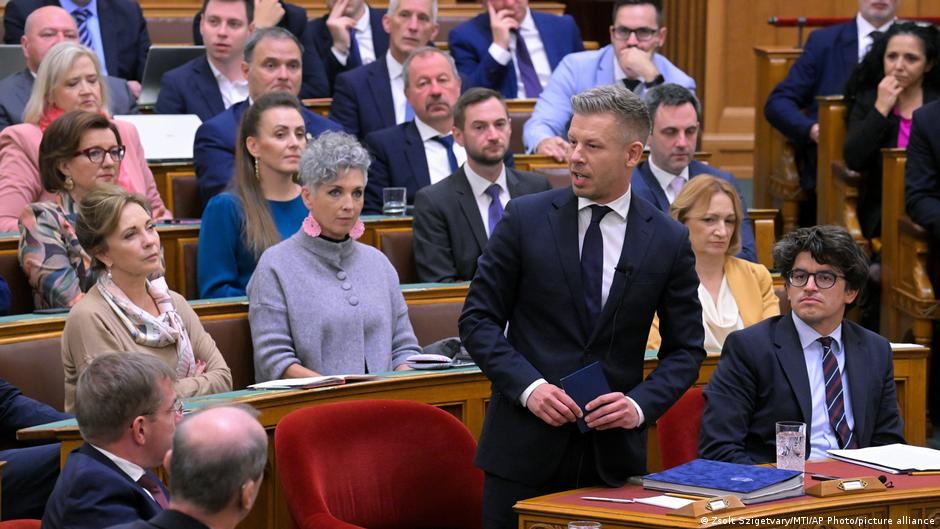
Hungary's Prime Minister Peter Magyar vowed to dismantle Orban's corrupt networks. High-profile figures are being arrested and many Hungarians are pushing for swift accountability, but the rule of law takes time.
One of the new Hungarian government's key pledges was to investigate corruption under Viktor Orban , recover embezzled assets, and hold those responsible accountable . Or, in the words of Prime Minister Peter Magyar, it is time to "liquidate Orban's mafia state." During his election campaign, Magyar had already announced a "program for the road to prison." As prime minister, he launched "Operation Purgatory" at the end of June 2026.
Measured against his fighting talk, little has happened so far. There have been no sweeping purges of the state apparatus, although some government funds flowing to Orban-aligned businessmen have been cut off. Police and prosecutors have summoned a handful of relatively unknown individuals for questioning, and a few people were arrested. The governing majority also established an agency to recover assets, but it is is not yet up and running.
But at the beginning of the week, Hungarians witnessed the first significant development in the promised reckoning with the Orban system. Two prominent lawmakers and former ministers were arrested over corruption allegations.
On Monday, Magyar's Tisza Party parliamentary faction used its two-thirds majority to lift the immunity of two lawmakers from the opposition Orban camp: Balazs Hanko, formerly minister for culture and innovation and a lawmaker from Orban's Fidesz party, and Miklos Sesztak, a former development minister who is now a lawmaker for the small Christian Democratic People's Party (KDNP), which has been a Fidesz affiliate since 2010. Both are the subject of corruption investigations.
Balazs Hanko was not among those in Orban's system who enriched themselves on a large scale. But he is seen as a symbol of the common practice under Orban of systematically using public money to fund the ruling party, Orban's network of allies, election campaigns, and propaganda efforts. Specifically, as minister, Hanko allegedly unlawfully allocated around 50 million euros from the National Cultural Fund (NKA), which he oversaw, in 2025 and 2026, including funds intended for election campaign purposes.
The case of Miklos Sesztak is different. He is one of the wealthiest lawmakers in Hungary and has made headlines for more than a decade with his personal corruption scandals, another typical trait of the Orban system. As minister, Sesztak allegedly accepted around €30 million ($34 million) in bribes with an accomplice between 2015 and 2018. The alleged payments involved contracts related to the state-owned Hungarian bus company Volanbusz and the construction sector.
Sesztak went straight to the prosecutor's office on Monday after his immunity was lifted, where he was taken into pretrial detention. Balazs Hanko took a different route. He arrived at Parliament on Monday morning with his wife and four teenage children and, after his immunity was lifted, said he was waiting for the authorities to make a decision. In practice, it appeared that he was barricading himself inside. Only after Parliament Speaker Agnes Forsthoffer formally ordered Hanko in writing that evening to leave the building, and he received a summons from the prosecutor's office, did he finally head for the exit, accompanied by his family and Fidesz lawmakers protesting what they called Magyar's "arbitrary rule."
The entire episode was livestreamed on Viktor Orban's Facebook page. After Hanko said goodbye to his family outside, a misunderstanding occurred. His SUV driver, apparently believing Hanko was already inside the vehicle, drove off without him. Hanko ran after the SUV, and the livestream on Orban's Facebook page then cut out. Later that evening, Hungarian media reported that Hanko had also been placed in pretrial detention.
Earlier that afternoon, Prime Minister Peter Magyar delivered a sharp speech in Parliament on the two cases. His own immunity had also been lifted beforehand, over a case that is classified in the records as theft.
In June 2024, Magyar took a phone from a man who had been filming him without permission at a nightclub and threw it into the Danube, where it was later found. Magyar had explicitly asked for his immunity to be lifted in the case. It is a calculated PR move intended to show that the same standards apply to everyone. But it is also a risky maneuver, if convicted, Magyar could lose his seat in Parliament.
In his parliamentary speech, he offered Fidesz and KDNP lawmakers a stark comparison: "How many hundreds of thousands of phones would you have to throw into the Danube to come close to the trillions allegedly stolen by the Fidesz-KDNP mafia?"
Magyar has also spoken forcefully about Hungary's justice system. He has praised rank-and-file judicial employees while criticizing the leadership of the prosecutor's office, accusing them of repeatedly covering up corruption cases as "collaborators of the Orban system." At the center of the dispute is a fight over the appointment of a new prosecutor general.
The Tisza faction rejected Zoltan Szathmary, the candidate proposed by President Andras Baka, because his brother works for the Office for Constitutional Protection and, in that role, is a suspect in an ongoing politically sensitive case known as the "Gold Convoy" affair. In March 2026, Viktor Orban ordered the detention of a legal Ukrainian money shipment. The escorts were arrested in dramatic fashion, and cash and gold bars were seized. Orban and other Fidesz politicians indirectly accused Magyar's Tisza Party of receiving funding from Ukraine . Several people involved in the operation are now under investigation for abuse of office. Orban himself is not currently part of the proceedings, but could be in the future.
To view this video please enable JavaScript, and consider upgrading to a web browser that supports HTML5 video
Although Magyar has formally emphasized the independence of the judiciary, his comments in the current debates have given the impression that he is getting ahead of judicial decisions or becoming too deeply involved. At the same time, expectations among many Hungarians for a swift reckoning are high, and public debate's often return to the topic of how people want to "hear the handcuffs click." A recent poll found that a large majority of Hungarians consider the former Orban order "systemically corrupt" and a "mafia state."
Overall, Magyar and his government face the challenge of balancing the rule of law with public expectations. Many former critics of Orban are also calling for the reckoning with the Orban system to be handled properly. Prominent attorney Gyorgy Magyar, for example, who represented people in numerous human rights and rule-of-law cases under Orban, called for "prudence, patience, calm, discipline, and professionalism" in an interview with the news outlet Hirklikk.
Questions remain about whether "Operation Purgatory" will be merely spectacle, or whether the justice system will investigate corruption cases independently and in keeping with the rule of law.