In Peru's Sacred Valley, a Rare and Immersive Dining Experience at Mil Taps Into Ancient Traditions
At the country's most immersive fine-dining restaurant, a new experience takes guests into local homes—and an Inca-designed food pantry—before the tasting menu begins. Writer Paola Miglio reports.
Norma Quispe Juarez is waiting for me at the entrance of Kollparay, a small community of just five households and 15 people total. We’re at 3,500 feet above sea level, in the Sacred Valley of the Incas . Surrounding us are magnificent mountains, though here everyone calls them apus, a Quechua word that literally translates to “lords” or “spirits,” denoting their significance to the people who live among them. Some of their peaks are still capped in snow, though most of it has melted by now. The dry season has begun, but, as is increasingly true with climate change, these patterns have become less predictable. Sometimes it rains, or a frost hits, even in the drier half of the year, turning patches of those golden winter fields into unexpected shades of striking green. This uncertainty is a compelling reason to think about the future, and the growing need to store the food and seeds that provide sustenance.
Kollparay, an annex of the community of K'acllaraccay in the Sacred Valley, is home to Doña Conchi and 14 other neighbors.
This rural community is the first stop on a new three-hour immersive experience offered by destination restaurant, Mil . The restaurant's team has brought me to Quispe, who is local to the area, and will act as my guide and translator. At the entrance of Kollparay, Quispe pauses, taking my hands and smearing them with soil, the soil of her village. “I have to introduce you,” she says to me. “The land needs to know who is treading upon it so you can walk freely.”
It is a gesture of courtesy that allows guests to feel at home on the tierra that Quispe regards as a living being. For that is the nature of the Andes: The people here welcome others openly, and share a worldview deeply intertwined with the natural world, one that values cooperation and continues to employ ancestral methods for organizing work. This belief system is called ayni, meaning “today I work for you, and tomorrow you work for me.” If a family needs to build a new house, the rest of the community will pitch in. The favor is returned as needed. There's a reciprocity among the people, and with the land itself.
As we walk along the stone path that crosses Kollparay, the only sound I hear is the gentle swish of ichu grass, dry and crisp, swaying in the wind. Quispe leads us to the adobe home of Doña Conchi, our local host for the morning, where breakfast awaits. Over the next three hours, we will learn about the ancestral foodways that live on over a meal with Doña Conchi, then, see firsthand how Inca food storage techniques are being revived to tackle today’s climate challenges, before, finally, sitting down for the imaginative tasting menu that has earned Mil the title of The Best Culinary Experience in the World , and landed it on consecutive years' worth of World's 50 Best lists.
Since 2018, the 37-seater Mil from husband-and-wife chefs Virgilio Martínez and Pía León, and researcher (and sister of Virgilio) Malena Martínez, has functioned as more than a restaurant. This outpost from the same family of Central and Kjolle fame, renowned for both cataloguing and reimagining obscure ingredients found throughout various altitudes of Peru, has become the home base for their culinary research arm, Mater Iniciativa . Here in the rural Sacred Valley is where their first cacao experiments began; it is where they have studied new ways of using coffee beans and fermenting local fruits; and where botanicals have been transformed into dyes and textiles. It is situated not in a big city like Lima or Cusco, but rather among the rural communities of the greater Cusco region, who have long lived in harmony with what is on their table.
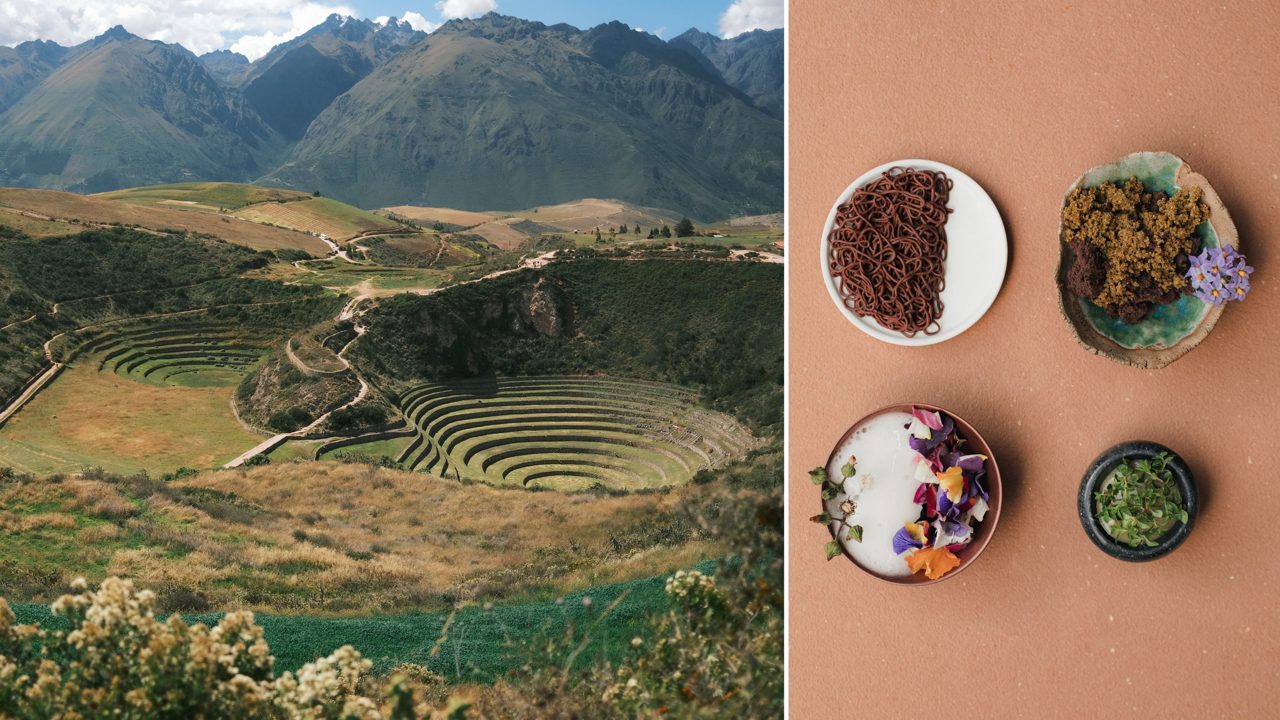
Mil has become what the neighboring archaeological site of Moray once was, a place for the Incas to study plants and herbs. Mil also offers hands-on experiences preceding its meals, with guests able to choose between the Botanical route, which explores endemic flora with an expert guide; the Warmi route, which was developed with a local womens’ co-operative, and navigates the world of textile and dying techniques; and, as of June 2026, this Qollqa Mater route, which focuses on the concept of the Incan qollqa (a food storage structure), and takes guests to a newly unveiled design. The journeys underscore how ancestral knowledge has informed the culinary work done at Mil, and the center's greater mission to collaborate with its neighbors.
The exterior of Mil, the 37-seat fine dining destination by Virgilio Martínez, Pía León, and Malena Martínez
Doña Conchi, whose full name is Concepción Meza Challco, is 89 years old and a respected member of the community. She lives alone, but her grown children visit often, bringing her lunch most days. You can tell how many years Conchi has spent in the sun, her cheeks perpetually rosy and her eyes squinted as if looking into its rays.
At the heart of her home is a hearth where she heats water and cooks burbling pots of food; there is also a black cauldron out back, next to her mortar, whose mano, pestle, was a wedding gift from her mother. It’s a perfect half-moon carved of rock, with which she grinds toasted corn to make sankhu, a paste that we’ll be having for breakfast, along with our emoliente (a medicinal herbal tea that is revered for its ability to cleanse the body and reduce inflammation). Every family has their own sankhu recipe, and Doña Conchi's is pleasant and grassy, somehow dry and sweet at once. She serves it to us on a small plate, and we eat it, slowly, with a spoon. This is a normal day during harvest season for Doña Conchi, Quispe says while translating host's words from Quechua. Conchi rises at four in the morning and is off to bed by ten, and now, welcoming guests like me into her home is a part of her days.
Quispe and I ask Conchi if she’s heard of the qollqas, the ancient granaries that the Incas used, and she says she hadn’t until recently. The new one, whose construction was initiated by the Mil team, is 10 minutes by foot from her home. Maybe she didn't know about them because she never went to school, she says, but she’s been told that qollqas like this could be a good thing for her community. When we finish eating, Conchi takes us to her pantry, her own little “qollqa” that she is very proud of: a room that most Andean homes have, called a truji, designed to store foods and seeds. It has been outfitted with stones and adobe so that humidity doesn’t get in, but, still, food only lasts for eight months at most in this structure.
Norma Quispe Juarez, who is one of the hosts and Quechua translators for guests, braids stems in the Sacred Valley.
When I was growing up in Peru, history books taught me that the Incas were capable of anything: They developed hydraulic systems, expansive road networks, agricultural terraces, and qollqas, these massive structures that harnessed the elements, and particularly cool breezes, for food preservation. When the Incas conquered other Indigenous groups, they didn’t destroy what they found but adopted what worked for them, using the Lupaqa and Wari design of stepped terraces for their farming, and connecting trails made by the Wari and Tiwanaku civilizations to create the 25,000-mile Inca highway known as the Qhapaq Ñan (parts of which today include the well-known Inca Trail to Machu Picchu). When the Spanish arrived in the 16th century, however, they laid everything to waste and rewrote history.
That’s how, for centuries, the concept of the qollqa was rendered obsolete in Peru, despite the fact that it has the potential to solve modern-day agricultural and food access issues. Some stand throughout the country as archaeological sites, such as the photogenic Pinkuylluna near Ollantaytambo , just an hour's drive from Mil. But today, the qollqa's simple yet brilliant design may allow communities to better navigate the challenges of sustenance farming.
“The qollqa is a way to bring ancient technology into the present, to show that it can still be a tool to conserve food while relying on nothing more than wind to safeguard what matters most: the products that nourish us," says Malena Martínez, Mater’s director. “It’s a construction that shifts our understanding of the past,” adds Virgilio.
To see this firsthand, Quispe and I walk to the new qollqa itself, making a 10-minute climb past fields that await harvest, and a small stream that, a couple of generations ago, carried saltwater but has since run sweet, elders say. There are fava beans drying in the sun, and piles of colorful tubers waiting for someone to collect them. And then, we reach Qollqa Mater, a conical, circular structure (15 x 52 feet) with walls made of adobe and stone. The entrance faces the apu Verónica, allowing cool breezes from the Amazon to flow in, and I can feel others coming off of nearby apu Chicón, whose chilly whispers sweep through the Sacred Valley every morning. Just as in ancient times, the structure’s orientation and location is no accident, but deliberately chosen to create an ideal microclimate inside. This qollqa, a new build, was designed by architect Juan Carlos Pareja in collaboration with archaeologist Rachel Schloss (UCLA), and built alongside families from the local community, led by Wilber Juárez Huamán, over the course of a year.
The Qollqa Mater, built over the course of a year, uses ancient Incan technology for present-day food needs.
Following tradition, one must ask permission from the apus and Pachamama (Mother Earth) to enter the qollqa, by taking a few dry coca leaves in the hands, lifting them toward each of the main apus surrounding the building, and then burying them in the ground with an intention. Then, we may step inside.
The design has one key reinterpretation of the original Inca structures. “It brings three different storage buildings under one roof, with one for seeds, another for fresh food, and one for textiles,” says chef Pía León. There are more than 110 pounds of potatoes and mashuas (a flowering tuber) that have been there since December. They are free of the eyes (sprouts) that would have long emerged if these had been left in the average kitchen or pantry. Proof, perhaps, that the structure is working.
The view Qollqa Mater from the 15-person Andean community of Kollparay
The main intention is that the qollqa will belong to the community, and remain under its care, with a plan to slowly integrate the space into the routines and needs of everyday life. It’s still in a phase of experimentation, but its use will mirror that of the past, storing the harvest’s bounty, as a safeguard against times of scarcity but, hopefully, also as a way of understanding how food evolves, how flavors change, and generally what happens to ingredients over time.
The dining spaces at Mil flow seamlessly from the inside to outside
Finally, we are led to the dining room, where all of these culinary explorations land on the table. This is not my first visit to Mil, and I have found myself dining at the exact same table each time: The last one on the right in the main dining room, beside a large picture window. I bask in the sunlight that pours over both the table and the mountains outside. The space has grown over the years: Two dining rooms now extend to an outdoor patio, and there are covered terraces, a nod to the harmony between humans and land that is so precious here.
Liquids at Mil are given the same attention as the dishes, with overlooked Peruvian ingredients distilled, fermented, and mixed in inventive new ways.
I begin my experience with one non-alcoholic beverage at the bar (today, subtle arracacia with fermented, dehydrated kjolle flowers) and then continue on to the dining room. Mil has always been singular: a rustic yet pristine setting for a fine-dining experience that uses only ingredients from the surrounding area. It is simultaneously austere, but precious. Earthy and herbal. Humble ingredients like potatoes and corn are elevated into various forms of art. Seasonality has always guided the kitchen, which is led by chef Luis Valderrama.
Today, I journey through dishes like huatia (recently harvested native potatoes cooked in clay); a refined lamb tartare, whose flavors are balanced by herbs and greens from the farm and cushuro (a nutritious river algae sometimes called the “Caviar of the Andes”); and bites of alpaca brightened with purple flowers, tricolor quinoa, and thin slices of tamarillo fruit (known, here, as tomato de arbol) in a ceviche-style dish.
The eight-course tasting menu at Mil, one of Peru's most coveted restaurant experiences
A wide spectrum of corn is on display in a colorful course that incorporates a delicate cream, and a piece of white cheese (a wink to the quintessential pairing of local cheese and corn sold in nearby towns), and sour butter is infused with chicha, an ancestral fermented corn drink. There is also duck, and a dish still in the testing phase with a sort of lamb ham, a reminder that new ideas are always sprouting here. You can almost taste the terrain in each bite, the rugged flavors that have harmonized with aromas and spices, making them gentler and more approachable. The non-alcoholic pairing is, as always, impeccable, with clarified extracts that highlight the subtlety of ingredients like papaya, corn, tumbo fruit, cabuya nectar, and 72% cacao nibs. We devour the landscape through sips and bites.
The desserts draw on the native Chuncho cacao, a rare form of the plant used here, not only as chocolate, but in partnership with the acidity of the fruit’s mucilage (the pulp that surrounds the beans; often unused, here it is a surprise guest). It is all delicious proof of how Mil has become a daily interaction with the place and people that surround it, a constant conversation that never quite ends.
Doña Conchi may not have known about the qollqas until recently, perhaps because her parents didn’t, maybe not even her grandparents, either. But today, she gazes at the new qollqa from her home with a mixture of wariness and admiration. She passes no judgment. She simply waits, patiently, to see what will come, waving goodbye to guests like me with a smile and discerning eyes. In the Andes, time is measured differently. There are things that take their toll on guests, the altitude, the elements, the uncertainty of nature. But not on Doña Conchi.
The Mater Qollqa immersion begins at Mil , about 30 miles (1.5 hours by car) northeast of the city of Cusco , beside the archaeological complex of Moray. It is offered in English and Spanish. Each session is about five hours total (from the start of the experience through the end of the meal) for groups of two to four people, and is offered twice per week. The full experience is $720 per person. Reservations are now open, and can be made on the Masi website .