Crimea faces ’energy desert’: Authorities completely stop fuel sales and cancel tourist season (Ukraine Battlefield update, Day 1,579)
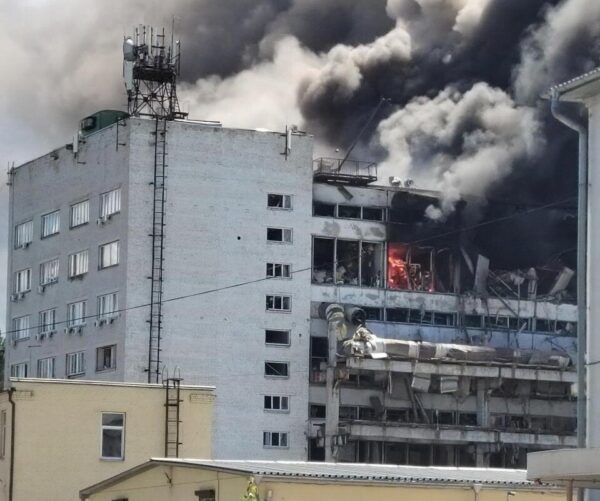
By smashing ferries, fuel depots and key roads feeding Crimea, Kyiv is testing whether it can strangle Russia’s Black Sea stronghold faster than Moscow can rewire its supply network.
Crimea is experiencing economic and energy collapse, Ukrainians warned it would get even worse. “Crimea has been left without petrol, electricity and water,” admitted on Sunday, after a new wave of attacks on the occupied peninsula, Komsomolskaya Pravda war correspondent Alexander Kots.
“Russians will remember with horror what Ukraine is preparing for them in Crimea. I do not envy the occupier who will be the last one to flee,” wrote Ukrainian deputy defence minister’s adviser Serhiy Sternenko after the same events.
The commander of Magyar Birds, Robert Brovdi, also joined in, addressing a long post to the “bunker grandpa”, as he calls Putin, in which he, among other things, apologised to Ukrainians in the occupied territories for the constant air-raid alerts and advised them to avoid military facilities and anything flammable.
According to him, Russians in Crimea face “the complete collapse of air defence, strikes on what remains of the (Black Sea) Fleet, the shutdown of the shadow economy, total exhaustion of resources and logistics, the end of tourism, an energy desert, a transport blockade, and so on…”.
Of course, this could be tough talk and a deliberate provocation, but the situation of the Russian army in Crimea looks dramatically bad. Among the videos of the day at the end of the article you will find footage of Russian convoys accompanied by mobile anti-drone teams. This is a Russian countermeasure against attacks on their logistics. So far, however, it is not working.
Moreover, as calculated by French analyst Clément Molin, the pace of Ukrainian medium-range strikes is not decreasing. On the contrary, it is intensifying. On Sunday he published statistics from videos he had analysed over three days. He counted an average of 30 strikes on Russian trucks per day. He attributed the increased tempo to a higher number of deployed drones, against which Russian countermeasures were at least temporarily insufficient.
The result is a series of very serious decisions that the occupation authorities had to take over the weekend and on Monday morning. We will list them step by step, and together they already create an almost complete picture of what Brovdi promised the Russian army.
“Fuel deliveries to the city are delayed,” announced Sevastopol mayor Mikhail Razvozhayev on Saturday, adding that any sale of fuel had been completely halted. All available fuel supplies were allocated exclusively to emergency and security services, at least until Tuesday.
Throughout Saturday, Razvozhayev used his personal channel to report on the ongoing air raids. On Sunday, he added a major announcement on new security measures:
The final blow to the tourist season in Crimea came on Monday morning. The leadership of the Republic of Crimea decided to cancel children’s camps on the peninsula from 22 June to 1 September. “If children are currently staying in camps in the territory of the republic, they will be sent home; information about this will be published on the education ministry’s channel or communicated to parents in person,” the authorities stated in their message. We have already reported that Russians were cancelling their stays in Crimea en masse.
How the situation deteriorated over the weekend. A major factor was the disabling of three ferries that provided transport across the Kerch Strait. The first video shows two of them under way. The Russians managed to shoot down an overflying drone.
😢💥Footage of the attack by an FP-1/2 strike UAV on the Kavkaz port in the Krasnodar Krai pic.twitter.com/m6pbkqgVZA
The next one already shows three different vessels, but smoking after being hit directly at sea.
😍Panorama of burning car ferries after a massive attack by Defense Forces drones near the port of Kavkaz pic.twitter.com/DCflMdv2hg
In addition, the authorities had to halt traffic on the well-known R-280 road in the south of occupied Ukraine. And the Crimean Bridge is not a solution, because since it was damaged, the transport of tank trains on its rail section has been allowed only in exceptional cases , and heavy lorries are also banned from entering the bridge.
“Now, after having partially achieved its goals in the form of a fuel collapse and power outages, the enemy will clearly try to move on to the final phase of its long-term campaign, whose ultimate aim is to hit the Crimean Bridge,” Russian commentator Rybar believed, like many of his colleagues.
On his map, this source marked locations critical for supplying Crimea, which are being targeted by the Ukrainian army:
Rybar also published a chronology of how Crimea ended up in its current situation. According to him, this began to happen systematically from mid-2025, when drone strikes started on ports in Crimea and on the opposite Russian shore, with the aim of restricting the movement of goods and people.
This was followed by the mass deployment of naval drones, which first targeted tankers and then ships in the Sea of Azov, leading to higher transport and commercial insurance costs and less willingness to send vessels to Russian ports in the Black Sea and the Sea of Azov.
At the same time, there were sustained attacks on fuel depots in Crimea and again on the coast of the Krasnodar region on Russian territory. “This led to a situation where storing fuel on the peninsula became practically impossible due to the constant threat of air raids. Crimea thus became even more dependent on supplies from outside,” Rybar stated.
Only when the long-term attacks had reached this stage, in which sea links were restricted and there was no longer enough fuel left in Crimea, did the attacks on the land corridor through the southern parts of occupied Ukraine begin. “In parallel, the enemy is attacking railway infrastructure both in Crimea and in Novorossiya (the Russian term for the occupied territories), which is regularly reflected in rail services,” Rybar noted.
A semiconductor factory in Voronezh was hit by precision-guided weapons. It produces electronic components for modern Russian weapons, including ballistic missiles. According to Russian channels, it was struck by cruise missiles, with Storm Shadow and Flamingo types being mentioned. The building caught fire. The attack appeared to be very precise. The facility is located in the middle of dense urban development, but in the published footage there was no indication that nearby structures had been hit.
More details have emerged regarding the struck and now burning factory in Voronezh, Russia. The Semiconductor Devices Plant produces parts for air defense, ballistic and cruise missiles, so basically the only products Russia is currently manufacturing. Devastating for them. pic.twitter.com/6A1pibgern
In this video, from the 15th second, local residents captured one of the incoming missiles manoeuvring before hitting the target. The footage is not of sufficient quality to determine the exact type of weapon, but it appears larger than a Storm Shadow cruise missile.
🇺🇦🚀 "Up to nine Storm Shadow missiles attacked factory in Voronezh. Flamingo missile launches were also recorded, everyone take cover immediately," - Russian monitoring channels pic.twitter.com/5WZrW8FRpn
In Kostyantynivka, Russian forces are moving ever closer to the northern edge of the town. Russian infantry showed their flags in three new locations. These were marked on a map by the Ukrainian channel Petrenko, which said, however, that the overall number of Russians in the town was still limited, which “does not allow them to take full control of several areas where they have already managed to film videos of flag-raising”. It nevertheless assessed the overall situation in the town as “extremely” tense.
As the OSINT account Playfra pointed out, Russian forces have so far only once, but still, reached even further north, when they pushed into the village of Osykove, which lies halfway between Kostyantynivka and Druzhkivka. The author estimated the number of Russians in the town at several hundred and compared the situation to that in Pokrovsk at the end of last year, that is, shortly before its fall.
Kostyantynivka. The situation continues to be very dire, with by now little hope of turning it around. A few days ago a small Russian infiltration group was eliminated in Osykove, just north of Kostyantynivka. In general, the total number of Russian infiltrators in the city by… pic.twitter.com/BTkDHmXLrQ
Russian maps show the entire southern half as occupied, but the Russian Telegram channel Dva majors wrote even in its Monday report on the front-line situation that “the elimination of enemy groups in the south-western part is under way”, that is, in the very area that is shown, for example on Rybar’s map, as being under Russian army control:
Russian forces set fire to a Turkish ship bound for Odesa and damaged two others. An Egyptian crew member was killed in the attack. The rest were rescued by the Ukrainian navy. In addition, the Russian army attacked two more ships sailing under the flags of Belize and Palau. This was reported by Ukrainian foreign minister Andrii Sybiha.
Overnight, Russia attacked a Türkiye-owned dry cargo vessel in the Black Sea. And it did so right after a high-level Turkish visit to Russia. A clear demonstration that Russia’s words cannot be trusted. Russia remains the main threat to the Black Sea security and prosperity.… pic.twitter.com/a3BSNyHsqM
This is undoubtedly a Russian response to the blockade of Crimea. Russian supporters of the war have long criticised the fact that the port of Odesa continues to operate normally despite constant air raids, which Ukrainians use to export their grain and import goods needed for the country’s survival.
The driver of a Russian tanker had excellent reflexes and a great deal of luck, which allowed him to dodge an attacking Hornet drone at the last moment.
This tanker was not so lucky. Note that it is the same type, painted orange, as in the previous case.
On a Russian supply route deep behind the southern frontline, a Ukrainian mid-range strike drone slams into a Russian fuel tanker. pic.twitter.com/51cEf29Fss
Russian forces have started escorting tankers in convoys along the R-280 road.
As expected, Russian 🇷🇺 forces are escorting key fuel trucks and protecting important road hubs with canon air-defense or drone interceptors teams. At the same time, they are reinforcing key bridges leading to Crimea, which have been hit, with pontoon bridges, again as… https://t.co/lawZvur0Q8 pic.twitter.com/GmV843qWD1
Note: Neither side provides regular information on its own dead or destroyed equipment. Ukraine publishes daily figures for Russian casualties and destroyed equipment, which cannot be independently verified. In this overview we use data from the Oryx project , which, since the beginning of the war, has compiled a list exclusively of equipment losses documented by photographic evidence.
This story was updated on 23 June 2026 to correct the name of the Telegram channel Dva majors .
Roman Pataj is Head of the Opinion section at Denník N and, since 2022, the author of the Ukrainian Battlefield update. He graduated in political science and has worked as a journalist since 2002.