Staying Connected to Your Kids When Traveling for Work Is Possible, Here's How
From FaceTime room tours to AI bedtime stories, these tiny rituals can help kids feel included from afar.
I travel for work somewhere between four and six months a year, which is both a privilege and, depending on the day, a knife to the heart. I bring my son when I can , but not every assignment is built with a 4-year-old in mind. A recent 17-day Smithsonian Journeys group tour through Central Asia focused on history and archaeology, for example, was not the moment to test his limits. So I went without him.
This was hardly my first work trip since becoming a parent, but it was the first where Julian was old enough to really notice my absence: There were teary FaceTime calls, often in the middle of the night for me because of the time difference. “Mommy, I miss you when you travel,” Julian told me. Another day, he tried a different argument: “You can’t go on a trip because I love you.”
There is no easy fix for that specific type of heartbreak, no airport plushie that makes your kid’s pain go away, or makes you not feel like the Worst Parent Alive for leaving. But tiny rituals can help: a note dashed off from a hotel room or a strategically planted kiss before departure.
These gestures do not erase the guilt of work travel. They give kids something to hold onto, and parents a way to stay connected when they can’t be huggable in the same room. I asked parents who travel often for work to share the small practices that help their children negotiate pre-departure dread, make check-ins from the road feel more special, and turn ordinary work trips into something that sticks long after everyone is home.
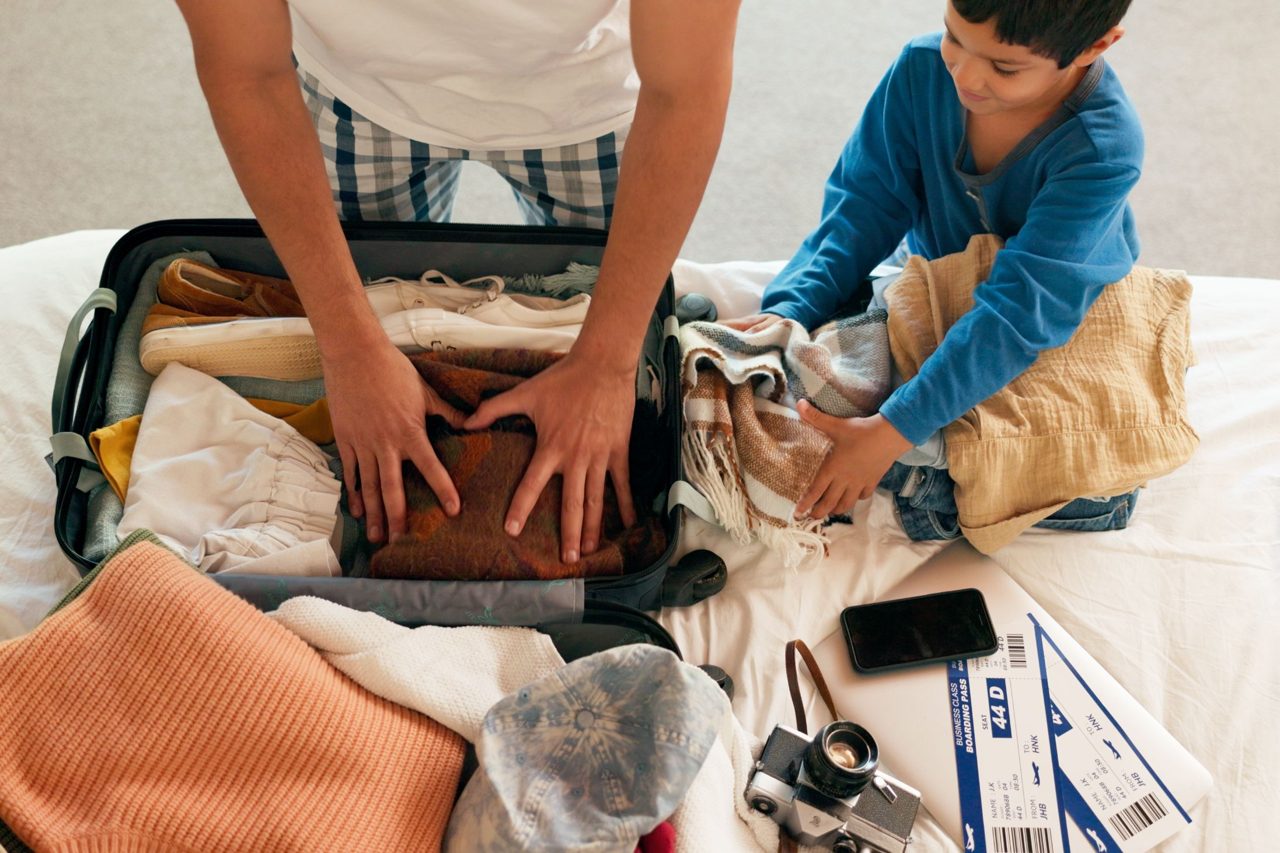
The anxiety around a work trip often starts before the suitcase is zipped, which is why some parents make the leaving itself more concrete. Angela Cowley, a Sydney-based managing director and mother of four, travels frequently interstate and internationally. Before each trip, her eldest, Georgia, helps her pack, choosing one thing for Cowley to wear each day she’s away: a bracelet, a watch, earrings. The tradition began before a 10-day trip to Singapore; now, Cowley says, it helps Georgia feel like she’s part of the experience.
Having your child help you pack for a trip is a great way to make them feel connected to your plans.
Monika Sundem, the Montana-based CEO of experiential travel company Adventure Life and another mother of four, created a more structured ritual before an Antarctica trip, when she knew ordinary check-ins would not be possible. She placed numbered envelopes in shoeboxes on their desks, one for each day she’d be gone. Some held a note; others included a small treat, toy, funny drawing, or an instruction like “Tell Dad this is good for ice cream after school today.” Sundem says the simple ritual helped ease the separation anxiety, especially for her youngest daughter.
In our house, the pre-trip tradition involves red lipstick. Before I leave, I plant a kiss on his left cheek, where the imprint usually lands in a lopsided heart shape. He calls the mark “my heart,” and because the formula is stubborn, it can stain for days. This once prompted a concerned call from his preschool nurse while I was in Istanbul; she thought he had a rash. I had to explain that his mom had simply marked him like a tiny valentine.
There is something thrilling to a kid about seeing a familiar toy turn up somewhere it does not belong. For James Massey, managing director of a London-based communications agency, that toy is usually a Lego figure belonging to his son Kit, now almost 14. Massey, who travels from Gloucestershire to London weekly and abroad about twice a month, started carrying the figures when Kit was around 7 and his younger son, Atticus, was 5. At first, they were more like good-luck charms; later, he began photographing them in airline lounges , hotel rooms, and, once, beside the famous Gstaad sign before a VIP dinner with Piaget. The figure was Han Solo riding a Tauntaun from The Empire Strikes Back , and Massey recalls getting “a lot of odd looks” while setting up the shot.
Now father and son negotiate over which figures are important enough to travel, and which are too rare to risk. Naomi McKee, a U.K.-based PR manager, did something similar when her sons, Oscar and Henry, were 7 and 5. Spare Bear-Bear and Blue Nose traveled in her luggage on long work trips, turning up at the base of Torres del Paine and a tango performance in Buenos Aires . Her boys especially loved when the stuffies misbehaved: climbing statues, sitting too close to a fire, or winding up in places clearly marked private. Now 16 and 18, they still like seeing the old bear photos, and want to visit some of those places themselves.
For Julian, the best FaceTime calls were the ones with props: In Central Asia, that meant souvenir show-and-tell with an ikat cat from Uzbekistan, a patchwork runner from Tajikistan, and knock-off M&Ms from Turkmenistan that became the surprise hit of the trip. Cowley has turned her hotel calls into a family sport, giving her kids FaceTime room tours and letting them rate the view, amenities, minibar snacks, pillow fluffiness, and toiletries. Sundem, meanwhile, uses WhatsApp voice memos and short videos to stay tuned into the small-but-important details of home, a basketball game, a math test, a reminder to bring a water bottle, rather than just broadcasting what she’s doing abroad.
For John Froese, senior vice president and general manager for North America at PayPal, technology has also become a way to keep bedtime rituals alive. The Jacksonville-based father of four, who spent more than half of 2025 on the road, uses AI tools to create personalized stories for his two youngest, 14-year-old Max and 7-year-old Bella, while traveling. This has included Thomas the Train spin-offs and Furby-inspired adventures featuring family alter egos such as King Burberry and Princess Baby Chanel. He has also created AI storybooks ahead of family trips, including one that helped Bella get excited about skiing . “Taking the time to write a story or walk them through the plan for an upcoming trip is how I demonstrate how I feel about them when I’m not physically there,” he says.
A souvenir lands differently when it is part of a running conversation between parent and child. When Alison Graham’s son Cooper was 2, she took a “dream job” that had her traveling up to two weeks a month. That’s when Graham, now a managing director in New York, started bringing Cooper a snow globe from each city. Over time, the collection grew to about a dozen cities, each one a tiny world they could shake together while she told him where she had been.
Now 14, Cooper still keeps the snow globes in his room, and Graham says those early objects helped build his curiosity about the world. The places she once described to him through a phone screen are now places they visit together.
Pick a souvenir that you can bring back from every place you travel to.
Sarah Doyle, a Phoenix-based communications director and mother of two young boys, has turned her own travels into an ongoing sticker project. Doyle, who is away seven to 10 times a year, adds destination stickers to a “Mommy’s Travels” section of her 2.5-year-old son Carson’s sticker journal when she gets home. The ritual began after a trip to New York, where a cashier at Liberty Bagels handed her a rainbow bagel sticker to bring back for her bagel-obsessed toddler. Since then, she has chosen stickers tied to places and interests he can understand: Mickey Mouse from California, ocean stickers from Fort Lauderdale. It is less about the sticker itself than the conversation it starts.
Two years ago, I met a hotel GM in Costa Rica who told me that he wrote postcards to his daughter from every work trip, even when she was too young to read them. He saved the cards and presented them to her when she was older. The gesture touched her so deeply that she had the postcards bound into a journal and displayed at her wedding. I started writing to Julian soon after.
Sometimes the postcards are less for the 4-year-old who can’t read them now than for the teenager or adult he will become, the one I hope will understand that even when I was far away, he was always on my mind. Fernando Diez, marketing director for the family-owned Galápagos travel company Quasar Expeditions , has taken a similar long view. Diez, who travels internationally for work every six weeks or so, sends postcards tailored to his three children’s interests: unusual foods, animals, and places he hopes will spark their curiosity. Each child keeps a postcard box in their room, and Diez has promised that when they turn 12, they can choose one place from the postcards for the family to visit together.
I plan to borrow that idea, too. Maybe one day Julian will pick a destination from his own stack of cards and set off on adventures I can’t yet imagine. And maybe, if I’m lucky, he’ll adapt a similar ritual for someone he loves.