Art's great innovator whose vivid paintings made him a household name
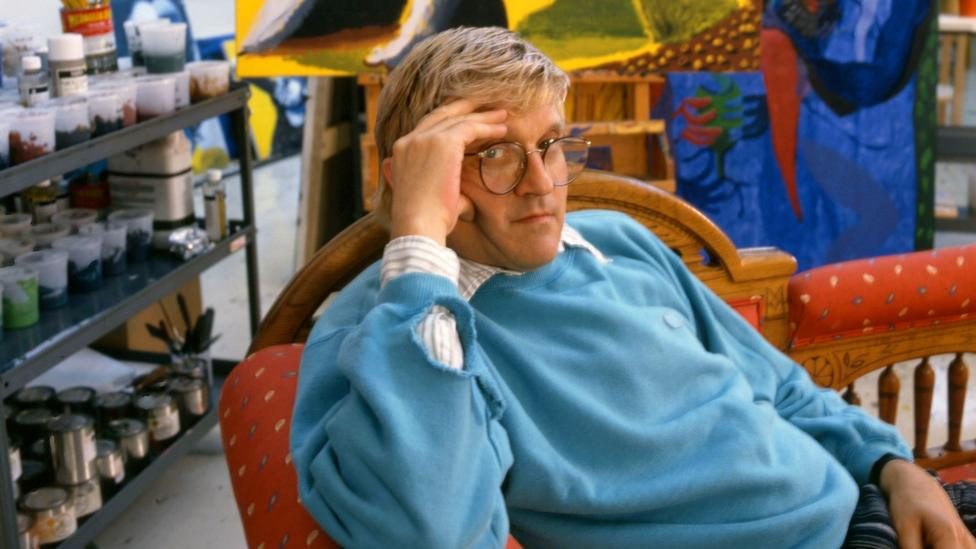
The proud Yorkshireman, who also painted iconic pictures of America, was routinely described as Britain's greatest artist.
David Hockney, who has died aged 88, was Britain's favourite artist - and a man of trenchant views, expressed in the broadest of Yorkshire vowels.
A genius in practically every medium, he worked with paint, photographs and iPads. He did etchings, lithographs, even stained glass windows - equally at home working with the grandeur of opera design and the intimacy of pen and ink.
A peroxide Bradford blond with round glasses and cheese-cutter hat, he set the art world alight in the 1960s, and packed out art galleries more than half a century later.
In 2018, one of his swimming pool paintings sold for nearly £70 million at auction - a record for a living artist. But Hockney was surprised at the public enthusiasm for his work.
He had simply followed one rule: "Paint the things you love".
His father, Kenneth, was a conscientious objector who detested social injustice, nuclear weapons and smoking in equal measure. His mother, Laura, was the backbone of the family: strong-willed and devoutly Methodist.
David was one of five children; a tight-knit, loving unit jammed into a tiny terrace in Bradford. During bombing raids, they hid under the stairs clutching bibles. In 1940, one explosion flattened the street.
He was single-minded and devoted to drawing. The wartime shortage of paper restricted his early efforts to the kitchen floor and hymn books in church.
Later, as a scholarship boy at Bradford Grammar, he refused to do any subject but Art.
"I am no good at science but I can draw," Hockney wrote in one exam. He was popular, funny and the despair of his teachers.
"He should realise that enthusiasm for Art alone is not enough to make a career," said a tutor's misguided report.
At 16, he was allowed to go to art school, arriving in pinstriped suit and bowler hat.
Hockney's appearance may have been flamboyant but his work ethic was Protestant. For 12 hours a day, he worked furiously at his easel.
National Service was spent, like his father, as a conscientious objector. It meant miserable hours washing bodies in a morgue.
But then came the Royal College of Art in London. Hockney lived in an unheated garden shed, spent every waking hour painting and revelled in his newfound bohemia.
The 1960s were in thrall to Pop Art and Abstract Expressionism.
But David's classmate, the American artist RB Kitaj, told him to ignore everyone else and simply paint things he loved. "It was the best advice I ever had," he said.
What interested him was politics, literature and exploring his homosexuality. So one portrait showed himself in an act of love with the American poet, Walt Whitman.
It forced the spectator to confront the interests and sexual fantasies of the artist. It was Hockney reaching for the person he yearned to become.
He was the college's star student but still gloriously pig-headed. David refused to write the one essay required to graduate, and so failed his finals.
It gave him his degree and even awarded him its prestigious Gold Medal. Hockney wore a gold lamé jacket at the ceremony, under the traditional academic gown.
Newspapers were launching glossy weekend magazines, turning pop stars and artists into an new breed of classless celebrity.
But - despite his newfound fame - Hockney quit the dreariness of post-war England in search of Paradise.
In 1964, he flew to Los Angeles - looking for the perfect light and bronzed torsos he'd seen in American male magazines.
As they landed, he saw hundreds of swimming pools glittering in the valleys below him. They promised a carefree existence of affluence, leisure and sexual freedom.
Britain had only just abandoned rationing; in California, swimming pools weren't luxuries - just a way of life.
Hockney was entranced. He ditched his British oil paints in favour of bright, Californian acrylics but retained his Bradford accent - which the Americans adored.
He was sexually promiscuous for the first, and probably only, time in his life and - inspired by an advert on TV - dyed his hair bright white.
Hockney painted the buildings he saw around him: determined to do for Los Angeles what Piranesi had done for Rome.
And the swimming pools themselves - with glorious weather and naked male bodies - became Hockney's most famous theme.
"David talks of the coming Golden Age," wrote Cecil Beaton in his diary. "The computer will do away with work; everyone will be ecstatically happy."
Hockney painted the angular buildings and cloudless sky with a roller. Then, with a brush, he captures the momentary disturbance of the water caused by an unseen diver.
It is a depiction of order and chaos. But while a camera would have frozen the action, Hockney makes it flow.
As homosexuality was still illegal, these paintings also defended a way of life.
On returning to London four years later, customs officers confiscated Hockney's magazines. These showed naked men in various, non-pornographic poses but the bureaucracy deemed them inappropriate.
Hockney went ballistic. "I'm not some little businessman who's going to run off. I'll see you in court," he told the cowering official.
He launched a loud anti-censorship campaign until the Home Secretary, James Callaghan, stepped in and had them returned.
His work-rate remained prodigious. He placed a sign at the foot of his bed in Notting Hill, telling himself to "GET UP AND START WORK IMMEDIATELY".
If he grew tired of drawing, Hockney would take photographs, do etchings or design operas. He was haunted by the feeling he wasn't doing enough.
His relationship with Peter Schlesinger - the young Californian subject of many of Hockney's paintings - was fizzling out.