Iphigénie en Tauride review, stylised staging of opera of bloodthirsty priestesses and divine intervention
Coliseum, London English National Opera’s production of Gluck’s opera has strong leads in Christine Rice, Nick Pritchard and Jacques Imbrailo. But why is it sung in French? Human sacrifice first; ask questions later. The story of Iphigénie among the Taurians, adapted from Euripides by Gluck and his librettist Guillard in 1779, is being told at English National Opera for the first time. It’s sung in French – more on that later – and staged by Lyndsey Turner, whose sparky Noyes Fludde won the company an Olivier award back in 2020. Within the narrow rectangular frame of Soutra Gilmour’s set, Iphi
Coliseum, London English National Opera’s production of Gluck’s opera has strong leads in Christine Rice, Nick Pritchard and Jacques Imbrailo. But why is it sung in French?
H uman sacrifice first; ask questions later. The story of Iphigénie among the Taurians, adapted from Euripides by Gluck and his librettist Guillard in 1779, is being told at English National Opera for the first time. It’s sung in French, more on that later, and staged by Lyndsey Turner, whose sparky Noyes Fludde won the company an Olivier award back in 2020.
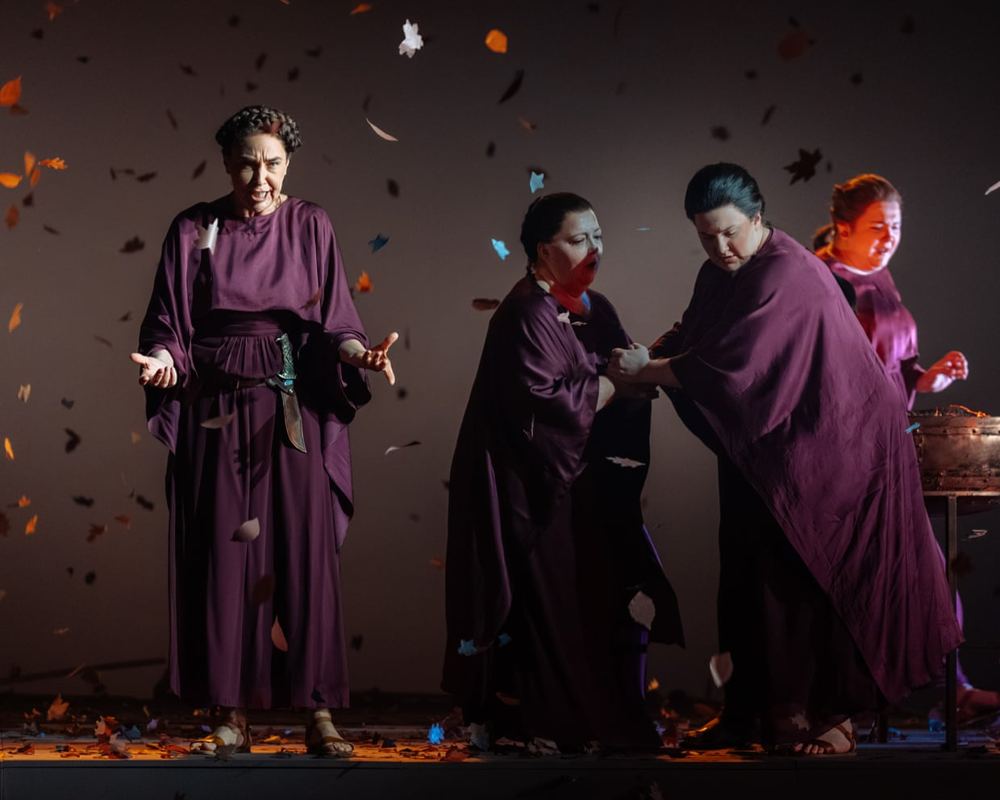
Within the narrow rectangular frame of Soutra Gilmour’s set, Iphigénie is one of many identical priestesses, all dressed in rippling folds of wine-red and lit in evening tones by Tim Mitchell (lighting that on opening night grew suddenly even dimmer in King Thoas’s aria, when a glitch brought things to a brief halt). Her job is to sacrifice to Diana any stranger who washes up on the shore, and her next victim may be her unrecognised brother Orestes. It takes divine intervention from Diana to make this all come good.
Visually, what lingers is the way the autumnal simplicity of Gilmour’s setting accommodates the potential horror of the story, the clinical nature of it: the smallish bloodstains on the priestesses’ aprons; the rubber gauntlets they wear while scrubbing the floors of the temple, which looks like an autopsy room. Thoas is a grey-suited thug whose leather gloves come off only when he wants to singe his palm on the hot coals of Diana’s shrine; his similarly tailored male subjects are pitted against a messier band of Greeks in sailors’ oilskins, Orestes and Pylades among them. The battle at the end is unconvincing, but the final tableau is touching.
The musical performance is striking too, partly for the vigour with which the conductor David Bates drives the ENO ensemble through their bloodthirsty yet jolly choruses, partly for the sonorous warmth of the orchestra, but mainly for the strength of the three leads. Christine Rice sings an intense, deeply felt Iphigénie and Nick Pritchard’s bright, honeyed tenor tugs the heartstrings for loyal Pylades, but it’s Jacques Imbrailo’s passionate Oreste that stands out, his baritone huge and warm, the bond between him and Pylades movingly drawn but not overdone.
The supporting roles are well cast, with Morgan Pearse authoritative as Thoas and the child soprano Zoe Houghton singing Diana’s lines beautifully. Why her and everyone else’s lines are in French, when ENO’s remit has long been to sing opera in English, is unclear: Blackheath Halls staged Iphigénie as a community opera in English only last year, so there is a singable translation out there. As ever at the Coliseum there are surtitles, so some will argue that it doesn’t matter. Others will find the whole thing more stylised, less directly communicative than a usual ENO show. Either way, at such a critical time for the company’s future, why mess with its USP?