US billionaire wealth hits record as worker wages fall to post-war low
Record wealth accumulation by US tech billionaires is colliding with a historic collapse in workers' wage share, fueling political backlash ahead of major stock market listings that will affect global investors.
Elon Musk briefly crossed the trillion-dollar threshold this week before a dip in AI investor enthusiasm pulled him back. Even with the fluctuation, his wealth has grown by $327 billion over the past 12 months. This extreme concentration is not isolated; the wealthiest 0.00001% of Americans, about 20 individuals, now hold assets equal to 12% of US gross domestic output.
This accumulation is occurring alongside a sharp deterioration in the financial health of the American workforce. Workers took just 53.8% of US GDP in the third quarter of 2025, the lowest share since 1947. With inflation hitting 4.2% in May 2026 against just 3.4% wage growth, real purchasing power is actively contracting.
About 66 million US workers, or 45% of the labour force, earn less than $25 an hour. That figure falls below the living wage calculated by the Massachusetts Institute of Technology for a single adult in most major metro areas. The gap between capital and labour is forcing consumers into debt to maintain spending, pushing US credit card debt to a record $1.277 trillion in late 2025.
For global investors, this dynamic is accelerating toward a wave of massive liquidity events. Musk’s gains were largely cemented by the SpaceX stock market listing. That pipeline will soon expand to include highly anticipated offerings from AI rivals Anthropic and OpenAI.
The US is home to 989 billionaires whose combined wealth surpassed $9.2 trillion in 2026, a 31.8% increase since 2025. However, this valuation boom is paired with rising systemic friction. CEO pay grew 20 times faster than average worker pay in 2025, according to an analysis from Oxfam and the International Trade Union Confederation.
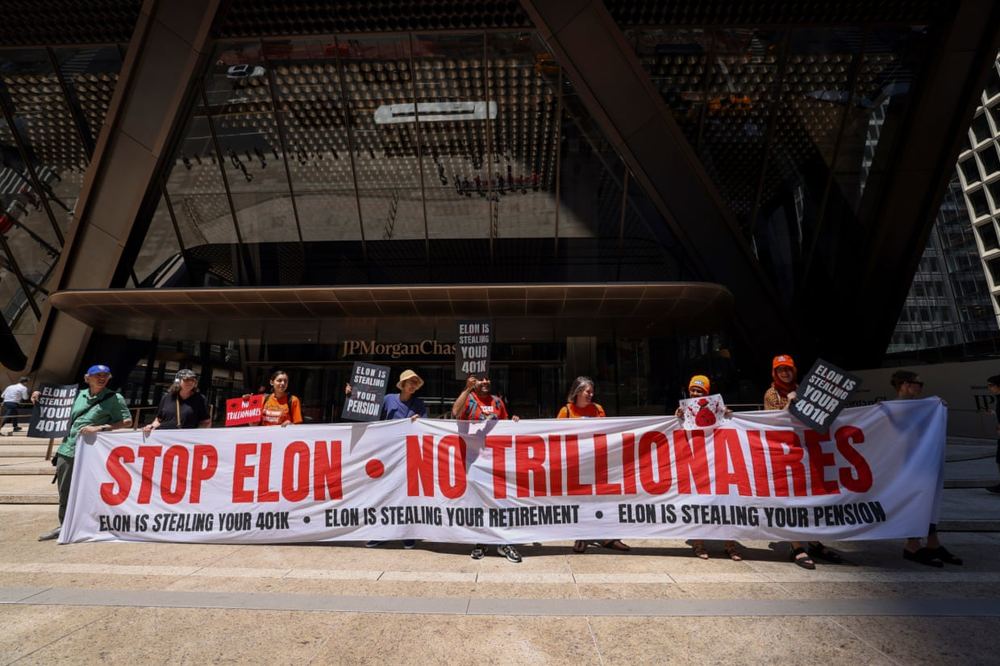
“We aren’t making enough to pay for groceries, we’re not making enough to pay rent,” said Cienna Pangan, a Chicago barista whose Starbucks store recently unionized. The contrast between executive compensation and stagnant wages is triggering a political response that could alter the operating environment for US corporations.
California voters will decide on a controversial billionaire tax in November after Silicon Valley elites spent heavily to try to block the ballot measure. Saru Jayaraman, president of One Fair Wage, noted that campaigns to raise wages are seeing explosive, cross-party growth.
Economists are warning of broader risks tied to this concentration. Gabriel Zucman, an economist at the University of California, Berkeley, questioned the stability of the current trajectory. “Nobody knows the exact concentration of wealth at which the kinds of plutocratic collapse we have seen in history becomes inevitable,” he said.