Russia’s fake war maps at Abu Dhabi peace talks aren’t fooling anyone (Ukraine Battlefield update, Day 1,721)
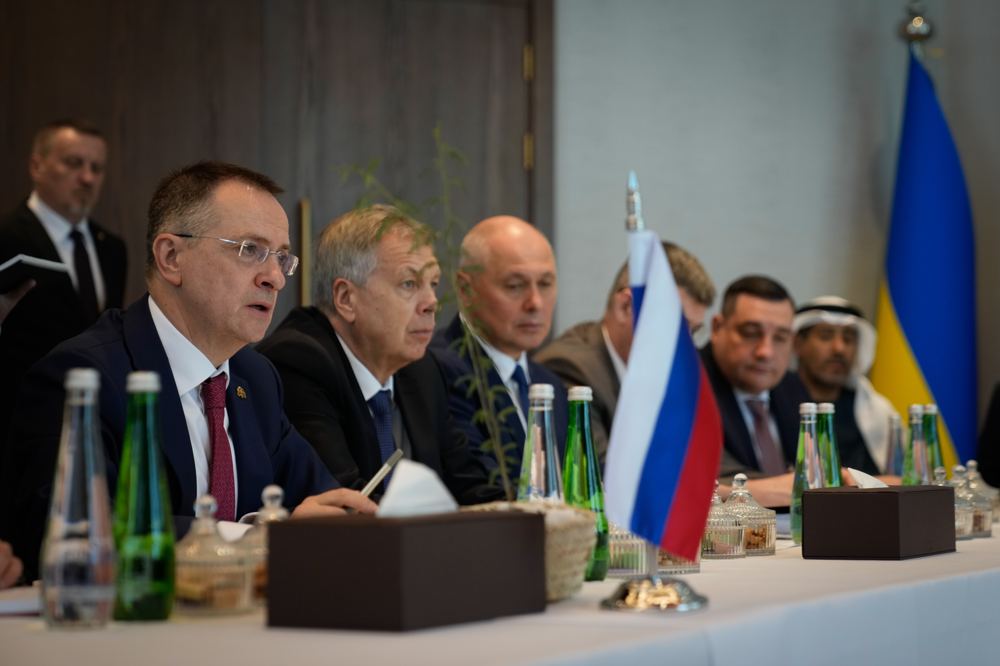
Delegates flew to Abu Dhabi hoping for a glimpse of compromise, but instead watched Russia double down on propaganda that leaves the endgame to this grinding war as murky as ever.
Near Lyman, the Ukrainian counter-attack continues, Rybar claims. It is probably merely once again retroactively accepting reality. The best-known Z-channel, Rybar , published a report according to which Ukrainian attacks in the area have not stopped, but have shifted somewhat further south.
While it describes the situation on the Zherebets river as stabilised, it reports Ukrainian army attacks at the point where the Lyman axis joins the Sloviansk axis: “Ukrainian forces are trying to push back Russian units and reduce the bridgehead they hold.”
By the bridgehead, Rybar means Russian positions on the western bank of the lower course of the Zherebets, around Yampil. Further downstream, this small river flows into the larger Siverskyi Donets.
The area described is on Rybar’s map below, on the right. The blue arrows point towards Zarichne, a village located directly on the western bank of the Zherebets; Torske, which is a little further south on the opposite side of the river; and the aforementioned Yampil.
Neither Ukrainian nor independent sources confirm the Russian reports of Ukrainian attacks in this area, but given past experience, it is possible that this is the result of the Ukrainian army’s operational silence.
As it has done many times in recent months, Rybar is “retreating” with its maps from entirely unrealistic positions that it, together with other Russian accounts, had drawn months earlier on the basis of reports from the defence ministry.
Far more credible sources, meanwhile, see the situation as even less favourable for the Russians than they themselves are willing to admit. The OSINT Playfra account marks both Zarichne and Yampil as grey zones, while Torske lies directly on its border. Rybar marks all three villages as controlled by the Russian army.
The situation is very similar according to the Finns from Black Bird Group :
During talks in Abu Dhabi, the Russians argued using their fabricated maps. Based on reports from members of the Ukrainian delegation, this is claimed by president Volodymyr Zelensky.
They told Kyiv that members of the Russian team believe their army has already occupied half of the remaining territory of Donbas controlled by the Ukrainian army.
“These were military officers, Russian intelligence, and they were serious about it. Our team told them, 'We don’t know how you can even say such things. We have video footage, images, other things proving that these areas are under our control,'” Zelensky said of the talks.
On that basis, he claims that Russian president Vladimir Putin lives in a different reality, which is a problem for the talks. According to Zelensky, however, the American delegation confirmed the Ukrainian version of the state of the front line.
The possibility, which the Ukrainian president wrote about, that Putin is simply being lied to, is only one possible explanation. The other is a deliberate decision to insist on unrealistic claims and to derive the future demarcation line from them.
What this may mean in the case of Lyman, mentioned above, is shown by the official map of the Russian state press agency Ria Novosti from Wednesday (11 November 2026). Not only is Lyman (in Russian, Krasny Liman) marked as captured on it, but according to the Kremlin, Putin’s August statement that the Russians had also captured Sviatohirsk, far to the west, still stands.
In reality, the front is more than 30 km further east at this point. But because Putin claims something different, according to Russia the situation is quite different. We do not know whether this is one of the areas Zelensky wrote about, but it is very likely, and there are more such places across the entire front.
This is how the same area looks according to Playfra. Sviatohirsk is in the upper left half of both images:
The monitored Russian sources have not yet directly commented on Zelensky’s post, but Rybar, for example, generally states that the outcome of the talks will be determined by reality on the ground, while positions differ on the question of Donbas: “The Russian side demands all of it and refuses to give up what it controls.”
The problem is that it controls far less than it claims. If this does not change, Moscow can drag out the talks for as long as it wants.
Russian incursions into Kupiansk continue. “On the Kupiansk axis, intense fighting continues, including fighting directly in the city. The presence of Russian soldiers has been recorded in several parts of the city: in the north-west, on the western edge, in the area of the Yubileinyi settlement, as well as in individual neighbourhoods,” the Ukrainian account Petrenko writes .
The same source confirms the presence of Russians in the village of Myrove as well, which lies directly on the north-western border of Kupiansk (on Petrenko’s map, Myrove is in the upper left).
Nevertheless, the author claims that although heavy fighting is taking place, there has been no significant change in the front line recently. He himself, however, expanded the grey zone to cover almost the entire city, meaning that the Russians have once again gained the upper hand there.
Four American cruise missiles were reportedly shot down over Russian territory. After almost five years of war, this already sounds like an ordinary report, but given US president Donald Trump’s openly pro-Russian stance, it is far more interesting. The Russians claim that they managed to shoot down four AGM-188A Rusty Dagger cruise missiles.
Its development began in the summer of 2024, and it was planned as a cheap weapon for striking targets on Russian territory. It was being developed by lesser-known American and European companies, and it was assumed that Norway, Denmark and the Netherlands would pay for its purchase.
The missile carries a 227-kg warhead, has stealth features and increased resistance to electronic jamming. The fact that the Russian army has just announced four successes does not mean that the AGM-188A has not been deployed before. It is possible that some of the successful attacks in previous months were carried out precisely with this weapon.
The Russians, for example, claim that they discovered components of the new weapon after the June attack in the rubble of the hit arsenal in Voronezh. It was initially speculated that it had been destroyed by British-French Storm Shadow/SCALP-EG missiles.
"3 misiles impactaron la planta de Voronezh el 22-Junio, causando graves daños a las instalaciones que fabrican sistemas de guía para misiles Kh-101 y otros. Los informes indican que el ataque utilizó los nuevos misiles AGM-188A Rusty Dagger desarrollados en EEUU y desplegados… https://t.co/uRjYtl5b9L pic.twitter.com/16E4eEafnI
On Tuesday, the Russians published a map showing how large a part of their territory the AMG-188A is capable of striking with its maximum range of 930 km. The map was published by the well-known channel Fighterbomber, but it was created by the propaganda agency Sputnik.
It also serves well as an illustration of the main theme of today’s Ukraine Battlefield update. Not only the territory of the Donetsk and Luhansk regions is marked as Russian on it, but also the entire Zaporizhzhia and Kherson regions.
In this case, these are not fabricated successes of the Russian army, but Sputnik is adhering to the Russian constitution, which, after the manipulated referendums in the autumn of 2022, declared all four regions to be full-fledged Russian territory.
On 11 November 2022, the Ukrainian army entered liberated Kherson. There are many videos in which enthusiastic local residents welcome it. They showed courage immediately after the occupation, when they repeatedly demonstrated against the Russian army directly in the city.
Four years after liberation, a large part of the city lies in ruins, the Russians systematically bomb it, and drone operators pursue even civilian residents in its streets. Most of them have fled.
Happy Kherson Liberation Day! 🇺🇦 Yes, on this very day in 2022, a major Ukrainian military operation culminated in the withdrawal of Russian forces from Kherson, as they sought to avoid having their entire force in and around the city completely cut off. Russia's only captured… pic.twitter.com/sps1n8YUn3
The Russians showed how they use Mi-28 attack helicopters to launch light Banderol cruise missiles.
Russia showed a launch of Banderol cruise missiles from a Mi-28NM helicopter. pic.twitter.com/Gc82AgpvkH
The same thing is happening to Sloviansk as to all the cities attacked by the Russian army, it is ceasing to exist.
The Russians continue to destroy the city of Sloviansk in the Donetsk region. Today, as a result of a strike by a FAB-500 and several FAB-250 bombs, about 60 private houses, at least 22 high-rise buildings, a medical facility, and cars were destroyed. pic.twitter.com/SSBLSTSrnT
The launch of a missile from the S-300 system. The rocket motor ignites only after it has left the launch device. The tubes containing the missiles always point vertically upwards in firing position; the missile takes its intended direction only after the motor is ignited.
RAND Corporation analyst Michael Bohnert created an illustrative simulation from the perspective of the crew of a Russian short-range Pantsir system, which typically directly guards important targets.
His aim was to demonstrate clearly how much the speed of a drone affects the reaction time of air-defence systems. The first flying object is the most common Ukrainian FP-1 drone, flying at a speed of 160 km/h at an altitude of 30 metres above the ground. The second is a Flamingo cruise missile flying at a speed of 500 km/h at the same altitude.
I wanted to make a video to show the effects of drone speed on air defenses. I used the Oct 30 Novokuibyshevsk refinery strikes as my example. I have three drones approach the refinery and pass a tower with a Pantsir. The first is an FP-1 at cruising speed. The second is an… pic.twitter.com/6Cawt2klBl