AI SRE may help you fight fires, but Foresight AI helps before the spark
Artificial intelligence is fundamentally changing how software is built, deployed, and managed. AI coding assistants are helping developers ship software faster than ever. Meanwhile, a new generation of AI-powered Site Reliability Engineering (SRE) tools promises to help organizations respond to incidents and recover from outages in record time. But there’s a problem with this approach: […] This story continues at The Next Web
Artificial intelligence is fundamentally changing how software is built, deployed, and managed. AI coding assistants are helping developers ship software faster than ever. Meanwhile, a new generation of AI-powered Site Reliability Engineering (SRE) tools promises to help organizations respond to incidents and recover from outages in record time.
But there’s a problem with this approach: By the time an AI SRE tool springs into action, something has already gone wrong.
What if AI could help prevent the incident from happening in the first place?
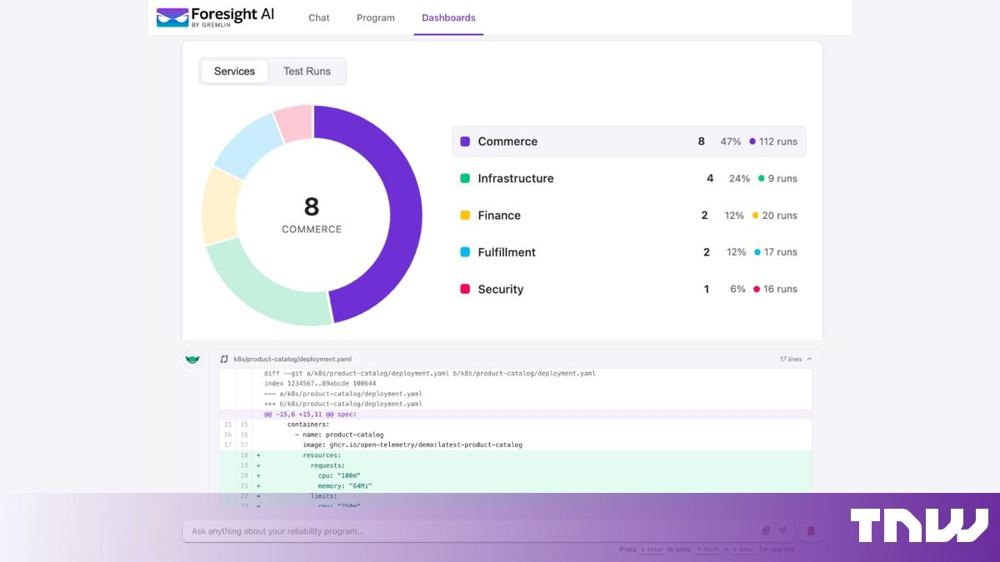
That’s the idea behind Gremlin Foresight AI , a new agentic reliability solution from Gremlin, the Chaos Engineering company. Rather than waiting for systems to fail and using AI to accelerate recovery, Foresight AI proactively identifies reliability risks and recommends and delivers fixes. It then validates that those fixes work, all before customers experience an outage.
The distinction represents an important shift in how organizations think about AI and software reliability. Instead of simply getting better at fighting fires, Gremlin wants to eliminate the conditions that cause them.
The rise of AI-powered software development has created an interesting paradox for engineering organizations. Developers can now generate and deploy code at unprecedented speeds. But that acceleration also creates more opportunities for bugs, configuration errors, and architectural weaknesses to find their way into production.
Meanwhile, the operational complexity of modern applications continues to grow. Cloud-native architectures, microservices, distributed infrastructure, and third-party dependencies have created increasingly interconnected systems where a seemingly minor issue can cascade into a major outage.
For years, organizations have invested heavily in observability, monitoring, and incident management tools to address these challenges. More recently, AI SRE solutions have emerged to automate troubleshooting, identify root causes, and help engineers resolve incidents faster.
These capabilities are valuable. Reducing the time it takes to recover from an outage can significantly limit its financial and operational impact.
But AI SRE largely addresses the consequences of a reliability failure rather than preventing the failure itself.
Gremlin believes that distinction is becoming increasingly important as AI accelerates the pace of software development.
“AI-driven development means shipping code at 10X velocity; it also means 10x the opportunity for bugs, risks, and failures,” said Kolton Andrus, CEO and founder of Gremlin. “While the rise of AI SRE tools are great for helping teams respond to incidents faster, it’s still cleanup after something breaks. Gremlin Foresight AI finds risks proactively, delivers the fix, and verifies the fix worked by rerunning the test. This provides teams with the assurances needed to move confidently.”
The philosophy behind Foresight AI isn’t entirely new. Gremlin has spent years helping organizations proactively discover weaknesses in their systems through Chaos Engineering. It is a discipline that deliberately introduces controlled failures to understand how applications behave under adverse conditions.
The challenge has always been making that process accessible and repeatable.
Traditional Chaos Engineering often requires specialized expertise, considerable engineering effort, and time that development teams don’t always have. Engineers must determine which failure scenarios to test, interpret the results, identify potential fixes, and verify that the changes actually improve resilience.
Gremlin designed Foresight AI to automate much of that work.
The platform uses specialized AI agents to analyze applications, identify potential failure scenarios, execute controlled reliability tests, and recommend targeted remediations. These fixes can take the form of configuration patches or infrastructure-as-code changes that fit into existing engineering workflows.
Importantly, the process doesn’t end when a fix is proposed or implemented.
Foresight AI reruns the original reliability test to verify that the weakness has actually been addressed. It can then continue testing as applications and infrastructure evolve, helping organizations identify regressions before they become production incidents.
This creates a continuous cycle of identifying risks, fixing weaknesses, and validating resilience.
Consider an application that relies on infrastructure deployed in a single cloud availability zone. Everything may appear healthy under normal operating conditions. Monitoring dashboards are green, application performance is acceptable, and customers aren’t reporting problems.
But if that availability zone fails, the application could become unavailable.
An AI SRE tool might help diagnose the resulting outage and accelerate recovery. Gremlin designed Foresight AI to identify the architectural weakness beforehand and recommend changes that improve redundancy. It then tests whether the application can withstand the failure.
The difference is between recovering from a preventable outage and avoiding it altogether.
One of the more interesting aspects of Foresight AI is the technology behind its recommendations.
While many AI-powered operations tools rely heavily on large language models to interpret telemetry, logs, and incident histories. Gremlin has built Foresight AI around its proprietary Failure Atlas.
The Failure Atlas draws on more than a decade of real-world reliability testing, including millions of fault-injection experiments conducted across distributed systems.
That historical knowledge provides Foresight AI with a specialized foundation for understanding how applications fail, which failure conditions are most consequential, and what kinds of remediation are likely to improve resilience.
Foresight AI doesn’t rely solely on an LLM to infer what might go wrong. It combines information about an organization’s actual infrastructure with Gremlin’s accumulated knowledge of system failures and recovery patterns.
The AI agents use that context to recommend relevant tests, interpret outcomes, and develop actionable remediation plans.
This is an important distinction in an increasingly crowded AI infrastructure market. General-purpose language models can offer plausible explanations for technical problems, but reliability engineering requires more than plausible answers. It requires evidence that a system will continue functioning when something goes wrong.
Gremlin’s approach attempts to provide that evidence through controlled experimentation and repeatable validation.
Foresight AI also introduces an agentic approach to reliability engineering, with specialized agents responsible for different aspects of the process.
An Analyst agent examines applications and infrastructure to identify potential weaknesses and recommend appropriate tests. A Tester agent executes controlled experiments to determine how systems behave under failure conditions. An Operator agent interprets the results and provides specific remediation recommendations.
A fourth agent, acting as a Technical Program Manager, helps organizations coordinate reliability initiatives across teams. It also identifies gaps in testing and tracks progress over time.
Together, these agents aim to reduce the manual work traditionally associated with reliability engineering.
Rather than requiring engineers to become experts in every possible failure scenario, Foresight AI helps determine where the risks are, which tests to perform, and what actions are necessary to improve resilience.
Human oversight remains part of the process. Engineers retain approval authority over testing and remediation, allowing organizations to introduce automation without relinquishing control over production infrastructure.
The broader objective is to make proactive reliability engineering a continuous operational practice rather than an occasional exercise conducted by a small group of specialists.
One of the longstanding challenges of reliability engineering is demonstrating the business value of prevention.