‘I railed against the stereotype of the humourless lesbian’: the cheeky, feminist photography of Jill Posener
Her witty photos served as a rebuttal to 80s misogyny and Thatcherite conservatism. Now 50 years on, the photographer is receiving an overdue retrospective. ‘I loved that we could respond with humour,’ she says. If it were a lady it would get its bottom pinched. If this lady was a car she’d run you down.” These are the words that Jill Posener immortalised in November 1979, when she picked her way through traffic on London’s Farringdon Road to photograph something most would have overlooked: a graffitied billboard. The first sentence was there by design – a sexist attempt at wit intended to pro
Her witty photos served as a rebuttal to 80s misogyny and Thatcherite conservatism. Now 50 years on, the photographer is receiving an overdue retrospective. ‘I loved that we could respond with humour,’ she says.
I f it were a lady it would get its bottom pinched. If this lady was a car she’d run you down.” These are the words that Jill Posener immortalised in November 1979, when she picked her way through traffic on London’s Farringdon Road to photograph something most would have overlooked: a graffitied billboard. The first sentence was there by design, a sexist attempt at wit intended to promote a new Fiat. The second she has since been repeatedly accused of adding herself.
In reality, the image-maker, playwright and nonprofit founder explains from her home in California, the now infamous phrase had been daubed by two women working at the nearby offices of the socialist newspaper Morning Star. “They had seen the billboard go up and were so incensed that they came up with this solution,” Posener recalls. “They didn’t think anything of it until they saw the postcard. I sent them a whole bunch and we all had a good laugh.”
Not that profit was ever Posener’s goal: the postcards were simply a way to disseminate what would become her signature brand of political satire. They were created at a time when the women’s liberation and gay rights movements were at odds with Margaret Thatcher’s socially conservative vision for Britain, and explicitly railed against the stereotype of what Posener describes as “the humourless lesbian or humourless feminist”. As with much of the photographer’s work, they also carried another message: “a big fuck you to the establishment”.
More than 40 years after it was taken, in 2023 the Fiat image enjoyed a somewhat unexpected revival when it featured in Tate Britain’s landmark exhibition Women in Revolt . For Posener, who had shifted her professional focus to animal welfare more than a decade earlier, the experience was cathartic. “I had absolutely walked away from photography,” she recalls. “So I do credit the Tate show with, and I don’t mean to sound dramatic, giving me my old life back.”
The show also sparked renewed institutional interest in her work, and eventually led to a new Glasgow School of Art retrospective, Jill Posener: Stage and Street . The exhibition looks far beyond that one well-timed photograph, traversing the image-maker’s years as a member of Britain’s first professional gay theatre troupe, Gay Sweatshop, exploring her time photographing party conferences for the Daily Mirror, and re-examining her influential 1987 series, Dirty Girls Guide to London. It also features several less famous, though equally deserving, examples of wry billboard graffiti.
Together, these works make Stage and Street Posener’s most significant UK solo show to date, and the first to recognise, in its entirety, a 50-year career dedicated to cultural production and social justice. Now 73, she is stoic about the overdue nature of the honour. “I think part of it is that I’m not a particularly gifted photographer,” she says, “and I’m not being self-deprecating. But I am somebody that sees things, and it’s possible that I can see things others don’t.”
This was certainly the case in November 1979, when Posener first caught sight of the graffitied Fiat billboard. Does she worry that, even now, this remains the defining moment of her photographic career? “I think, if you have one image that so encapsulates a moment, a movement, then embrace it,” she says. “I have no problem being a one-hit wonder.”
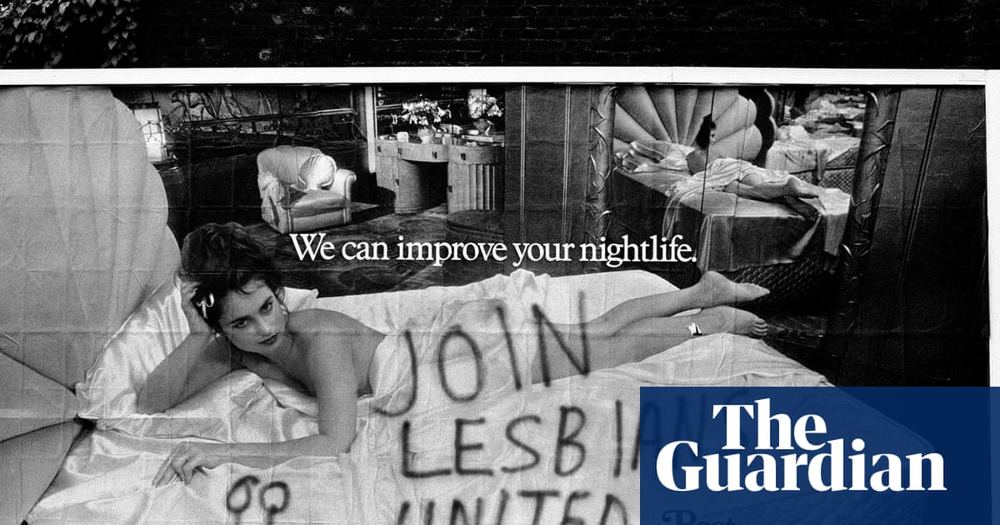
Join Lesbians United, London, 1981 (main picture) “I’m not sure how I came upon this one, but I think it was in north London. You can’t help but laugh when you see it. Maybe because I’ve lived with a lot of anger in my life, I loved that we could respond to these things with humour, and that other people could then recognise and take pleasure from that.”
Promotional photo for Posener’s play Any Woman Can, performed by the Gay Sweatshop theatre company, 1976 “At the time, there was a lot about it that resonated with people,” says Posener. “The last line was: ‘You’re looking at a screaming lesbian, and I’m looking right back at you.’ For me, as a young woman, this was both a reflection of my own coming out and my confrontational nature toward the world.”
Margaret Thatcher at the Conservative Women’s Conference, London, 1987 “I took some photographs at the Tory party women’s conference that really made fun of that audience, and sometimes I feel embarrassed that I did that. On the other hand, they were showing who they were, and I was identifying that and photographing it. Thatcher in the creche was just the most hilarious thing I could possibly imagine.”
From A Dirty Girls Guide to London, 1987 “It’s called A Dirty Girls Guide to London because it was like a tourist brochure. But instead of just icons of British culture, there’s two women kissing, basically saying: ‘We can do this right here, in front of everybody.’ It’s about not hiding, and it’s about saying: ‘You cannot control our lives and you cannot control our bodies.’”
Drew Griffiths performs in Jingleball, a Gay Sweatshop production, eight years before his murder, which remains unsolved, 1976 “When Sweatshop had its first press conference, Drew actually couldn’t face the press. He was too ashamed to face the media, so he had his back to them, even though he’d started the group. And I think that’s what we all felt: this terrible fear, and yet this hope and possibility of something new.”
Jill Posener : Stage and Street is at Reid Gallery, The Glasgow School of Art to 9 January