Ben Whishaw and Kathryn Hunter are a dynamite duo on the road to nowhere in Eurotrash
Young Vic, London Adaptation of Christian Kracht’s novel is full of heartwarming comedy as a mother and son take a trip to distribute ‘dirty money’ to good causes You would be hard-pushed to find a more charismatic double act than Kathryn Hunter and Ben Whishaw. She dazzles as a dowager, bringing flamboyant physical flourishes as she knocks back the cooking wine; he is her lugubrious son, Christian, a novelist with writer’s block. Their story trades on kookiness but the chemistry would keep you captivated even if they watched paint dry for the duration of this interval-free drama. Based on Swi
Young Vic, London Adaptation of Christian Kracht’s novel is full of heartwarming comedy as a mother and son take a trip to distribute ‘dirty money’ to good causes
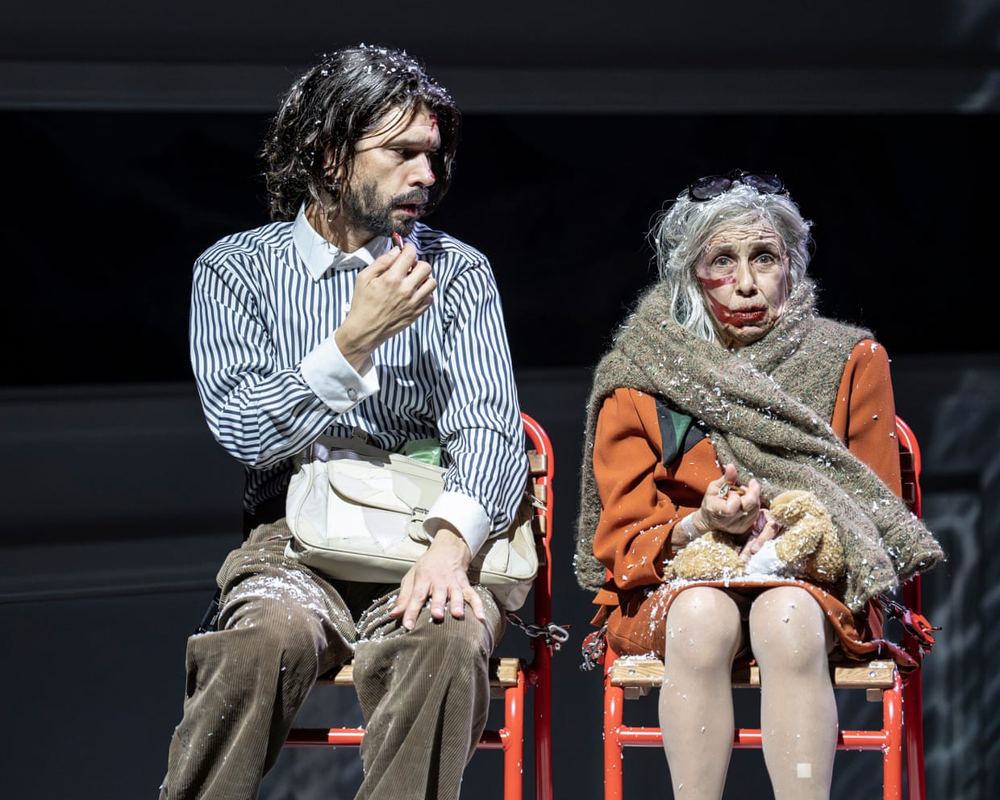
Y ou would be hard-pushed to find a more charismatic double act than Kathryn Hunter and Ben Whishaw. She dazzles as a dowager, bringing flamboyant physical flourishes as she knocks back the cooking wine; he is her lugubrious son, Christian, a novelist with writer’s block. Their story trades on kookiness but the chemistry would keep you captivated even if they watched paint dry for the duration of this interval-free drama.
Based on Swiss author Christian Kracht’s bestselling novel, adapted by Colin Teevan, it is charmingly directed by Walter Meierjohann. The third big star is Lizzie Clachan’s set, so full of mischief that it is like a magician pulling out imaginative visual jokes and clever thrills and spills. Glyn Pritchard heroically plays ancillary roles (from taxi driver to waiter) with lightning-quick wardrobe changes while the sound effects are visibly, wittily created in a glass studio.
All of it almost papers over the cracks in the story but something is still amiss. Mother and son embark on a road trip across Switzerland with a plastic bag full of euros to give to a worthy cause. There is an early mention of the mother’s German heritage and a father who was in the SS as they drive around with their “dirty money”. A review of Kracht’s book by Der Spiegel called it a work about “the destructive power of silence, over decades, over generations”. The silence relates to how Christian and his mother have contended with, and put away, their family history of nazism, and, by extension, Germany’s relationship to the second world war.
The puncturing of silence around guilt and culpability comes wrapped in their irascibly lovable mother-son escapades, which take them from a vegetarian commune where they find a comic fascist in plain sight, à la The Producers, to a failed high-altitude search for edelweiss. The show, like the book, is full of heartwarming comedy and moments of fractiousness, and on that level works beautifully. But Kracht’s book is unforgiving and full of interrogations of the mother, as well as disgust at Germany’s past, which is absent here.
Christian, as delightfully as he is played by Whishaw, does not quite feel believable in his passivity. His diffidence seems so British that you are left wondering where he is from (a Canadian boarding school is mentioned). There seems to be a subtle attempt at universalising the story by distancing it from the specific context of its central trauma. The mother wants to go to Africa to distribute her money but later suggests they give it to Syrian refugees. The themes inhabit similar ground to the film Fatherland , about novelist Thomas Mann’s reckoning with Germany’s shame, but the silence between Christian and his mother is tied to historical forces that are not fully interrogated.
We come to the source of the big, howling silence between them towards the end of the play, not at the beginning as in the book: what was done to her, what was done to him, a mirror trauma she failed to prevent. It is a searing moment, but there is not nearly enough follow-through. What you get instead is the strange accomplishment of brilliant streaks of drama in a story with holes. The silence, sadly, remains.