Lend them your ears! Julius Caesar is staged with just four actors, and a great big gong
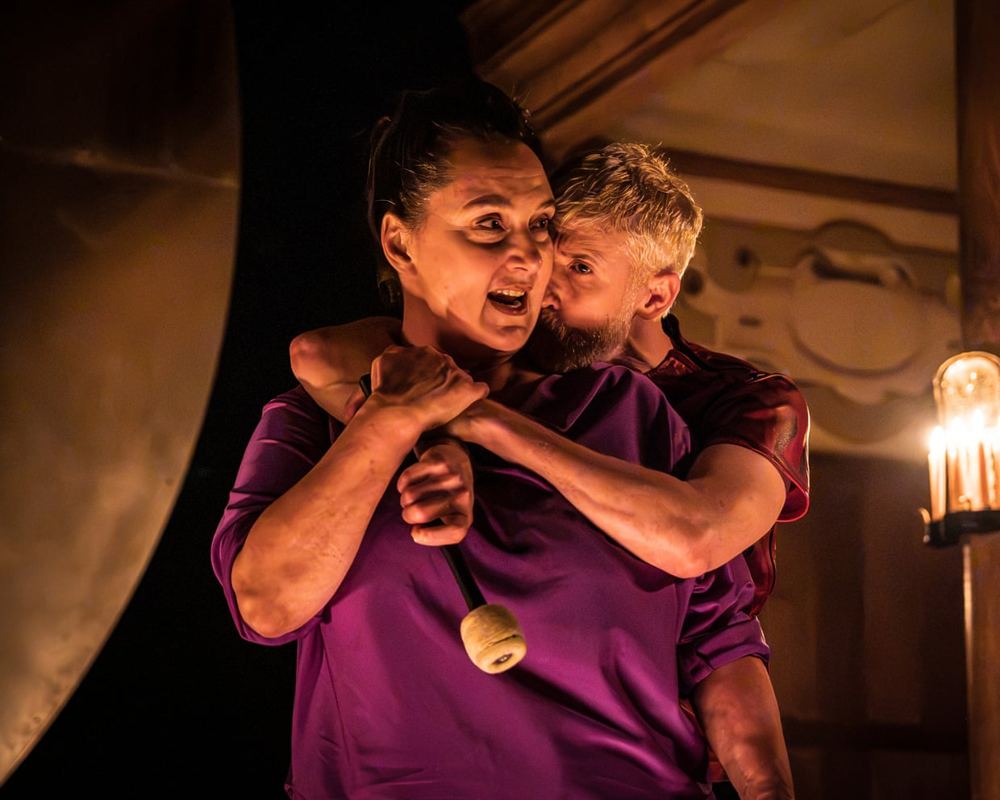
Sam Wanamaker Playhouse, London This truncated, candlelit version makes use of skilful percussion to occasionally fill in for oration but loses some of the play’s beauty and power Any modern reformulation of Julius Caesar may inevitably be compared with Phyllida Lloyd’s innovative, all-female 2012 production, now revived by the Royal Shakespeare Company , which reimagined the tragedy as a play-within-a-play in a women’s prison. This reworked version, adapted and directed by Joe Hill-Gibbins, does not match its depth and originality but certainly does something different. It is performed at 90
Sam Wanamaker Playhouse, London This truncated, candlelit version makes use of skilful percussion to occasionally fill in for oration but loses some of the play’s beauty and power
A ny modern reformulation of Julius Caesar may inevitably be compared with Phyllida Lloyd’s innovative, all-female 2012 production, now revived by the Royal Shakespeare Company , which reimagined the tragedy as a play-within-a-play in a women’s prison.
This reworked version, adapted and directed by Joe Hill-Gibbins, does not match its depth and originality but certainly does something different. It is performed at 90 minutes straight-through with just four actors who take on the central roles of conspirators Cassius (Natey Jones) and Brutus (Caoilfhionn Dunne) alongside Mark Antony (Adam Gillen) and Caesar (Kate Duchêne, who also plays the soothsayer and Octavius). It is not as gimmicky as you may think.
Sound is key to the effects, with a fantastically expressive and almost constant drumming throughout, the atmosphere thrumming with rising discontent and the percussionists (married duo Louise Anna Duggan and Zands Duggan, collectively known as Minihi) are as important as the actors. Sometimes, this sound is a substitute for the lines themselves.
The stage is kept in prevailing darkness with elongated shadows, firelight and handheld candles, which, just about, illuminate the performers’ faces. As the backdrop to Rosanna Vize’s set design there is a great MGM-style gong that is bashed. It is immensely effective as a motif for battle propaganda and saber-rattling as well as meteorological disturbance in Rome: it sounds like thunder at times or a ferocious wind sent from angry gods.
Rome here floats dislocated from a specific time and place, bringing a kind of universality in its presentation of power, rebellion and the place of rhetoric in it. Characters crawl or kneel before each other, in supplication or disassembling demonstrations to power. They are all barefoot and almost like bare-knuckle fighters.
The darkness and candlelight exude conspiracy well, but you lose out on clearly seeing actors’ expressions, and the pace is slow, despite the circling movements on stage and the thriller tropes.
The weight of Shakespeare’s verse is almost lost in the midst of it all. Gillen gives a standout performance as Mark Antony but you wish Dunne’s Brutus was not quite so featureless, and that Duchêne’s Caesar bore either more braggadocio or gravitas. Caesar’s death comes with immense wallops of sound, and the performers themselves are loud, but the volume feels a little too one-note.
There is potential confusion, too, for those who are not familiar with the play when Caesar begins doubling up as the soothsayer (“beware the ides of March”), and you miss the presence of Brutus and Caesar’s wives as two of Shakespeare’s commanding women.
What you get is an elemental sense of the play, almost its essence, but not the beauty of its verse and the subtleties of language, which is a great shame for a play based on the power of oration and its ability to harness (or manipulate) the masses.