Brussels sets October deadline to rebalance €1bn-a-day China trade deficit
The EU has given Beijing until October to deliver concrete progress on rebalancing a record trade deficit, as heavy job losses in Germany's auto sector force a harder European line.
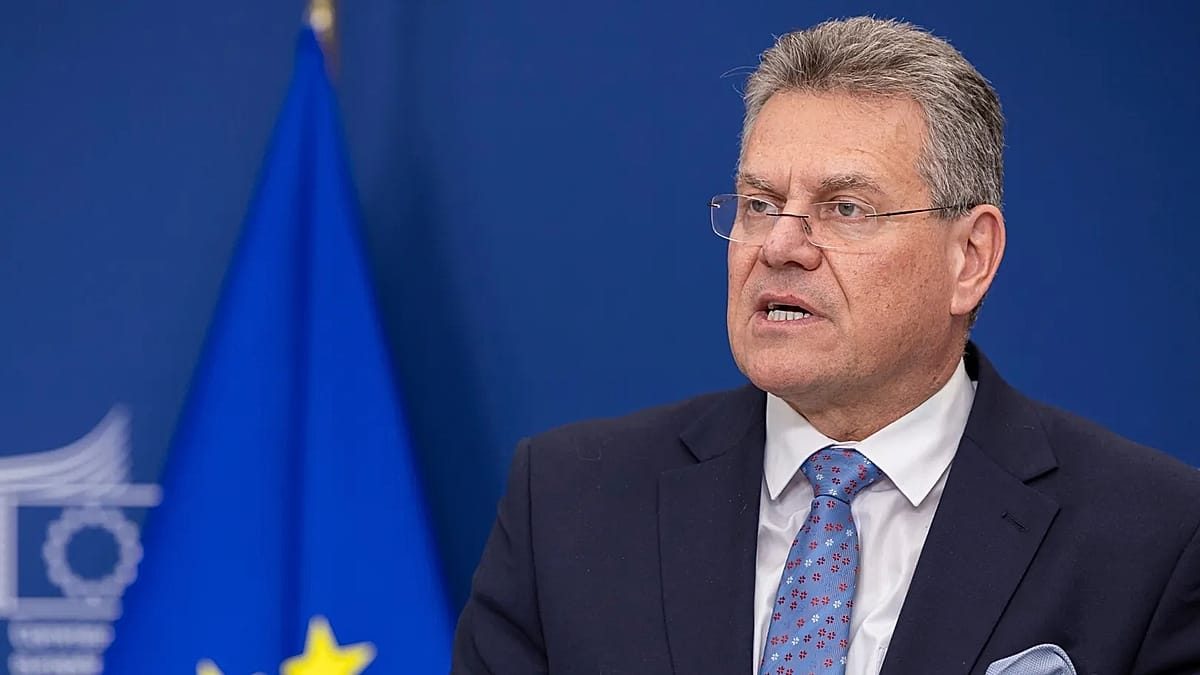
The European Union has set an October deadline to secure "tangible" results in its trade dispute with China. EU Trade Commissioner Maroš Šefčovič issued the timetable on Monday after hosting his Chinese counterpart, Wang Wentao, in Brussels for prolonged talks. "Our teams have a clear mandate and an ambitious timetable to deliver tangible results by October this year," Šefčovič told reporters.
The urgency stems from a worsening economic imbalance across the continent. The bloc's trade deficit with China has hit a record €1 billion a day, a figure that prompted EU leaders to mandate the European Commission at a June summit to force a rebalancing. Tensions have escalated in recent weeks as China threatened retaliation against European efforts to shield its market from Chinese overcapacity.
The pressure is most acute in Germany, where a record €87 billion trade deficit with Beijing has served as a wake-up call for Berlin. German trade minister Katherina Reiche also met Wentao on Monday, with her ministry stating that "open markets require a level playing field, reliable supply chains, and balanced trade relations." The shift follows fierce competition from Chinese rivals in Germany's automotive sector, which has announced more than 100,000 job cuts in the coming years.
Despite the frictions, Monday's talks yielded a framework for continued engagement. Both sides agreed that "increased market access measures and initiatives can contribute to the balancing of the trade relationship". They also committed to establishing a "joint monitoring mechanism" that will rely on identical data sets from both sides to track trade flows.
Brussels is carefully navigating the standoff. Governments want to block cheap imports and dumping, a priority highlighted by a March Commission bill favouring made-in-Europe products in public procurement. Yet they fear Beijing could restrict exports of rare earths vital to the EU's green technology and defence industries.
To manage this risk, EU leaders have asked Commission President Ursula von der Leyen to overhaul trade defence instruments. A "diversification mechanism" to encourage alternative suppliers and a "solidarity mechanism" for countries worst hit by Chinese competition are both in the pipeline. Šefčovič said the two sides would "intensify" their dialogue ahead of his planned trip to Beijing this autumn to assess the progress.