Sanchez’s snap election, and what his (likely) defeat means for Spain’s Nato spending
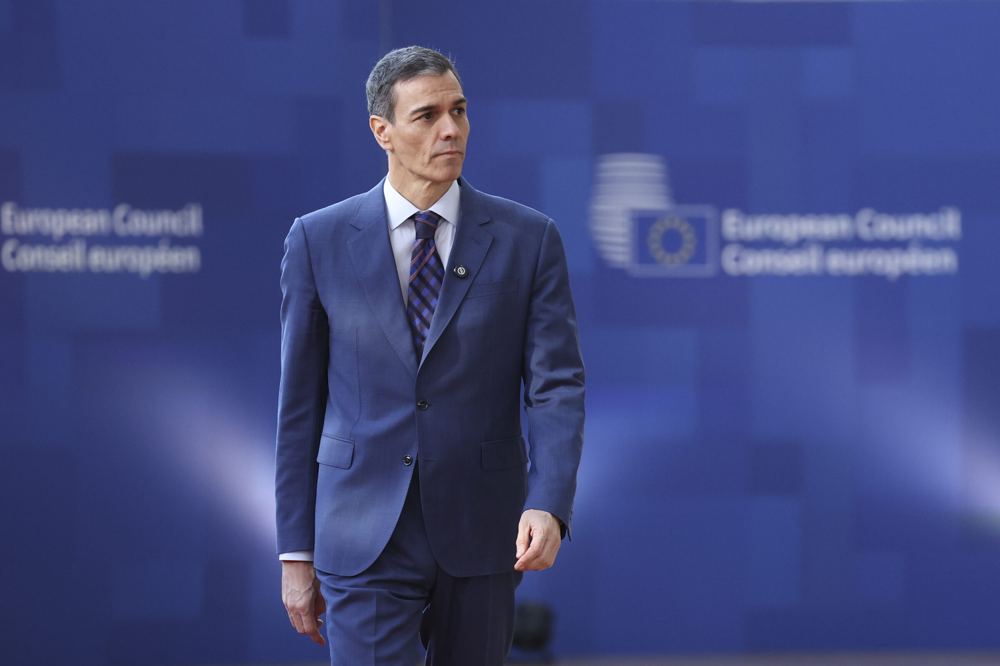
Prime minister Pedro Sánchez’s rejection of Nato’s five-percent target was less hostile to rearmament than it looks. Military spending rose by 50 percent in 2025, and not even the election campaign slowed this pace down, as earlier this month the Spanish government authorised a further €12.2bn for air defence, counter-drone systems, submarines and ships.
Spain votes on Sunday (29 November), though its rejection of Nato’s five-percent target will probably survive a change of government.
That reluctance is far from a rejection of rearmament itself: Spaniards are willing to spend more, but never alone.
Prime minister Pedro Sánchez’s rejection of Nato’s five-percent target is less hostile to rearmament than it looks. Military spending rose by 50 percent in 2025 , the steepest increase among the 15 biggest spenders, and passed two percent of GDP for the first time since 1994.
Equipment purchases doubled, to almost €15bn , although under a rolled-over 2023 budget and with a 2025 plan that put only a fifth of its €10.5bn into new weapons.
Not even the campaign has slowed this pace down, as on 10 November the government authorised a further €12.2bn for air defence, counter-drone systems, submarines and ships.
Abroad, Spain leads Nato’s brigade in Slovakia , sent a frigate to protect Cyprus in March after drone attacks on the island, takes part in a new allied A400M fleet , co-develops the Eurodrone , co-founded the ballistic-missile-defence coalition and joined four of the five European defence projects of common interest.
Spaniards would also rather pay through common European debt than through taxes or cuts, which makes Spain a testing ground for Europe.
This European faith partly reflects distrust of Donald Trump’s United States. According to an internal ECFR poll ( see chart, 2026 ), 66% expect other Europeans to defend Spain and only 12% think Washington will. From Sumar (Greens/EFA and The Left), now part of the Frente Amplio (FA) coalition , to Vox (Patriots for Europe), every electorate gives net support to European weapons and a European nuclear deterrent. The US, by contrast, divides them, with 38% of Socialist voters (PSOE, S&D) seeing it as an adversary, compared with 8% of Partido Popular voters (PP, EPP). Common debt wins net support in every electorate except Sumar/FA, where it is tied, but putting a price on the national bill is enough to erode even conservative support.
Sources: ECFR/YouGov (30 April, 11 May 2026; n = 1,542; ±2.6 points) and survey data accessed by ECFR (13-19 August 2026; n = 1,638; tax question). Sumar: n = 67 and 62, before joining Frente Amplio (±12 points).
Like most Germans and Italians , 54 percent reject cutting other spending to pay for defence, but for reasons of their own.
Only seven percent see the US as an ally, and it is hard to sell a target that began as a demand from Trump. Spaniards also look south as much as east, and in May, before July’s Ceuta crisis , 67 percent already feared a migration crisis at Europe’s borders.
A change of government would alter the tone and the method, but probably not the figure.
Alberto Núñez Feijóo, the Popular Party's (PP) leader and candidate, signed up to the European People's Party five-percent pledge the day after the Hague summit , but his party’s programme sets no GDP figure , and neither does the far-right Vox’s .
The PP promises to honour its commitments with the endorsement of the Cortes, a multi-year defence law and joint European purchases, while its MEPs voted to explore defence bonds .
Vox’s Santiago Abascal, for his part, has called for more money “to protect our borders and our interests” , starting with Ceuta and Melilla, and mocks a European army at von der Leyen’s “personal service” , even though his voters back the spirit of “buy European”.
Under SAFE, the European Commission borrows on the markets and lends member states up to €150bn for defence, over the long term and at low cost.
Nineteen countries applied; others, such as Germany or the Netherlands , which borrow more cheaply on their own, did not. It is credit, not a transfer, and it counts as national debt , so it holds little appeal for the most indebted.
Spain is a case in point: it argued that it would reach two percent without straining its accounts and held off requesting the fiscal escape clause until April 2026 .
SAFE’s second call, opened on 29 October for the €21.3bn left unallocated, repeats the design, even though common debt has already funded the recovery fund’s grants and now sustains Ukraine, with €90bn agreed and a further €45bn proposed .
Yet 53 percent of voters back common European debt for defence and only 28 percent oppose it.
None of the five projects the EU approved in September looks south.
Madrid should propose a southern-flank equivalent of Eastern Flank Watch , including the territories that Nato's Article 6 does not expressly cover.
With maritime surveillance, counter-drone defence and protection of critical infrastructure, it could be shared with Italy, Greece, Portugal and France and partly funded by the EU.
The next government should also aim to join the E5, the group of France, Germany, Italy, Poland and the UK, which is committed to greater leadership within Nato and which, together with the EU institutions, forms the European team that will negotiate peace in Ukraine .
To be sure, a European label should prevent any Spanish government from underinvesting at home.
Nobody in Ankara accused Spain of failing to meet its commitments, but burden-sharing within Nato is moving against its budgetary position.
Even so, Spain is proof that European rearmament wins over a public that rejects spending cuts and is divided over a purely national bill. Rest assured that Spaniards will rearm, but never alone.
Andres Gonzalez Montero works at the Madrid office of the European Council on Foreign Relations. He holds a bachelor’s degree in international relations from Rey Juan Carlos University and a master’s in political science from the Free University of Brussels.