How We Pulled It Off: A Pakistani Wedding Under the Mudéjar Arches of Seville
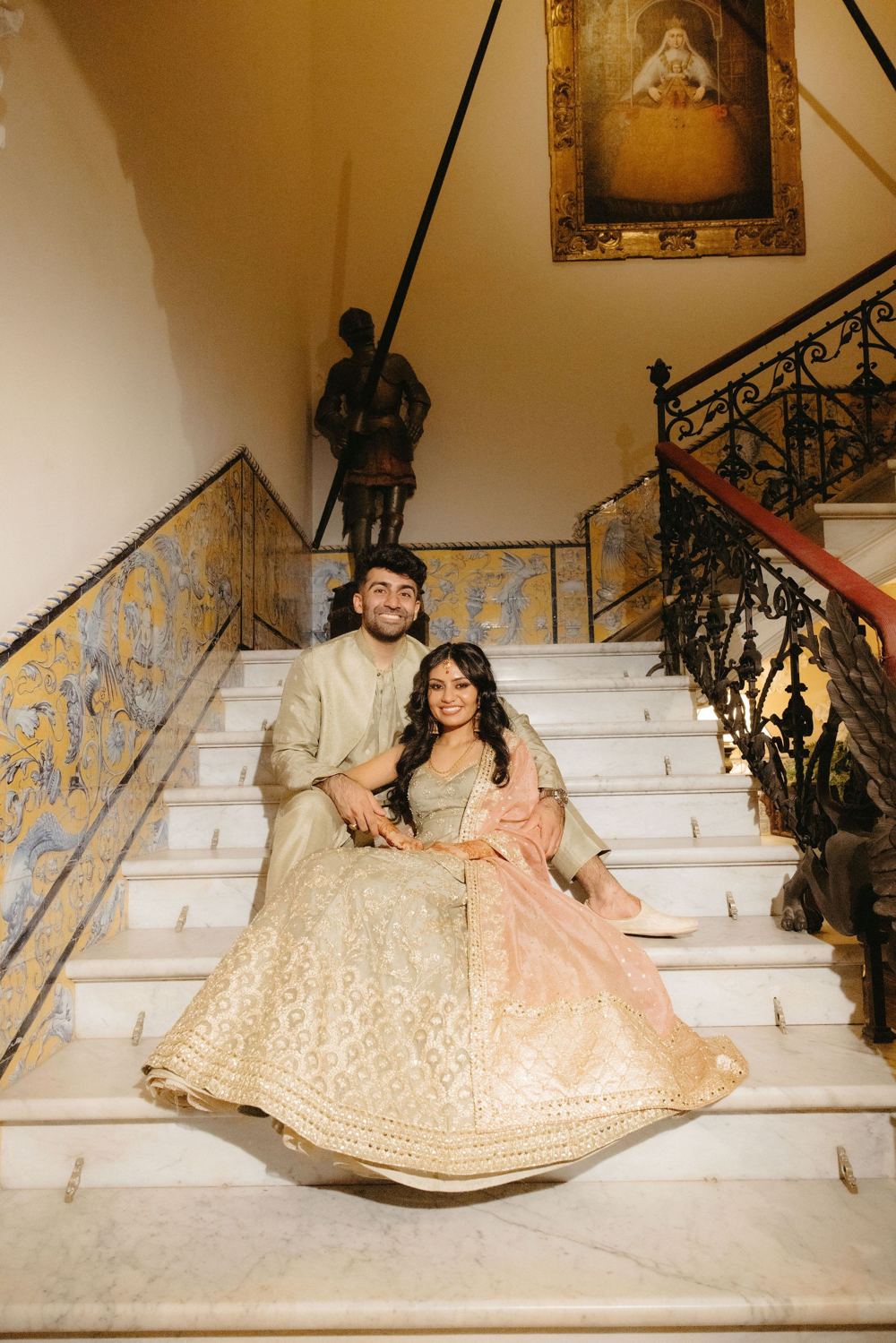
Two childhood sweethearts from Atlanta took over a hotel in the south of Spain for their big day—horse-drawn carriage, sangria and all.
An incredible love story deserves an incredible wedding. Growing up in the Atlanta suburbs, Falaknaz Chranya and Awaez Jiwani met on a field trip in middle school, then became best friends as teenagers. It was toward the end of high school that their connection turned romantic.
“She got into college and was moving out of state, and it felt like this might be the last chance that I would possibly have to be with this girl,” Awaez remembered. “We decided to see where things would take us.”
Falaknaz Chranya and Awaez Jiwani met on a middle-school field trip.
The two grew up in the Atlanta area and got together toward the end of high school.
The relationship took them into their twenties through to a proposal in July 2023: an elaborate scavenger hunt that Awaez staged around Chicago, where they lived briefly before turning to Atlanta. When plotting their wedding, they were sure they wanted something just as detailed and thoughtful, and immediately landed on a destination celebration. “We knew we didn’t want to have it in Atlanta, because we didn’t feel like we would be able to give our guests the kind of intentional experience we really wanted to,” says Falaknaz.
Ahead, the couple explains how and why they chose to hold a Seville destination wedding in August 2025 for 160 guests, and discusses the (many!) venues they booked for their various events, the fun guest surprise they plotted, and loads of other sangria-soaked details.
Hotel Alfonso XIII is an elegant, historic property commissioned by and named for the Spanish king.
The property and Sevilla in general are known for the Mudéjar-style architecture of Southern Spain.
Falaknaz and Awaez were open to getting married anywhere, a wonderful but intimidating prospect. They scoured Pinterest and spoke to planners across the US. “We looked into Chicago, we looked into California, and at one point we looked into a cabin wedding in Montana,” the bride says. “None of those really felt right until I came across some of the venues in Seville, Spain.”
Her major moment of connection was seeing the Hotel Alfonso XIII , an elegant, historic property commissioned by and named for a king of Spain, who aimed to host esteemed international guests there. The scale and vibe of Seville itself, smaller than other European cities, but with an incredible history, stunning architecture, and loads to do, appealed as well. The couple reached out to several planners and booked a trip to visit the Alfonso and several other venues.
In person, the property was just as incredible as they’d hoped. “Hotel Alfonso was honestly a non-negotiable for me once we stayed there that very first trip,” says Awaez. “We were exposed to all the different ways we could utilize the hotel and make the most of it.”
And given the hotel’s 150 rooms, the majority of their guest list could stay there, and did. “One of the major things we wanted from the wedding was everyone to be together. We loved the idea of it being almost a resort, where you’re constantly bumping into people from the wedding,” says Falaknaz.
The couple chose event-planning firm Bodas del Sur because it had worked on South Asian weddings before.
As they tried to narrow down the location for their wedding, the couple had a few dismaying calls with potential event firms. “We met with a lot of planners, and they had a lot of stipulations right off the bat. They weren't really open to hearing what we wanted out of our wedding,” Falaknaz says. They ultimately opted to work with Bodas del Sur , a Seville-based firm that specializes in destination weddings across Andalusia and gave them utter confidence in their ideas. “From our very first conversation, they just seemed like they were going to make what we wanted happen,” the bride continues. “Whatever we said, they ran with it, like, ‘Okay, these are all the ways we can make it happen.’ That was the most reassuring thing: that we felt heard.”
In addition to their vast experience with Seville venues and vendors, Bodas del Sur had also worked on South Asian weddings in the past, says the bride, “so it gave us a lot of confidence that they knew what they were doing.”
A 15th century palace, Casa de Pilatos, played host to the night of dancing and performances known in Packistani-Muslim weddings as the sangeet.
A key aspect of the typical South Asian wedding is that it involves several events, and for the couple’s own Muslim-Pakistani celebration, they figured out quickly that not all of them made sense for the Hotel Alfonso XIII. Though Falaknaz began to panic at the realization, “Of course I was like, all hope is lost, we have to go back to the drawing board”, the Bodas team took them to see more spaces, which cemented Seville for them as a whole.
“The first venue they took us to was Casa de Pilatos . We both walked in and were like, ‘Oh my gosh, this is it. We can’t possibly give this up,’” Falaknaz says. “And the more places they took us to, the more we fell in love with Seville.” The biggest draw for the couple was the city’s rich Islamic heritage, it was under Muslim rule for over 500 years, and the corresponding architectural features, such as the arches, pillars, and intricate tiles, a fusion with Christian motifs known as Mudéjar style.
The mehendi, in which the bride is decorated with henna, was a daytime celebration held at Casa Guardiola , a 19th century formerly private home known for its iconic Sevillian architecture.
“That blend was something we just weren’t finding elsewhere,” says Falaknaz. “That’s truly where we felt like we could give our guests the kind of experience we wanted, that would make them feel connected to something that was more than just a wedding.”
The couple held four major events over three days. The mehendi, in which the bride is decorated with henna, was a daytime celebration held at Casa Guardiola , a 19th-century formerly private home commissioned by a nobleman that stands as an apex of Sevillian Romantic architecture. The pithi, another daytime party during which the couple is decorated with turmeric paste to represent a pre-wedding cleansing as well as the golden joy to come, was staged at Hotel Alfonso XIII. The night of dancing and performances, also known as the sangeet, happened at Casa de Pilatos, while the slightly more Western-style wedding reception and its after-party were at Hacienda La Soledad , an estate constructed in 1542 as the center of an olive grove.
The Sevilla celebration of 160 people felt “tiny” compared to the Atlanta nuptials the couple held for their legal ceremony.
The one ceremony the couple didn’t have on site in Spain? The actual wedding itself. Their Nikkah, the Islamic wedding rites, was held at an Ismaili Jamatkhana at home in Atlanta, in an effort to include the much larger guest list of everyone important to their families, about 600 people in all. That contributed to the relatively tiny group of 160 in Seville feeling much more intimate, “Well, intimate was still about 160, but intimate for us,” says Falaknaz.
“We felt connected to doing that in a place where we both grew up. We were able to do it in our mosque at home, the one we grew up going to and where all of our friends and parents’ community is. It was really special to have that be a part of the storyline, that we’ll share hopefully when we have kids,” says Falaknaz. “It was nice to be able to share that with everyone that wouldn't be able to make it to Spain.”
The wedding reception had the simplest decor, in ivory and gold, with tablescapes of singular, slender cala lilies and pearl chandeliers.
Given the spectacular aesthetics of their chosen venues, the couple decided to bring in very little outside decor, and keep what they did bring in complementary. “The intention was to find places that spoke for themselves,” says Awaez. “We wouldn’t have to dedicate so much time to constructing the decor, versus the place standing on its own.”
For their first two events, they matched the color schemes to the major activities, with the pithi blanketed in shades of turmeric (from fluffy roses to mirrored pillows), and the mehendi outfitted in reddish browns and burnt orange. To create the feeling of intimacy and home at the latter, tables and other furniture were kept low, and wide cushions lay on a floor covered in overlapping rugs to encourage lounging.
Their sangeet was a night filled with dance performances, channeling a peacock theme to echo the jewel-toned florals and vivid garden colors.
Their sangeet, the night filled with dance performances, fittingly received a peacock theme, which carried from the feathers embroidered on Falaknaz’s gold gown by Taali to the signage to a jewel-toned palette for the florals. “We pulled colors that we felt would balance the venue, with these beautiful blues in the tiling and obviously the greens in the gardens,” says Falaknaz, who changed into a glittering indigo lehenga by Seema Gujral for her own performance.
The wedding reception had the simplest decor, in ivory and gold, with tablescapes of singular, slender calla lilies and pearl chandeliers, with architectural floral sculptures set around a fountain. Their planners were the key minds behind the creative vibe of the wedding, along with a local florist, La Galería by Jesús Fuertes .
Transportation to the sangeet was by horse-drawn carriage, and the couple's photography sessions included a ride around Seville's iconic Plaza de España.
While the schedule (and culture) of the wedding events was very expected, the couple kept guests on their toes when it came to transportation to the sangeet: They were taken by horse-drawn carriages to Casa de Palatos. “They were so surprised to see a whole bunch of carriages waiting outside for us. It was such a cool moment,” says Awaez. The rides took a scenic route through the Plaza de España before reaching the venue. “We knew that our guests probably weren't going to be able to have a lot of downtime between the events to explore the city,” says Falaknaz of the bonus tour.
While much of dinner was Desi dishes, the couple also served the most Spanish of dishes, paella.
A key part of Awaez and Falaknaz’s three planning trips to Seville involved considering the caterers that their planners suggested. “We were genuinely concerned about how the food was going to taste, especially out in Spain in comparison to our typical Indian-Pakistani restaurants here in the U.S.,” says Awaez. “We tested and tried a lot of those options that they shared with us, and found several of our own, and ultimately the two that we landed on were fantastic.” They worked with the staff of the Indian restaurant Taj Mahal Sevilla to cater their sangeet, and Ágape 360 Catering y Eventos for their mehendi and reception.
The gastronomic director of Ágape 360, Manuel de Pablo Deco, is Spanish but was excited to learn and adapt to the couple’s cultural needs: For a few crucial dishes, among them Desi-style karahi paneer and a nihari beef stew, the couple’s mothers actually found YouTube videos demonstrating the technique for cooking the recipes. “We sent those videos over to Manu, and he studied them to a T. He really learned to cook Indian food from scratch,” says the grateful bride.
After days of distinctly Pakistani events, the couple’s wedding reception was an unabashed celebration of the local culture. Tinto de verano, a popular summery version of sangria, was served at the cocktail hour, while passed hors d’oeuvres included tapas bites like torta de potatas, Moorish-spiced meat skewers, and chicken croquettes. A troupe of flamenco dancers performed; the couple had seen the group dance at a taverna their planners had recommended on their first planning trip to Seville. While much of their dinner was Desi dishes, they also served the most Spanish of dishes, paella, in both seafood and vegetarian styles, followed by flan for dessert.
To create the feeling of intimacy, tables and florals were kept low.
A step and repeat served as a photo op for guests to snap their own shots.
To maximize their booking and the guest experience alike, Falaknaz and Awaez utilized each possible room or space within their venues. For the sangeet, they took family and couple portraits in the gardens of the Casa de Pilatos, moved to the central, most ornate courtyard for dinner and speeches, held performances in the soaring “courtyard of the halt,” and then moved to an entirely inner room for the after-party, given the local ordinance in the city center that required outdoor spaces to quiet down after 11:00 pm.
In order to keep the energy high for that final transition, they enlisted the help of their bridal party, who performed the final dance act of the night. “Almost flash mob style, we ran off the stage and through the crowd and into the indoor space,” says Falaknaz. The same crowd-pleasing song that’d been playing outside was already being piped indoors, “Dholi Taro Dhol Baaje,” from the beloved Bollywood movie Hum Dil De Chuke Sanam, so the group of 100+ party-goers was enticed to stay a little longer. Or a lot longer: The party continued back at the hotel’s basement, stretching until 3:00 am.