Germany news: Breweries tap thirst for alcohol-free beer
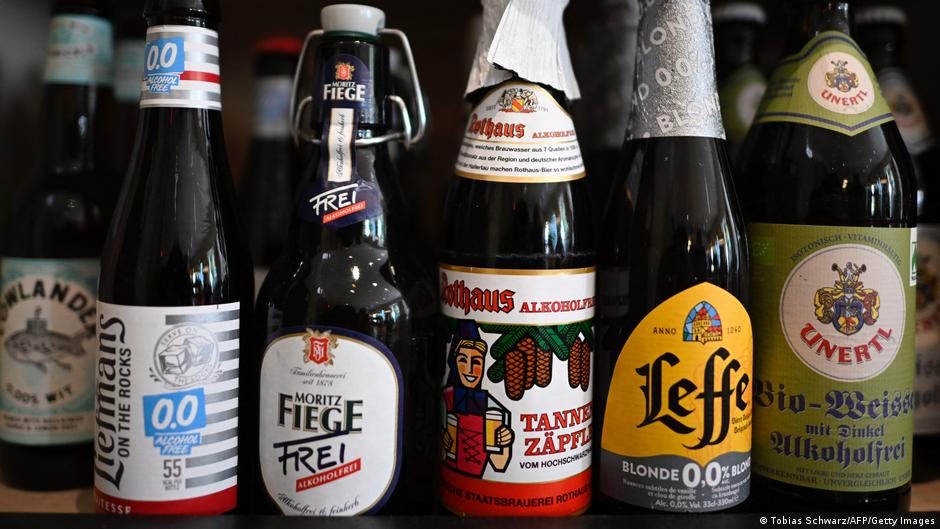
Germany is producing more non-alcoholic beer as consumer tastes change. Meanwhile, a top court is reviewing a Bavarian law that allows police intervention before a concrete threat has emerged. DW has more.
Germany's government plans to reduce the period in which new parents can receive a type of state financial support known as parental allowance, or Elterngeld, from 14 months to 12 months.
Under current rules, parents earning up to €175,000 ($200,000) can receive state support for up to 14 months, that is, if each parent takes at least two months of childcare leave .
The proposed reform would reduce the total to 12 months and require both parents to take a minimum of three months off work. The remaining six months can be divided flexibly between them, resulting in a total entitlement period of 12 months. Single parents would be able to receive a full-12 months of allowance.
Meanwhile, the minimum allowance would rise from €300 to €330, while the maximum payment would increase from €1,800 to €1,900. The existing rule that caps the benefit of 65% of a parent's net income would remain unchanged.
The draft reforms come as Germany's Family Affairs Ministry seeks to cut spending by around €500 million next year.
"Parental allowance is by far the largest item in the ministry's budget," a ministry spokesperson said on Tuesday. "As a result, we are also required to make savings in this area if we are to meet the government's budget targets."
To view this video please enable JavaScript, and consider upgrading to a web browser that supports HTML5 video
German Foreign Minister Johann Wadephul has defended Germany's defense spending against fresh criticism from US President Donald Trump.
Wadephul said the figures were moving in the right direction as NATO leaders prepared to meet in Ankara for a two-day summit.
"We're looking at the numbers and they are pointing up," Wadephul told the broadcaster Deutschlandfunk.
Ahead of the two-day NATO summit in Ankara, Trump once again criticized the level of defense spending by major European partners such as Germany, France, and Great Britain; he also described Germany's NATO contribution as "ridiculous."
NATO allies agreed last year to raise core defense spending from 2% to 3.5% of gross domestic product by 2035, and Wadephul said Germany was on track to reach the target by the end of the decade.
"We are spending more than many of our partners," he said. "What Germany is doing is also being noticed in Washington."
The summit is expected to focus heavily on defense spending, European security and continued support for Ukraine.
Drug-related deaths in Germany have risen to a record level, according to new figures released on Tuesday, with young people making up a growing share of the victims.
Federal Drug Commissioner Hendrik Streeck said 2,150 people died last year as a result of drug use , up from 2,137 in 2024.
Since 2021, deaths among people under 30 have risen by more than half, while deaths among those under 20 have almost doubled.
"What particularly shocks me is that the victims are getting younger," Streeck said.
"When almost every fourth drug death is under 30, our response cannot just be concern," Streeck said. "There must also be consequences: more prevention, earlier help and a support system that reaches people in time."
He warned against cutting addiction services at a time of tight federal and local budgets. "We have a good addiction support system in Germany, but we must not cut it to pieces," he said.
Opioids and opiates were linked to the largest number of deaths, with 1,316 cases. They were followed by cocaine and crack at 769, heroin and morphine at 708, psychoactive medicines at 696 and opiate substitutes such as methadone at 611. Amphetamines were involved in 602 deaths.
German production has risen more than expected, offering a fresh sign of stabilization in Europe's largest economy .
The Federal Statistical Office says industrial, construction and energy output rose 0.9% in May from April.
Industrial output alone rose 0.8% in May, driven largely by a 3.6% jump in car production. Output in energy-intensive sectors, which have come under pressure from higher energy costs linked to the Iran conflict, edged up 0.2%.
The overall figure beats economists' forecasts of a 0.1% to 0.2% increase.
Michael Herzum, an economist at fund manager Union Investment, told the Reuters news agency it was "a sign of life, but not yet a comeback."
Herzum said years of declining competitiveness had pushed production back to levels last seen in 2010, underlining the depth of Germany's industrial slowdown.
"German industry has halted the downward trend, but the path out of the crisis is not a sprint upward; it is a snail's pace," he said.
Germany has confirmed plans to build a state-owned natural gas reserve for crisis situations, with costs estimated at €1.2 billion to €1.5 billion ($1.37 billion to $1.71 billion).
The reserve would not be funded directly from the federal budget, but through a levy on gas consumers.
The plan foresees a reserve of around 24 terawatt-hours (TWh), equivalent to about 10% of Germany's gas storage capacity . To avoid distorting the market, the gas would be bought over two to three years, with the first filling planned for summer 2027.
Economics Minister Katherina Reiche has previously described such a reserve as an emergency tool for the Federal Network Agency, which regulates public utilities. The ministry said it could help prevent shutdowns of individual industrial customers and buy time for repairs or alternative imports.
According to the Reuters news agency, the reserve is designed to cover a 30-day outage at Dornum, the main landing point for Norwegian gas. It could also bridge around 40 days of disrupted LNG imports or cover household and commercial supply for 10 days during an extreme winter.
Germany's Federal Constitutional Court has begun reviewing Bavaria 's contested police law and whether officers can act before a concrete threat exists.
Judges in Karlsruhe opened a two-day hearing on Tuesday into the state's 2017 and 2018 changes that expanded police powers in cases of a merely "impending threat."
The law lowered the threshold for action in cases involving threats to state security, life and health. It allows police to use tools that include covert searches of phones and computers, undercover officers, drones, and surveillance to determine whether a concrete threat may emerge.
In this respect, the Bavarian law is "unparalleled nationwide," the reporting judge, Constitutional Court Justice Yvonne Ott, said at the start of the hearing.
Bavaria amended the law in response to the threat posed by terrorism and extremism, which was considered high at the time. Legislative records cited the 2016 racist attack on a Munich shopping mall and a 2016 Islamist attack on a Berlin Christmas market .
The case was brought by lawmakers from the Green Party, the socialist Left Party and the business-focused Free Democrats (FDP), along with civil society groups and the Society for Civil Rights (GFF). They argue the law risks violating the basic rights of people not suspected of wrongdoing.
GFF lawyer David Werdermann said before the hearing that the law placed citizens "under general suspicion" and allowed police to interfere with basic rights with few limits.