Top 100 reader novels
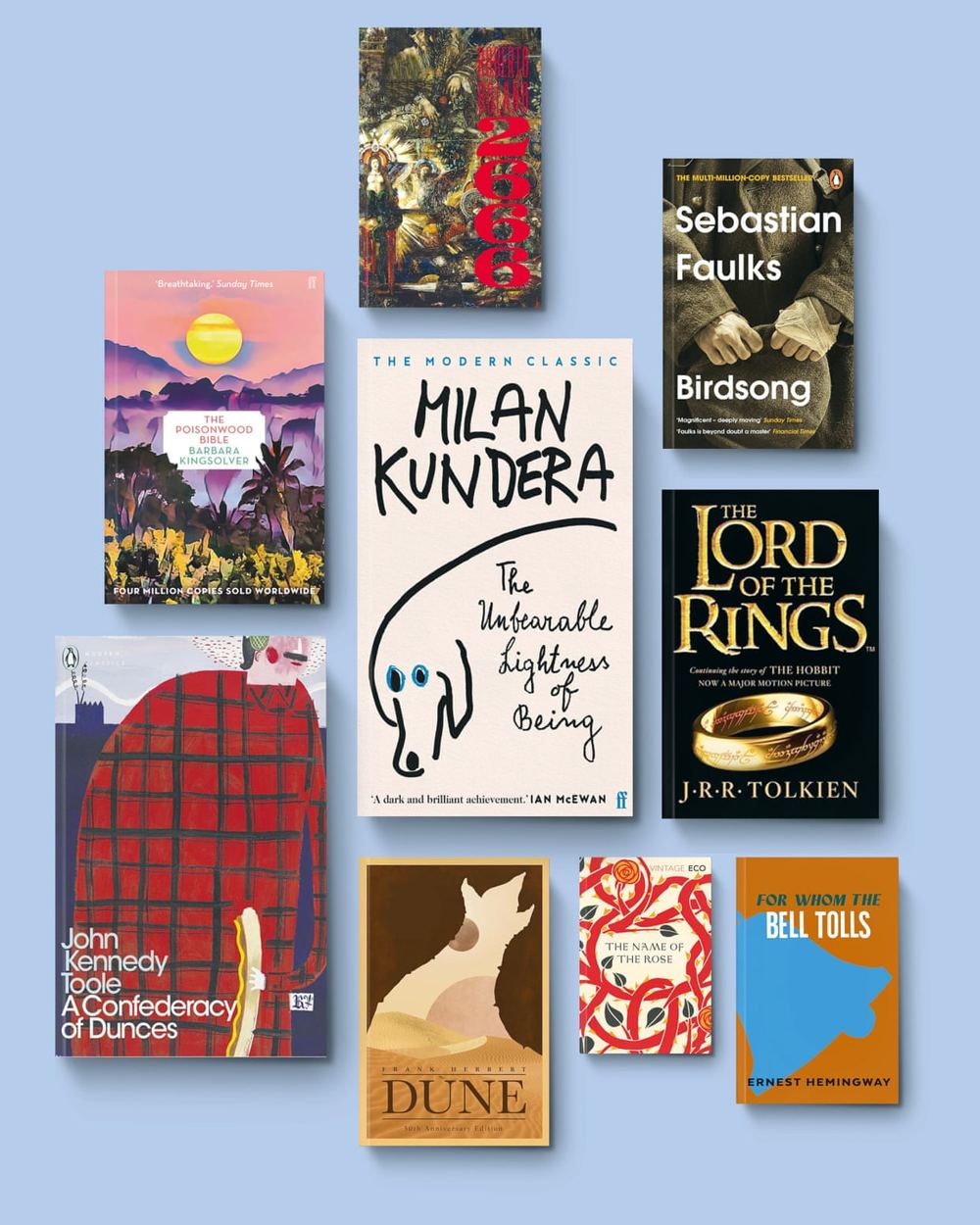
After critics and authors picked their top 100 novels we asked for your favourites. From Uruguay to the Isle of Skye, more than 3,000 readers cast their votes. Here’s your list – topped by a new number 1 • Read about your choices here *** 100 Continue reading...
After critics and authors picked their top 100 novels we asked for your favourites. From Uruguay to the Isle of Skye, more than 3,000 readers cast their votes. Here’s your list, topped by a new number 1
William Wood, Alberta, Canada, 68, retired art historian : “A series of novels that concerns several specific tiers of English society in the first three-quarters of the 20th century, upper class, bohemian, military, political, with comic brio, melancholy and knowing social analyses.”
Heather, Sydney , Australia, 40, engineer : “Devastating. I never want to read this again, yet I will never forget it.”
Roger Paine, Boulder, Colorado, US, 84, retired : “History is brought fully to life in the lives of Marie-Laure and Werner, the storytelling is vivid, the tears are real.”
Jenny Lundy, London, UK, 47 : “Reading this as a teen was my entry-level book to socialism. It opened my eyes to injustice, oppression and abuse of power. My parents always blamed my ‘communist’ English teachers for introducing me to Orwell!”
Adam Glasser, London, UK, 70, musician: “ Unsurpassable literary achievement depicting the psychological and emotional reality of passionate love. A phenomenally original story, with fantastical yet totally believable characters, set against the detailed vast canvas of Colombian history and culture at the turn of the century. A tale so poetically bewitching that the reader is compelled to admit the ending is no fairytale but one hundred percent reality.”
Natasha Walker, Heidelberg, Germany, 55, consultant: “I wish I’d written it! All the world of emotion and relationships contained in Mrs D’s few hours preparing for her party. Heart-wrenching and most beautifully observed.”
Lee Anne Test, Columbus, Ohio, US, 57, former bookseller: “It’s a little bit of a melodrama, and who doesn’t like that? Maugham is eminently readable, and this is his best.”
Dominic Riordon, Gerringong , Australia, 61, retired lawyer : “Reading this book as a young man I was dazzled by the depth of the narrative, the evocative setting and the complex weaving of ancient Greek mythology into the story.”
Brent Grisim, Seattle area, US, 60, scientist : “A foundational critique of the mentality of the enslaver. It took me 20 hours to complete and I emerged as if from a religious experience. Savage and dazzling.”
Chris Winter, the Netherlands: “ This novel was simply pivotal for my thinking about so many things. Religion. The nature of politics, AI, class society, the Middle East, you name it. Since then, I’ve never come across a book so densely packed with ideas.”
David, Chicago, high school literature teacher: “ Potent read in 2026: an idealistic leftwing American hero sacrifices himself for a greater cause while his country stands aloof. Masterful narrative command from Hemingway, who shows tremendous empathy for those who courageously resist the fascist killing machine.”
Natalie Clark, St Andrews , Scotland, 31, paediatrician: “ Clarke understands the English psyche profoundly. She subverts and challenges it, using fantasy as a mirror to Napoleonic war-era society and critiquing the roles of people of colour, women and the working classes by slowly revealing that, for them, magic never disappeared. I believe it is truly the greatest novel of the 21st century.”
Amy Lapierre, Wolcott, Connecticut US , 56, local realtor: “ It took Yourcenar 20 years of meticulous research to write Memoirs of Hadrian and it reads as if she channelled his voice.”
Lisa Reynolds, Norfolk, retired : “ An A-level text that has stayed with me … making me re-evaluate my views over time. A novel that questions Victorian hypocrisy … and one that prompted a group of sixth formers to visit Hardy’s Dorset for five days in 1979!”
Tony Dodd, Abingdon, Oxfordshire, 73, software engineer: “A gem from nowhere, unprecedented and without successor. After 50 years it still has me in stitches.”
Deirdre Slater, Youlgreave, Derbyshire, 77, retired modern foreign languages teacher: “It’s a very good historical whodunit on one level, pretty accurate knowledge of medieval clerical history on another and a grim look into the deepest and darkest places of the human mind, often hiding behind the expression of religion.”
Catherine Healey, Chicago, US, office manager: “This list is not complete without Wilde’s masterpiece. This might be one of the most ingenious concepts put to pen, and Wilde (of course) is able to master it with his signature ease, what does the corruption of the soul physically look like when beauty and youth are prized above all else?”
Josh, Atlanta, Georgia, US, 53, ER doctor: “One of the most powerful books written, The Plague is the story of a doctor trying to simply do what’s right during an outbreak despite religious and political obstruction. It’s also a metaphor for the rise of fascism. A perfect modern novel.”
Julia Weiner, London, 60, art historian: “A flawed hero that you end up loving, two very different heroines, one so melodramatic, the other so passionate. An unforgettable final few pages. What is not to love? I am off to find my copy and start again.”
Liam Given, Málaga, Spain, 56: “McCarthy’s language is sparse and beautiful and you are carried along through horrors and hells, invested in the fate of the father and boy. I’ve read it many times. It’s a book that warns humanity what it is at risk of losing.”
Anita Pomerantz, Baltimore, US, 59: “Unforgettable. No one engages the reader like Stephen King. It’s riveting for over 1,000 pages. Other readers may argue King isn’t literary enough, but I would argue he just fools you into thinking that because he’s such a propulsive writer. ”
Anonymous, Australia: “ Reflects our modern society in an almost more accurate way than Nineteen Eighty-Four, and a dystopia we never tried to avoid.”
Declan Durrant, South Australia, 28: “It is the great novel from possibly the greatest prose stylist of the 20th century. Creamy and redolent with excess and guilt and moral decay in a lost England which, perhaps, never existed, and if it did, maybe shouldn’t have.”
Vince, Melbourne, Australia, 55: “Could a story be more perfectly constructed? And it’s short while being an incredibly deep exploration of what makes us successful as humans and our fatal flaws.”
Matt, Seattle, US, 31: “I never felt I could understand the despondency and the aimlessness of the post-first world war period until I read this book. Surrounded by beauty and passion but being unable to connect with it in any meaningful way is devastating. The last line is one of my very favourites in literature.”
Fiona May, Glasgow: “Captures the essence of cold war Britain, melancholy, sentimental and exciting. George Smiley is one of the most amazing literary creations.”
Ryan Hook, East Yorkshire, 34, lorry driver: “On the Road changed my life. First reading the book in my early twenties when I had lost interest in reading, this book dragged me right back into a love of words.”
Joshua Tanzer, Hoboken, New Jersey, US: “I’ve read it three times at three different ages, and felt three different ways about it. It gives you so much to think about love and relationships, you live with every page.”
Alison, London: “It’s a beautiful, strange fable ultimately speaking to the experience of losing time. You can read it through the lens of emerging from chronic illness or grief, but especially after the time warp of pandemic lockdowns it hit me hard.”
Clare, Toronto, Canada, graduate student studying philosophy: “The only book I’ve read that treats an anarchist society with humanity and realism. It’s about theoretical physics, political ideology, and at heart it is a story about trying to find your home in a world where you don’t own anything. It’s beautiful and radical and smart.”
Martin Ley, Chicago, US , 76, retired English teacher at a community college: “I read this in college, the year after I’d gotten back from serving in Vietnam. It was my first encounter with stream-of-consciousness writing. That, the profound diffidence of the narrator/implied author, and the sense of grief pervading every page changed the trajectory of my life.”
Belle Taylor, Edinburgh, 34, works in science and tech communications: “I loved spotting the parallels and characters from David Copperfield but, more importantly, I adored this novel of a young man ploughing through a traumatic life, marred by addiction, abandonment and poverty, in Appalachia, at the beginning of the opioid crisis. Amazing characters and I learned loads.”
Marcos Mariño, Geneva, Switzerland, 55, professor of physics and mathematics: “Émile Zola opened literature to the lives of the working classes and to regions of the psyche and sexuality that had long been concealed by a mixture of prudery and prejudice. At the same time, he transformed ordinary people into modern heroes and their hardships into a new form of tragedy.”
Judith Klau, Massachusetts, US , 91, retired secondary school literature teacher: “No writer I have ever read understands the desperation of powerlessness and immobility like Flaubert in this book; nor the cataclysmic energy of sexual passion.”
Lucia Benavides, Barcelona, Spain, Argentine-American writer and journalist: “This is the most realistic and complex friendship I’ve read in fiction. The characters are nuanced and complicated. The world-building that Ferrante accomplished is extraordinary and a pleasure to immerse oneself in. I often dream of the Naples and the people of this quartet.”
Hunter Mattacks, Leeds, 37, works in clinical trials research: “Reading this novel was the first time I was presented with a character’s inner life in a way that reflected my own. Plus, it’s a well-crafted and atmospheric story, a great example of real world gothic, and I never feel Du Maurier gets the recognition she deserves for how good her characterisation and dialogue is.”
Dylan Moore, Cardiff , 46, English teacher: “This was put in my hand by a bookish neighbour when I was 17 and she was seventysomething. It opened up a world, not just of isms and ideas, but of the pure joy of being transported by reading. Before the famous killing on the beach, I was right there with Meursault: swimming, frying eggs, and simply existing under a Mediterranean sky. A true gift.”
Clare Winstanley, London, 75, allotment gardener who worked in public housing: “Grass was the first novelist to poke fun at the Nazis, through the brilliantly conceived main character, the dwarf Oskar. A pageant, a circus, a pilgrimage, a battle and so much more. Oskar sees the world at a different level and enables the reader to do so as well.”
Alok Ranjan Jha, Lusaka, Zambia, 53, diplomat: “This novel, a mind-boggling canvas of fictionalised modern Indian history, changed the destiny of Indian writing in English!”