England-Argentina rivalry defies football's commercialisation
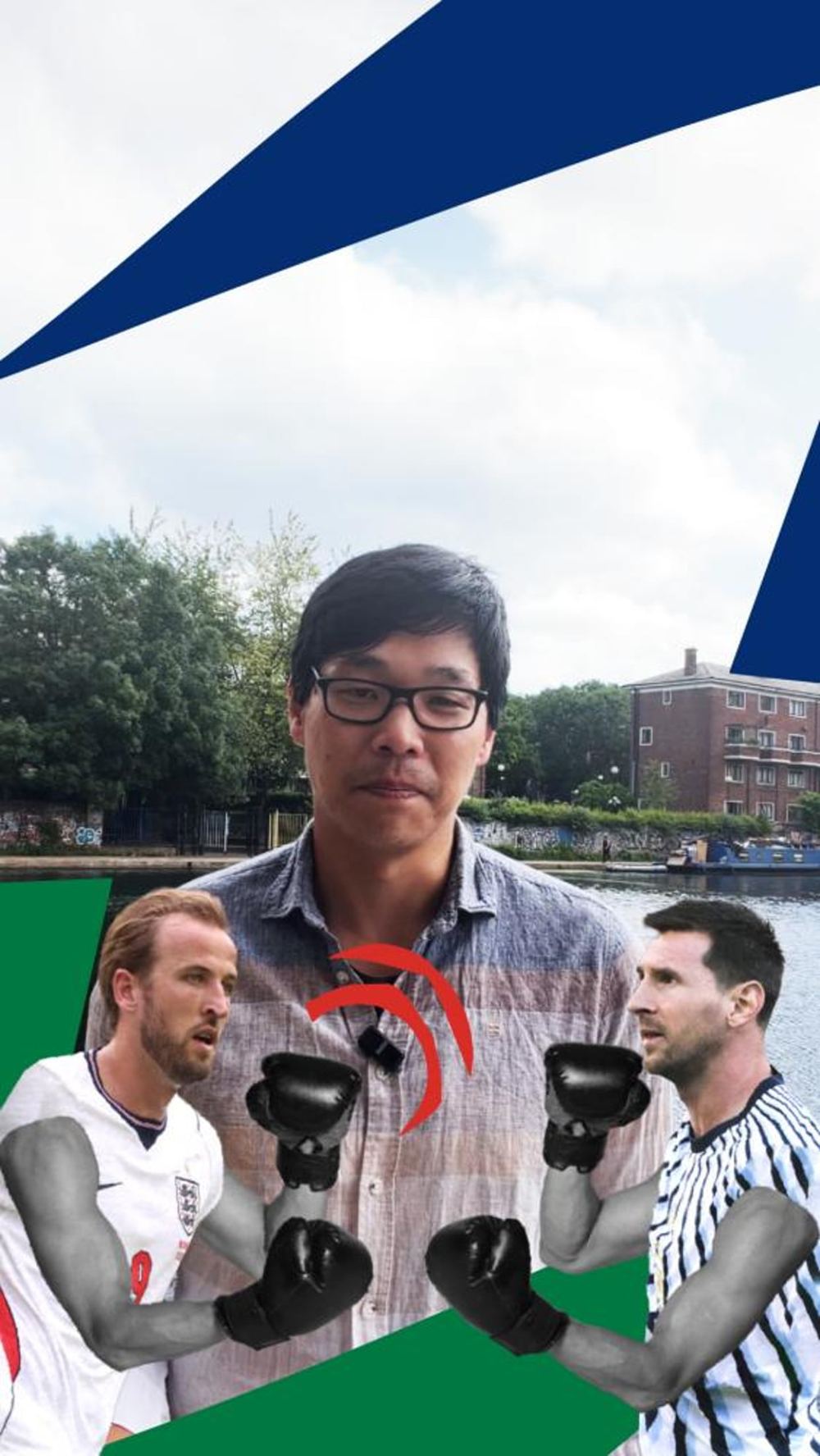
Look beyond the flashpoints and flare-ups and perhaps this is the greatest and most romantic of footballing rivalries It’s about the ball, right up until the moment it isn’t. On Sunday afternoon Godoy Cruz played Defensores de Belgrano in Nacional B, the second division of Argentinian football, and among the sea of blue home banners were two crosses of St George, apparently expropriated from England fans at the 2014 World Cup. One reads: “Boys & Girls From Oakwell Barnsley.” The other: “Big Al – Y-Bird – South Croydon – CPFC.” Now I want you to reflect on the levels of pure and gorgeous ma
Ahead of Sunday's World Cup semi-final between England and Argentina, the depth of the rivalry surfaced in Argentina's second division. During a Godoy Cruz match against Defensores de Belgrano, home fans unfurled two St George's crosses reportedly taken from English supporters at the 2014 World Cup in Brazil. One read "Boys & Girls From Oakwell Barnsley" and the other "Big Al, Y-Bird, South Croydon, CPFC", kept pristine for 12 years specifically for this moment.
The banners underscore a relationship that extends far beyond sport. Unlike most global football matchups, this fixture has not been smoothed over by the commercial machinery of the modern game. The two nations have not played competitively since 2002, preserving a cultural friction that time has deepened rather than dissolved.
That friction is rooted in a specific economic and colonial history. Argentina was once considered a "sixth dominion" of the British empire, absorbing cultural and commercial imports ranging from afternoon tea to the only overseas branch of Harrods. The luxury department store operated in Buenos Aires from 1912 until 1998. English rock bands like the Smiths and the Cure also remain disproportionately popular in the country.
However, a deliberate political decoupling began in the 1940s and 1950s under Juan Perón, using football as a vehicle to reject English influence. "Very early, an Argentinian way of playing football was born that clearly distanced itself from the English influence," said Jorge Valdano, a veteran of the famous 1986 World Cup quarter-final between the two nations. "We tried to be antagonistic to the English."
This divergence remains visible in the modern football economy. Despite Argentina's rich footballing culture, its integration with the English market is surprisingly modest. While players like Ossie Ardiles, Sergio Agüero and manager Mauricio Pochettino built careers in England, legendary figures like Gabriel Batistuta, Juan Román Riquelme, Diego Maradona and Lionel Messi never did. Rodrigo De Paul recently sent his framed 2022 World Cup shirt to a Malvinas veterans centre, highlighting how political currents continue to overshadow market forces.
The result is a sporting dynamic that defies typical commercial logic. Too distant to be friends, yet too historically entwined to be simple enemies, the England-Argentina fixture remains a rare, uncommodified clash shaped by post-colonial history rather than modern sport business.