Pele at the Azteca? England in '66? Ranking the best World Cup finals
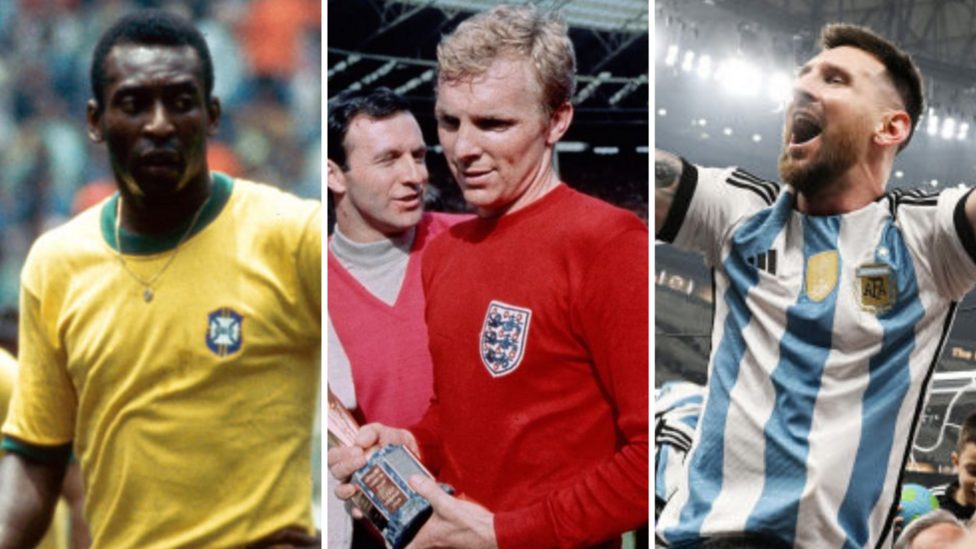
Pele and Brazil at the Azteca in 1970? Lionel Messi's first World Cup? England winning it on home soil in 1966? BBC Sport attempts to rank the best finals.
Every World Cup final, by its very nature, is iconic. It is a rare treat we get to enjoy every four years and this summer is only the 23rd edition of a men's tournament that has spanned the best part of a century.
So how do you quantify the 'best' - is it goals, drama, superstars at their peak?
Well, I have tried to take into account all of those aspects, as well as the showpieces that provided the most compelling storylines and delivered the most enduring legacies.
So below are my top 10 World Cup finals - you can rank your own at the bottom of this page, too.
Not the most dramatic standalone final but one dripping with gripping narrative.
It was a summer that evolved into Ronaldo's redemption arc after the trauma he went through before Brazil's defeat by France in the final four years earlier, and the career-threatening injuries sustained in between World Cups.
Ronaldo only played a handful of games for Inter Milan before the tournament but was at his goalscoring best to fire Brazil to the final, the number nine supported by Rivaldo and Ronaldinho with the explosive Roberto Carlos and Cafu flying down the flanks.
Ronaldo's second-half double proved decisive as Brazil saw off Germany in the Yokohama showpiece - no-one in the stadium would have banked on the Selecao not winning another World Cup since.
The image of Zinedine Zidane trudging past the pitchside World Cup trophy is legendary. Just not for the manner the Frenchman would wish.
Zizou was enjoying a stellar tournament and had already Panenka'd Gianluigi Buffon in the final with a spot-kick that kissed the bar and wriggled just over the goalline before he was later dismissed in extra time.
Marco Materazzi would prove the main protagonist in Berlin. Having fouled Florent Malouda for France's opener, the towering defender levelled with a thundering header from Andrea Pirlo's corner inside 20 minutes.
The Inter Milan centre-back's most memorable contribution, though, was to get a reaction out of Zidane, the balding French playmaker landing a headbutt on the Italian's sternum.
It was Zidane's last act as a player, having announced his decision to retire after the World Cup.
Zidane walked, and Italy won on penalties. Materazzi, of course, scored his.
'A true miracle of destiny' - Messi and Lamine Yamal's incredible first meeting
This was supposed to be the Netherlands' time, as Johan Cruyff and co dazzled throughout the tournament with their revolutionary Total Football approach.
By the final, the Oranje were supremely confident, despite complaining local media were trying to unsettle them, with a story about a party thrown in their hotel appearing in the Bild newspaper under the headline: Cruyff, champagne, naked girls and a refreshing dip.
An early goal at Munich's Olympiastadion only added to their swagger, leading before West Germany even touched the ball. Cruyff went on a mazy run and was brought down by Uli Hoeness; Johan Neeskens converted from the spot.
Yet the hosts had other ideas. Paul Breitner responded from the spot and by half-time West Germany led through Gerd Muller. The Dutch were unable to recover.
Four years later, without Cruyff, they reached the final again, only to be beaten by Argentina in extra time under a sky of Buenos Aires ticker tape.
In the summer of 1954, no team was more fancied than Hungary's Magical Magyars with their swashbuckling superstars Sandor Kocsis, Nandor Hidegkuti and, of course, Ferenc Puskas.
Hungary recorded a famous victory over England at Wembley the previous year and beat them 7-1 before the tournament. They were the Olympic champions and had not lost in more than 30 games - a spell stretching back five years.
Furthermore, they had scored an average of 6.25 goals per game on their way to the final and thrashed the same West Germany side they would meet in the showpiece 8-3 in the group stages.
Come the final, the Hungarians even raced into a 2-0 lead inside eight minutes at Wankdorf Stadium - Pukas and Zoltan Czibor on target - but West Germany were level 10 minutes later and somehow survived as the Golden Team hit the post, crossbar and had a number of efforts scrambled off the line.
Instead, with six minutes remaining, Helmut Rahn scored a shock winner in a victory that would become known as The Miracle of Bern.
This was very much Diego Maradona's tournament, even if for most of the final Lothar Matthaus attempted to stick to the diminutive Argentine like a sweat-drenched polyester jersey in the Azteca heat.
Argentina opened up a two-goal lead, Jose Luis Brown scoring the opener and Jorge Valdano finishing a swift counter attack in the second half.
The South Americans should have added to their advantage before the green-jerseyed West Germans mounted a comeback.
Captain Karl-Heinz Rummenigge poked home in the 74th minute and substitute Rudi Voller levelled soon after from another corner.
But, with six minutes remaining, a moment of Maradona magic settled the final - the forward's superb first-time half-volleyed through ball sent Jorge Burruchaga racing away to nab the winner. El Diego had his crown.
Given France's modern World Cup prestige, it is hard to imagine a time when Les Bleus had never won the game's biggest prize. In 1998, however, when they hosted the tournament for the first time in 60 years, that was the case.
France boasted a multicultural squad that represented a diverse nation, with second-generation Algerian immigrant Zinedine Zidane at its heart.
As defender Lilian Thuram told me: "That all of these players from these different backgrounds could represent France and go on and win, that was a very powerful message to send out to society."
While France's superstars dazzled on the pitch, the final is, however, remembered for pre-match hysteria surrounding the world's best player, Brazil striker Ronaldo.
Ronaldo suffered a convulsion earlier in the day but was given the green light to start for Mario Zagallo's side. Yet he was nowhere near his best.
France ran out comfortable 3-0 winners, Zidane netting twice and Emmanuel Petit grabbing a late third.
Pele who? The teenager was already a superstar in Brazil, netting goals at an incredible rate and becoming his country's youngest ever scorer, but the forward was not unleashed on the wider footballing world until the quarter-final stage at the 1958 World Cup after arriving in Sweden with a knee injury.
He netted against Wales and then bagged a second-half hat-trick against France in the semi-finals, with his legend cemented in the final.
Pele, the 17-year-old with number 10 etched on his makeshift blue shirt, scored twice in a 5-2 win - the highest-scoring World Cup final on record.
His first remains one of the showpiece's all-time great goals, taking the ball on his chest and lofting it over a defender before volleying into the bottom corner.