Pompeii uses modular technique to reconstruct ancient banquet hall ceiling
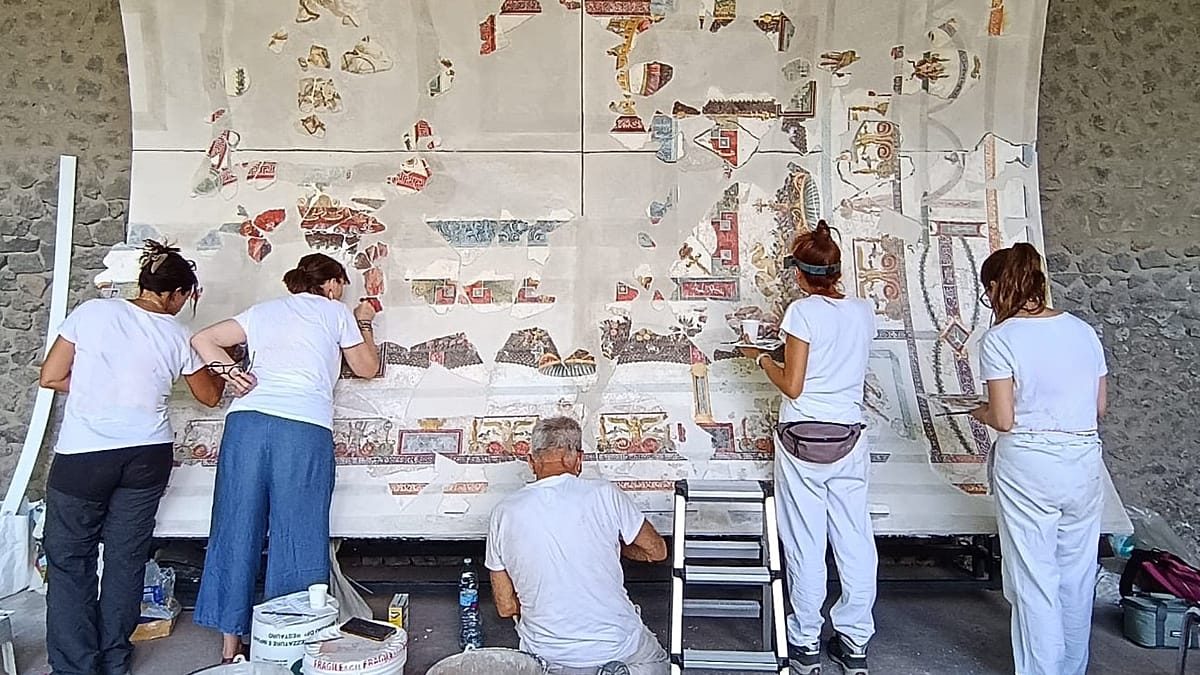
Archaeologists have unveiled a partially reconstructed frescoed ceiling using a new modular technique, highlighting Italy's ongoing investment in the cultural infrastructure that drives one of Europe's most vital tourism economies.
Restorers at the Pompeii Archaeological Park have unveiled a partially reconstructed frescoed ceiling from an ancient banquet hall. The vault, located on the upper floor of a residence adjoining a bakery, features scenes depicting the union of Dionysus and Ariadne. Experts utilized an innovative curved support structure to position the fragments, successfully replicating the original shape of the room.
This modular approach allows teams to rebuild more than a quarter of the original ceiling while keeping the structure open for future additions. By designing a system that accommodates newly uncovered and restored fragments, the park is streamlining long-term conservation efforts. Such technical efficiency is critical for managing the operational and financial demands of maintaining a massive historical asset.
The ceiling project anchors the park’s 2026 programme focused on Dionysus, building directly on recent large-scale fresco discoveries at the House of Thiasos in Regio IX. Continuous excavation remains a core operational strategy for the site to sustain visitor interest. Just last June, teams uncovered an equid skeleton in the bakery area of the House of the Chaste Lovers complex, ensuring a steady pipeline of new historical attractions.
Buried by the eruption of Mount Vesuvius in AD 79, the UNESCO World Heritage Site remains one of Italy’s most heavily visited tourist destinations. Maintaining its status as a premier European attraction requires constant institutional expertise and careful management. The restoration was presented on Thursday at the conclusion of an international workshop on new discoveries, underscoring the site's role in global academic and economic networks.
Gabriel Zuchtriegel, director of the Pompeii excavations, emphasized the broader value of these conservation projects for the European cultural sector. "Italy is a world leader in archaeological restoration, and Pompeii, with its team of restorers, plays a central role in that effort," he told the Italian news agency ANSA. He noted that sharing these results globally provides vital opportunities for research, exchange, and the advancement of heritage management techniques.