Glenn McGrath calls Jasprit Bumrah 'spring chicken': Australia legend tells India pacer to increase longevity
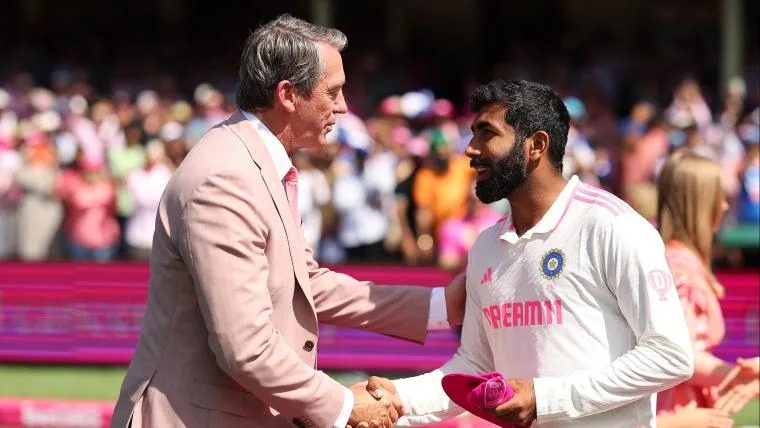
Aussie legend Glenn McGrath called Jasprit Bumrah a 'spring chicken' and shared key workload advice for the Indian pacer to maximize his career longevity.
Australian pace legend Glenn McGrath has weighed in on Jasprit Bumrah's ongoing fitness concerns and described the Indian spearhead as a 'spring chicken' who is still relatively young in cricketing terms. However, he suggested that Bumrah might need to figure out a way to stretch his career further, potentially by cutting back his workload in one of the three formats.
Ever since the international calendar resumed following the IPL back in June, India's fast bowling stocks have been repeatedly tested by injuries. Bumrah's own participation in the upcoming Test series against Sri Lanka remains uncertain, while fellow pacer Prince Yadav also picked up an injury during the recent Zimbabwe tour.
Mayank Yadav only recently returned to international duty after being sidelined for two years, and given India's packed year-round schedule, the team management has increasingly leaned on a rotation strategy to manage player workloads.
MORE: Laxman praises Sooryavanshi's maturity after heroics vs Zimbabwe
McGrath, who works with the MRF Pace Foundation, said the decision on how to manage Bumrah's career will ultimately rest with the bowler himself.
“Well again it’s up to him what he wants. How old’s Bumrah now? 31- 32? He’s only a spring chicken. So he’s got to find a way to have a bit of longevity," he said.
According to McGrath, much of the path forward depends on what Bumrah himself wants, whether that means prioritising Test cricket or shifting focus more toward the shorter formats, alongside how his body continues to respond over time.
"He’s had a few injuries unfortunately, but he’s class, a quality bowler. Just see what he wants to do," McGrath said.
"That’s what it comes down to: whether he wants to focus on Test cricket or whether he just wants to play T20. It also depends on his body. And like I said, guys who hyper-extend their arm do place a bit more stress through that joint there. So we’ll see what the future holds."
MORE: 'Abhishek sorted out': Srikkanth believes Samson will return to India T20I side
Beyond Bumrah specifically, McGrath used the opportunity to share broader thoughts on how fast bowlers are managed in the modern game, arguing that players should be conditioned to handle the physical demands of pace bowling rather than being overly shielded from potential breakdowns.
“It’s the nature of the beast being a fast bowler; it’s not a natural action so injuries are part of the game,” McGrath said.
"Where I’m a little disappointed these days, and it’s probably been that way a little bit for a long time, is that they put them (fast bowlers) in cotton wool. We try to nurse them back to full fitness, and we protect them."
MORE: Why is 33-year-old Saransh Jain included in India Test squad for SL tour
In his view, extended rehabilitation stints often do more harm than good, since months spent recovering can leave a player's overall fitness and strength trailing far behind where it needs to be.
"The best way to do it is to get stronger than the stresses of fast bowling. To do a rehab program for months and months puts your fitness and your strength so far behind that you’ve got so far to catch up."
After tearing his side muscle and dropping to just 77 kilograms, McGrath said he realised a change was necessary if he wanted a sustainable career, a turning point that led him to work closely with trainer Kevin Chevell, who helped make him considerably more durable over time.
"Getting physically stronger and fitter doesn’t mean bowling hours in the nets or working on the wrong things in the gym," McGrath opined.
"I got stronger than the stresses of fast bowling and very rarely got injured. So instead of putting him in cotton wool, we should be actually making him unbreakable, getting him working hard.
"When I tore my side muscle, I lost a heap of weight. I weighed 77 kilograms, so I realised if I keep doing what I’m doing, I’m not going to last very long. That’s why I went down the train and Kevin Chevell (training), who’s working here with the boys and he made me unbreakable."
MORE: 'How can I plan?': Samson on his India future at 2028 T20 WC amid Sooryavanshi's rise
McGrath's stance carries weight given his own remarkable longevity, but applying his era's approach directly to today's game overlooks how drastically fast bowlers' schedules have changed.
Modern quicks like Bumrah juggle franchise cricket, bilateral series and global tournaments almost year-round, a workload McGrath never had to manage across three formats simultaneously. Building physical resilience is undeniably important, but so is smart load management in a calendar this congested, something India's rotation policy already attempts to address rather than pure over-caution.
Bumrah's hyper-extension action also isn't comparable to a standard side strain, it's a structural factor that genuinely increases injury risk regardless of conditioning levels. McGrath's broader point about strength training holds value, but reducing Bumrah's fitness challenges purely to a mindset issue risks oversimplifying a much more complex modern problem.
For all the latest cricket news, opinion, and commentary and to share your voice, head to our Facebook , Instagram, and X (Twitter) pages.
Soham Mukherjee is a content producer and writer, with a focus on cricket, football, tennis and Indian sports. His work has appeared in Goal.com previously, where he has covered the Premier League, La Liga, Champions League, FIFA World Cups and Indian football. Armed with an MA (Master's) in Sports Journalism from Symbiosis International University, he knew early on that his future wouldn’t be on the pitch but behind the pen, shaping narratives about the games he adores.