Russians infiltrate last stronghold before Sloviansk, as North Korea supplies devastating new missiles (Ukraine Battlefield update, Day 1,639)
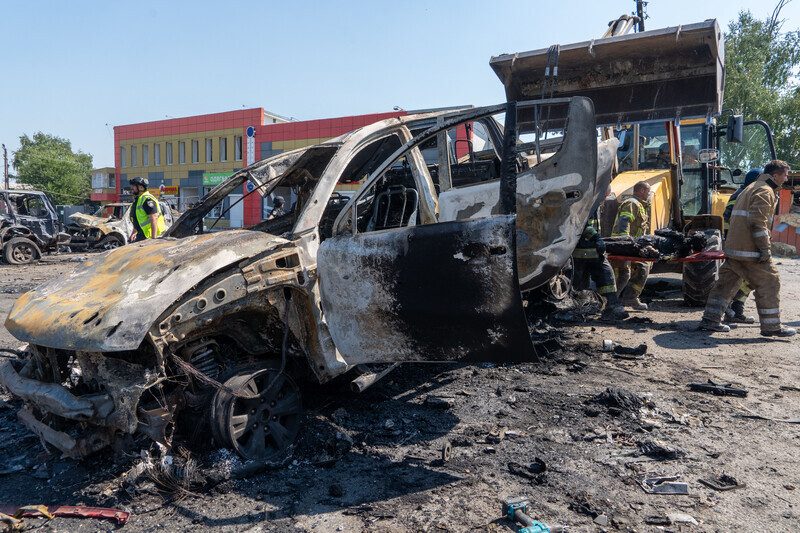
As small Russian units slip into Mykolaivka street by street, exhausted Ukrainian defenders, foreign-trained deserters, and terrified civilians brace for a possible assault on Sloviansk, backed by new, vastly more destructive North Korean missiles.
North Korea has supplied Russia with a missile with several times the destructive power of anything it has used against Ukraine so far.
Dozens of Ukrainian soldiers deserted during training in Germany.
Videos of the day, a grandmother mourns her grandson, killed by Russians during an air raid on Kyiv; rare footage from the cockpit of an Su-34 struck at the start of the invasion; a Romanian F-16 destroys a Russian naval drone; a Russian Ka-52 helicopter unsuccessfully pursuing a drone; a compilation of Russian attacks on petrol stations
The battle for the last town before Sloviansk has begun. It is Mykolaivka. Before the invasion, it had a population of 14,000; in June this year, only 709 remained. As is common in Ukrainian towns, it combines neighbourhoods of family homes and housing estates with apartment blocks. The high-rise buildings are in the eastern part of the town, precisely where the Russian army must break through.
“The town is shifting to defence and becoming part of the forward frontline,” local news channel Mykolaivka, Sloviansk Online wrote shortly after midday on Thursday (20 August). The currently contested locations remain more than 13 km from the centre of Sloviansk, but less than five kilometres from its administrative boundary. The Russian army is therefore already very close to being able to begin the main phase of the battle for this strategically important urban area.
Local reporting offers a good indication of the nature of the fighting, which involves the infiltration of small groups. The Telegram channel said that several ‘DRGs, the abbreviation commonly used by both sides for sabotage and reconnaissance groups, infiltrated Mykolaivka on Wednesday (19 August). Fighting was active on the road from Rai-Oleksandrivka and around the landfill in the direction of the Sloviansk thermal power plant.
Mykolaivka Online said that the Russians had probably entrenched themselves in a large residential building at the, ironically named, 11 Peace Street.
On Friday morning (21 August), the outlet reported further infiltrations: “One may be hiding in the building at 8 Yuvileina Street. According to Mykolaivka Online sources, he ran into an entrance. An FPV drone attacked him at the entrance to the building, but it is unlikely to have hit him.”
This happened at the location marked by the white arrow on the following map. Previous infiltrations were further north:
The tally of attacks on civilian targets in Sloviansk on Thursday (20 August), during which seven residents were injured over 24 hours, illustrates the conditions in which the area’s remaining inhabitants are surviving:
A FAB aerial bomb damaged more than 20 private buildings, a medical facility and a shop.
Fire from a Tornado-S multiple rocket launcher injured three people and damaged nine buildings and two cars.
Molniya drones struck several targets across the town, injuring three people.
FPV drones struck several residential buildings and injured one civilian.
The analytical account Playfra confirmed the local Telegram channel’s reports and marked two routes on its map along which the Russians are advancing. From the south-east, they have been managing to infiltrate areas north of Rai-Oleksandrivka. The village itself remains in the grey zone, but above it the Russians have managed to hold ground by a forest, which is helping them advance further west.
The forest and vegetation play the same role along the route from the north-east, where Ukrainian drone operators face a more difficult task.
Addendum. Updated Russian infiltration routes according to information from https://t.co/k6nsZvNPro and information about known Russian infiltration events in the city. - The main responsible Russian units in this sector are their 6th and 7th Motorized Rifle Brigades. - The… https://t.co/UvuiOEeOPI pic.twitter.com/mFLqFUAmC3
The mechanism by which Russian soldiers infiltrate is already well known. In Mykolaivka, according to Mykolaivka Online, it works as follows :
A Russian drone guides one or two soldiers through the kill zone. “They cross one or two at a time, gather and then occupy the town. This means they lose 500 people so that 10 to 15 can reach a designated location. And occupy several positions. This is how they are now operating in the direction of Mykolaivka,” the local source wrote, describing how soldiers defending the town had explained the course of the fighting.
The video shows a group of soldiers in Mykolaivka. According to its description, they are Russian, but it is confusing that the one who falls just before the drone strikes has a bright green patch on his sleeve. Ukrainian soldiers use bands of a similar colour for rapid identification. However, it cannot be ruled out that it was a patch bearing the emblem of a Russian unit.
Russian FPV strikes Ukrainian soldier in Mykolaivka 48.858458, 37.778673 @UAControlMap @GeoConfirmed https://t.co/U3ZpetP4tP pic.twitter.com/KSPIW9tD2W
The Russian Rybar attributed the advance to the systematic destruction of bridges and equipment across the entire urban area, which, it said , had left the Ukrainian army unable to move reserves and replace losses.
Roman Pataj is Head of the Opinion section at Denník N and, since 2022, the author of the Ukrainian Battlefield update. He graduated in political science and has worked as a journalist since 2002.