Germany news: Third drone found in Leipzig airport probe
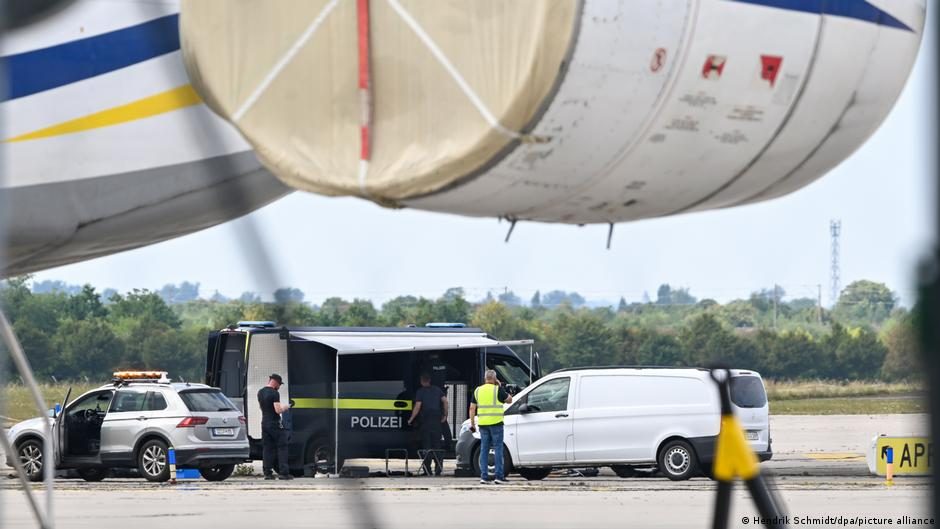
German media is reporting that investigators found a third drone and suspected explosives linked to the Leipzig/Halle Airport incident.
This blog has been closed. Here is a roundup of top stories from and about Germany on Tuesday, August 25, 2026:
Please join us again on Wednesday morning for more news, updates and analysis from Germany.
Journalists' NGO Reporters Without Borders has spoken out against Russia putting a correspondent for the Frankfurter Allgemeine Zeitung (FAZ) on its Interior Ministry wanted list.
"The [German] federal government and the European Union must make it clear that Russian repression of independent media cannot be extended beyond its borders," Christian Mihr, the director of the German arm of Reporters Without Borders, said.
FAZ and Russian media including Tass reported last week that the paper's Balkans correspondent Michael Martens had been put on the Russian Interior Ministry's wanted list for fugitives at large. It wasn't clear whether Russia had also sought an international arrest warrant.
Martens is wanted in connection with a question he had put to Ukrainian President Volodymyr Zelenskyy in Belgrade, when he asked what European countries could do to help Ukraine "kill more Russian soldiers." The FAZ has apologized for the framing of the question but said that seeking to arrest Martens over unfortunate phrasing was an attempt at "intimidation" of the free press.
"Whether this question was put forward in a clever manner could be disputed. But that's not the issue here," Reporters Without Borders' Mihr said on Monday. "A journalist's question does not justify a prosecution, a manhunt or the threat of international pursuit."
Mihr argued that case showed how the Kremlin sought to take comments out of context in order to better use them for political intimidation.
A Bavarian baker is paying a high price for a half loaf that was 10 grams light.
The master baker in Pfaffenhofen has not been fined, as such, or forced to pay compensation, but he was ordered to bring in precision weighing equipment to prevent such complaints in the future.
A customer purchased a half loaf in one of his stores last September, and seemingly was having a bad day when he brought it home, put it on the scales and realized his ratios for his recipe were off.
"He came into the store and he was really tremendously upset: He wanted the right quantity for his money," Matthias Breitner told the German DPA news agency.
Breitner too might not have been in his best form. He told the man, "you win some, you lose some," only for the dissatisfied customer to leave, warning that it was not the end of the matter.
"That was my mistake," Breitner conceded, speculating that he could have headed off trouble at the pass. "I should have just given him a free loaf."
An official from the weights and measurements authority arrived a few weeks later. He said that Breitner would have to purchase precision weighing equipment to guarantee an exact replication of the stated per-kilo price, or cease all sales of half loaves in future.
Breitner said he had not realized that he was in fact already obliged to do this. He estimated the costs of buying the equipment and training staff across six branches at around €15,000 (roughly $17,500), or several thousand half loaves.
The German Association of Carmakers, or VDA, has issued a critical statement amid the latest potential tariff exchange between Canada and the US .
Trump has threatened to impose 50% tariffs on steel, cars, and car parts imported from Canada; and Canada is expected to issue some form of response shortly.
The US tariffs are only set to come into force at the start of next year, and could prove to be one of Donald Trump's ever-volatile negotiating gambits rather than a serious plan.
Nevertheless, the VDA said that such erratic trade policy via social media post made planning and budgeting a serious challenge.
"Constantly changes in tariffs and trade rules as well as ever more threats create uncertainty and put a strain on investments," the VDA warned.
Several German carmakers have factories in Canada, and even more have facilities in the US, mostly they are designed to cater for the entire North American market, or even a wider catchment area.
German carmakers are also wrestling with Trump's ever-changing tariff threats and positions for cars exported from the EU. The rates or proposed rates have changed multiple times during his second term.
Trump's most recent threats in May were to increase tariffs on EU cars from 15% to 25% , although a VDA official said last week that this latest pronouncement had not been implemented in most cases. Still, he said the raised rate of 15% represented a considerable impediment, as did the uncertainty about the 80-year-old's next moves.
To view this video please enable JavaScript, and consider upgrading to a web browser that supports HTML5 video
Germany deported 23 men to Kabul in Afghanistan on a charter flight early on Tuesday.
It's the latest set of repatriations by the government that have gone ahead despite criticisms from opposition lawmakers and rights groups, not least because of the renewed Taliban rule in Afghanistan.
The Federal Interior Ministry said that of those deported, "the vast majority were criminals convicted of serious crimes, such as sexual offenses and crimes involving bodily harm." It didn't specify how many of them were convicted criminals.
The government has emphasized its efforts to deport people convicted of serious crimes while seeking or after being rejected asylum, which was a campaign pledge from the Christian Democrats.
However, amid criticism in July, Interior Minister Alexander Dobrindt also confirmed that the repatriation policy would no longer apply exclusively to criminals and people deemed to pose a threat .
Like the EU, Germany does not formally recognize the Taliban government in Afghanistan, but it has been working with Taliban representatives on migrant returns .
War? Blackouts? Attacks on critical infrastructure? For a long time, such scenarios felt distant. Germany lived in relative peace and stability. But following Russia’s full-scale invasion of Ukraine in 2022, this is shifting. How serious are the risks facing Germany today? What lessons have been learned from recent threats and emergencies? And is Germany and its people truly prepared for a worst-case scenario?
Germans are spending less of their free time socializing with friends and more on individually planned and digital activities, according to a new representative survey.
The Hamburg Foundation for Future Studies found that just 19% of 3,000 respondents said they regularly went out with friends, down from 37% when its first "Leisure Monitor" was conducted 40 years ago.
Meeting friends remains the most important social leisure activity, but its role has weakened significantly over time .
"Traditional sociability is losing reach, while social contacts are increasingly shifting toward individually planned and digital forms," said Ulrich Reinhardt, the foundation's scientific director.
He said everyday leisure was increasingly dominated by internet use, television, music and smartphones. Digital activities have grown sharply:
Artificial intelligence is now used at least once a week by 42% of respondents, rising to 62% among 18- to 24-year-olds.
Reinhardt said younger users were turning to AI not just for information, but also for advice, reassurance and, in some cases, as a substitute for friendship.
Ukrainian President Volodymyr Zelenskyy has thanked Chancellor Friedrich Merz and Germany for their support for Ukraine's defence and independence.