Europe completes new weather satellite trio with Ariane 6 launch of MTG-I2
The successful deployment of the MTG-I2 satellite aboard an Ariane 6 rocket completes Europe’s third-generation meteorological fleet, providing the high-frequency atmospheric data necessary to protect economies and infrastructure from increasingly severe climate events.
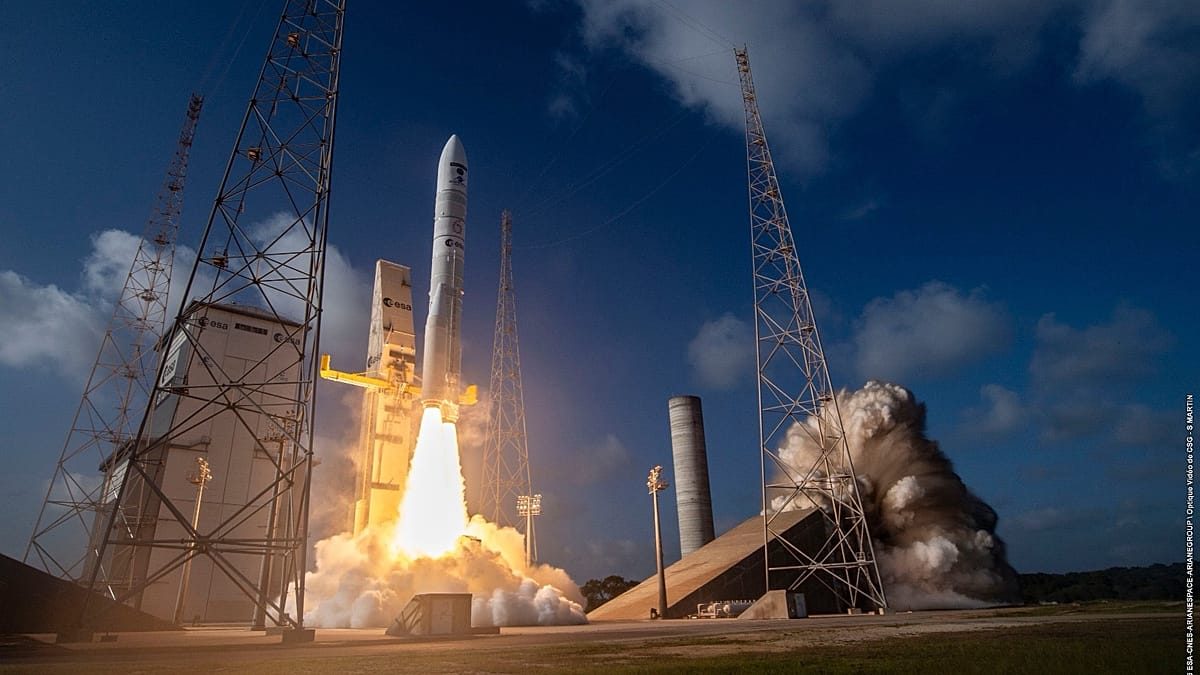
The European Space Agency successfully launched the MTG-I2 satellite from Kourou, French Guiana, on 27 July. Riding atop an Ariane 6 rocket, the mission places the spacecraft into a geostationary orbit 36,000 kilometres above the Earth. This deployment completes the first trio of the Meteosat Third Generation constellation.
For European businesses and public authorities, the new fleet offers a critical upgrade in disaster preparedness. The satellite’s Flexible Combined Imager will scan the continent every 2.5 minutes, delivering the rapid data required to track severe storms, floods, and wildfires. A dedicated Lightning Imager will also map electrical discharges day and night, feeding a three-dimensional weather model that monitors atmospheric dynamics and greenhouse gases.
This enhanced nowcasting capability is particularly vital for the Mediterranean and North Africa, regions frequently exposed to extreme meteorological events. By anticipating severe weather and DANA events with greater precision, the constellation will help authorities and industries mitigate the damage that natural disasters inflict on European infrastructure. The technology also improves the continuous monitoring of wildfires and air pollution across the continent, providing essential environmental data for public authorities.
The mission also marks a major technical milestone for the European space industry. It represents the ninth flight of the Ariane 6 heavy-lift rocket and its first time delivering a payload to a Geostationary Transfer Orbit. Flying with two P120C solid-fuel boosters, the launcher reached its maximum distance to date before successfully deploying the satellite.
Ground teams are currently managing the Launch and Early Orbit Phase, overseeing solar panel deployment and propulsion ignition to fine-tune the trajectory. The Meteosat Third Generation programme was developed under ESA leadership by a European industrial consortium headed by Thales Alenia Space, with support from OHB System and Leonardo. Once scientific calibration concludes, Eumetsat will assume responsibility for operating the fleet and distributing the resulting data to the international scientific community.
The scientific and operational value of this data distribution is substantial, as the international scientific community relies on these observations for continuous meteorological research. By guaranteeing the continuity of services that began with the previous generation, Europe secures its long-term observational capabilities and supports the broader European industrial base. A second family of MTG satellites is scheduled for staged launches from 2033, ensuring this critical infrastructure remains operational beyond 2040.