The Trials of Magnus Coffinkey review, time stands still at 3.43am in fringe fairytale
Summerhall, Edinburgh Angele and Malcolm Galea’s two-hander cycles through grief and sorrow as a broken-hearted hero is trapped in purgatory A fairytale plunges the reader into a dilemma then resolves it. But what if the happy ending never arrives? Will the tale just circle around into a netherworld, never finding a conclusion? That is the prospect in this two-hander by Malta’s Angele and Malcolm Galea, a couple whose experience of pregnancy loss finds expression in a thwarted fairytale – the kind of tale, perhaps, they might have read to their daughter. Continue reading...
Summerhall, Edinburgh Angele and Malcolm Galea’s two-hander cycles through grief and sorrow as a broken-hearted hero is trapped in purgatory
A fairytale plunges the reader into a dilemma then resolves it. But what if the happy ending never arrives? Will the tale just circle around into a netherworld, never finding a conclusion?
That is the prospect in this two-hander by Malta’s Angele and Malcolm Galea, a couple whose experience of pregnancy loss finds expression in a thwarted fairytale, the kind of tale, perhaps, they might have read to their daughter.
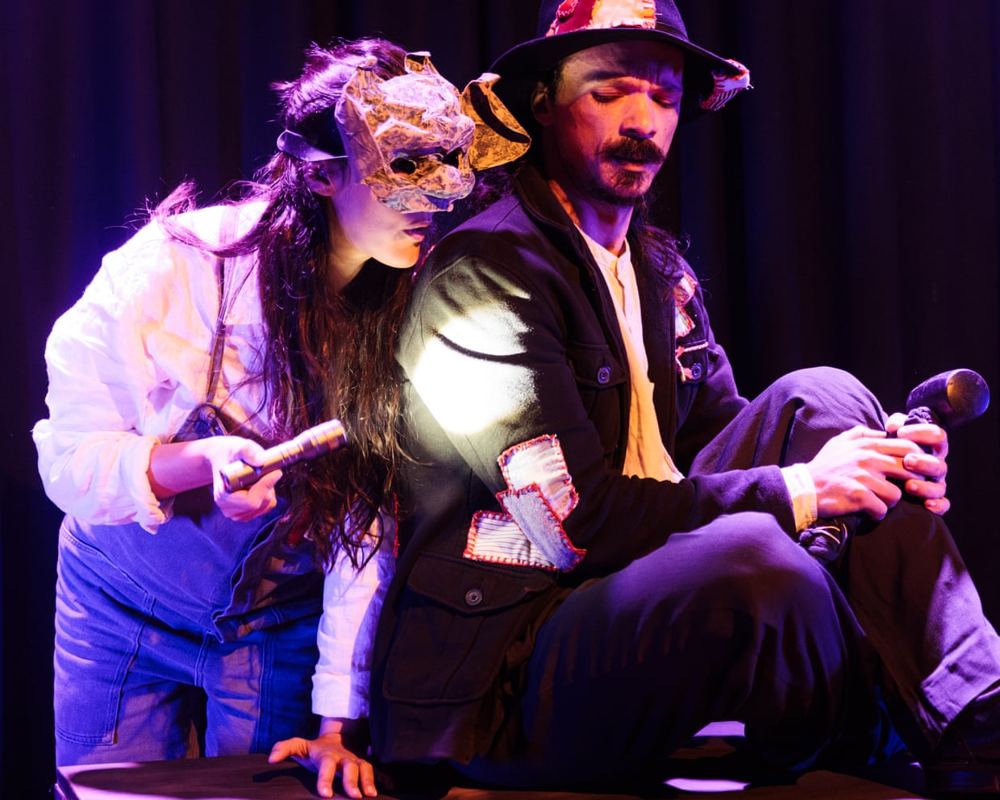
In Philip Leone-Ganado’s production, starring Becky Camilleri and Joseph Zammit, the writers envisage a picture-book landscape of archetypes and autumn leaves. Here, Magnus Coffinkey, a man who makes a living fixing bells, climbs a tower to complete the most difficult job of his career, one made harder by ominous gargoyles and bats.
At 3.43am, he and the bell come crashing down, a symbol of a child lost seven months into a pregnancy. There is no coming back from this, or so it would seem: no relief from the loss, no escape from the emptiness, only a debilitating grief. Duly, Magnus ends up in a purgatory known as the “gloom”, his heart broken, with only guilt, pain and sorrow ahead. Among his visitors is Harmony who, like an unborn child, is “not dead and yet not living”.
As the rhyming narrator of this faltering tale, Camilleri interrupts. She cannot see a way out for her characters, only a depressive cycle of broken hearts. Her fairytale will not resolve. It takes time, a sympathetic therapist and a “safe space for dialogue” to make an ending possible.
Camilleri is a sharp and physically lively actor, bringing levity and perspective to a tale of gothic inertia. But the play is slow to reveal its purpose and, when it does, dwells on emotions that are more sad than dramatic.