US, UK test SM-6, other missiles on SINKEX target frigate
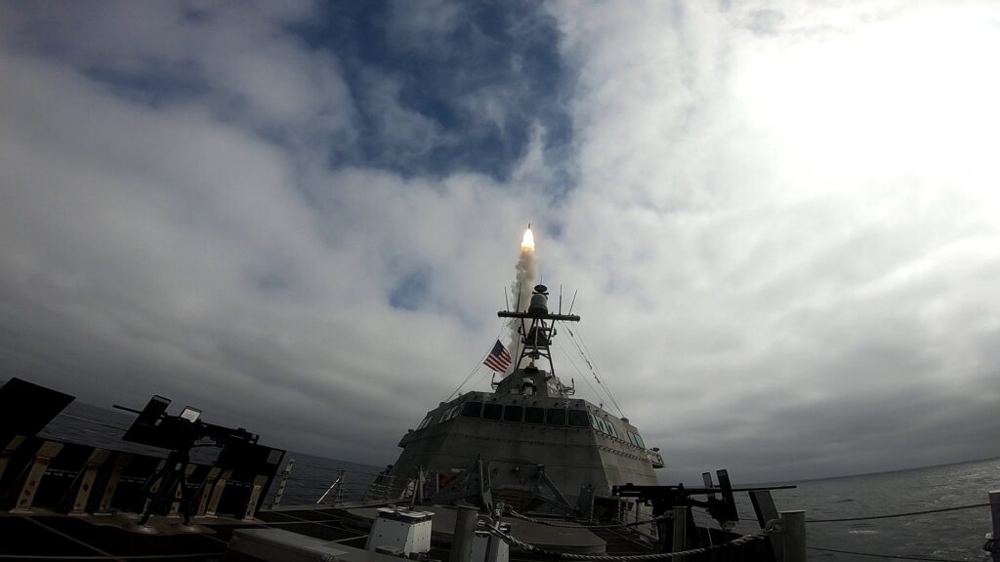
The joint exercise saw the test of several muntions but the final blow was delivered by an Mk 48 Advanced Capability Torpedo, a Navy official said.
WASHINGTON, The US Navy, along with the UK Royal Navy and Air Force, used the decommissioned guided-missile frigate Klakring for target practice this month, in part to test the outer range limits of the SM-6 missile among other munitions tests.
The sinking exercise, or SINKEX , was part of Exercise Atlantic Thunder 2026 and took place in the North Atlantic, the US Navy told reporters today. Its goal was to bolster skills in live-firing against a surface target at sea, as well foster interoperability between the US and the UK for long-range maritime sinking operations , according to the Navy.
“Atlantic Thunder demonstrates the unmatched lethality and interoperability of the United States and United Kingdom,” US Navy Capt. Kelechi Ndukwe, commander of the 6th Fleet’s Task Force 65, said in a statement. “This sinking exercise not only validated the power behind U.S.-UK offensive weapons but delivers a clear message to adversaries that the U.S. Navy and Royal Navy remain a ready allied force.”
Ndukwe said as part of the Sept. 14-25 exercise, the destroyer USS Paul Ignatius fired the SM-6 missile .
“We were testing the surface-to-surface engagement ability at the furthest range that we could,” Ndukwe said. “We were just testing that range.”
Ndukwe did not disclose details surrounding the exact range of testing for SM-6 during a media roundtable with reporters today. The Center for Strategic and International Studies think tank lists its range at nearly 230 miles.
Likewise, Ndukwe confirmed that a Royal Navy Wildcat helicopter launched the new Sea Venom missile, and that the Royal Navy employed its Naval Strike Missile during the exercise as well.
Traditional thinking about how to protect facilities must adapt to new threats such as drones or downstream attacks.
But the final blow to the Klakring, however, came from an Mk 48 Advanced Capability Torpedo, fired from the Virginia-class submarine Massachusetts.
Ahead of the drill, Naval Surface Warfare Center Carderock and Naval Information Warfare Center Pacific installed sensors aboard the Klakring to assist in collecting data from the sinking exercise, which will be used to “really push the envelope on what we’re able to do with future weapons designs,” Ndukwe said.
“We started with the longest-range ordinance, which is why we were going with SM-6 first, and then moved into shorter range,” Ndukwe told reporters. “The embedded sensors that were on the frigate will analyze the data and the impact zones and the more the technical aspect over the course of the next few months as all of that data is processed.”
Additional US and UK units involved in the exercise included the Royal Navy frigate HMS Portland, US Navy and Royal Air Force P-8 maritime patrol aircraft, and US Air Force F-15E Strike Eagles, among others.
“The biggest takeaway for us here was we were really proud of the ability to communicate throughout the entirety of the exercise, communicate with each other,” Ndukwe said. “The shared battle damage assessment will ensure that the Navy and our navies will continue to be capable and lethal fighting forces.”