Private money follows profit, not ruins in Ukraine’s EU-backed reconstruction
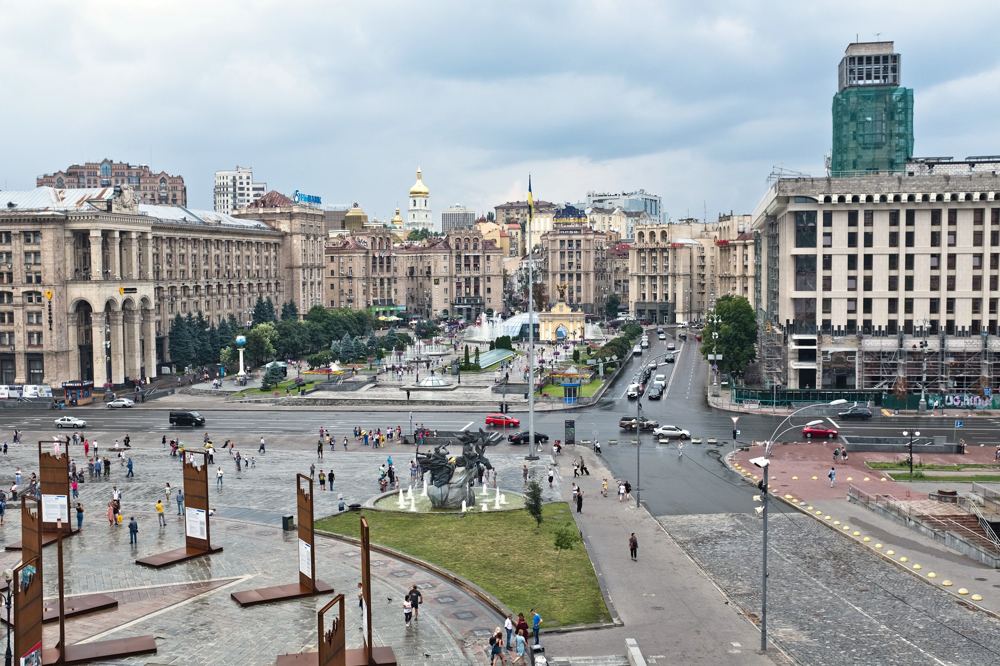
Internal financing data, loan records, and investment flows reveal how European promises to “rebuild Ukraine” quietly sidestep the utilities, housing, and local firms in Ukraine’s battered eastern and frontline regions, while capital concentrates in Kyiv and the safer west.
Ukraine’s reconstruction is being planned from a map of destruction. Financing its private assets instead follows a map of earnings.
Since the full-scale invasion, the European Bank for Reconstruction and Development (EBRD) has lent $131m [€115.3m] to Nova Post, Ukraine’s largest parcel and courier network, an established business with visible demand, revenue, and an owner able to put up around a quarter of the cost itself.
Shipments grew 16 percent in 2024 as traffic reoriented towards western and central Ukraine and across Ukraine’s borders with the EU. Part of the financing paid for more than 600 safety capsules and shelters at its premises. A wartime resilience need met an earnings stream, and a lender followed.
Three sets of records show where else those conditions hold.
The first is what the international financial institutions have financed. Over four years the EBRD , European Investment Bank (EIB), International Finance Corporation (IFC) and World Bank announced some $19bn (€17bn) of project-level finance for Ukraine, more than two-thirds of it to public authorities and state-owned companies.
Of the $2.4bn that went directly to private companies, eight corporates took 83 percent, around $450m to ArcelorMittal’s steel mill at Kryvyi Rih alone.
Guarantees to banks, some $1.8bn of them, are meant to reach smaller and mid-sized firms. Yet bank lending accounts for under four percent of Ukrainian capital investment. Mid-sized companies appear to be underserved.
The second is what foreign investors have done. They put around $2.9bn of new equity into Ukraine from 2022 to 2025, most of it into services rather than industry or energy.
Across 134 EBRD financed projects, announced third-party equity appears in three, all of them technology companies incorporated outside Ukraine. A growing number of international venture funds are entering Ukrainian defence technology, whose assets can travel with global demand. A food processor in Vinnytsia, for instance, has neither that pull nor that mobility.
The third is what companies in Ukraine do with their own money, and it dwarfs the other two. Capital investment runs at around $18bn a year, and companies' own funds finance 71 percent of it.
In construction, the pattern is starker still: unfinished apartment blocks in Kyiv are going up without bank debt, paid for by the people buying the flats.
That money is heavily concentrated. Kyiv and its surrounding region take 54 percent of it; the eight western regions 16 percent. The eight frontline and border regions, which hold 78 percent of the damage and 62 percent of the projected cost of rebuilding, take seven percent.
Three kinds of financing, one pattern. Lenders and investors follow earnings, not destruction.
Much of reconstruction will therefore remain publicly financed. International funding flows to public entities which meet urgent needs and will likely not go bankrupt. For the most part, this is right. A large share of the damage sits in assets that never earned or whose earnings the war has interrupted, and repairing schools, de-mining fields, or restoring homes whose owners cannot pay will remain public spending.
But the balance matters beyond making public funds reach further. State-led reconstruction creates revenue-generating assets in public hands. EU accession will subject them to competition and state-aid rules they do not currently face, and some will have to be restructured or sold.
Expanding the overlap between the two maps means mitigating the externalities of war more effectively. Energy infrastructure was hit 4,500 times in 2025, drones striking transformers and substations and interrupting the cash flows of otherwise functioning power plants.
When the Kakhovka dam was destroyed in 2023, up to 1 million people lost access to drinking water, and water supplies across four regions, including Kryvyi Rih's, have had to be replaced or rebuilt, and the municipal utilities involved are counterparties private investors are reluctant to contract with.
Despite around $200bn of international public non-military support to Ukraine since 2022, the instruments addressing those externalities are patchy at best. A solar developer financing a projec against a Ukrainian public buyer needs a payment obligation it can rely on, and insurance that covers both capital and cash flow.
Closing those gaps is a political decision, not a technical one. European decision-makers need to mandate the EBRD and the EIB to stand behind public buyers of services, widen the guarantees and risk cover available to private investors, and take more risk on their own balance sheets. Of the €9.6bn EU Ukraine Investment Framework, only €220m is equity, anchoring a fund meant to reach €1bn over time. That pool of public risk capital should be larger.
Export credit agencies are a separate lever, and it is national governments that set how far they can reach. Denmark's agency has backed more than €450m of financing for Ukrainian wind farms built with Vestas turbines, but uptake of a broader European export credit scheme administered by the EIB has been slow.
None of this fully aligns the destruction and earnings maps. It widens the ground on which they meet, the part of the rebuilding that can keep earning when the public money stops.
Paul Klouman Bekken is a Norwegian diplomat with more than two decades' experience in conflict areas. He is currently a fellow at ECDPM, where he published a discussion paper on Ukraine's reconstruction gap in June 2026.