Building a Nigerian Picturebook Ecosystem
Author, festival organizer, and Ouida Books founder Lola Shoneyin on her efforts to establish "a living picturebook culture" for Nigerian children "that can also compete confidently in global marketplaces." The post Building a Nigerian Picturebook Ecosystem a…
Author, festival organizer, and Ouida Books founder Lola Shoneyin on her efforts to establish “a living picturebook culture” for Nigerian children “that can also compete confidently in global marketplaces.”
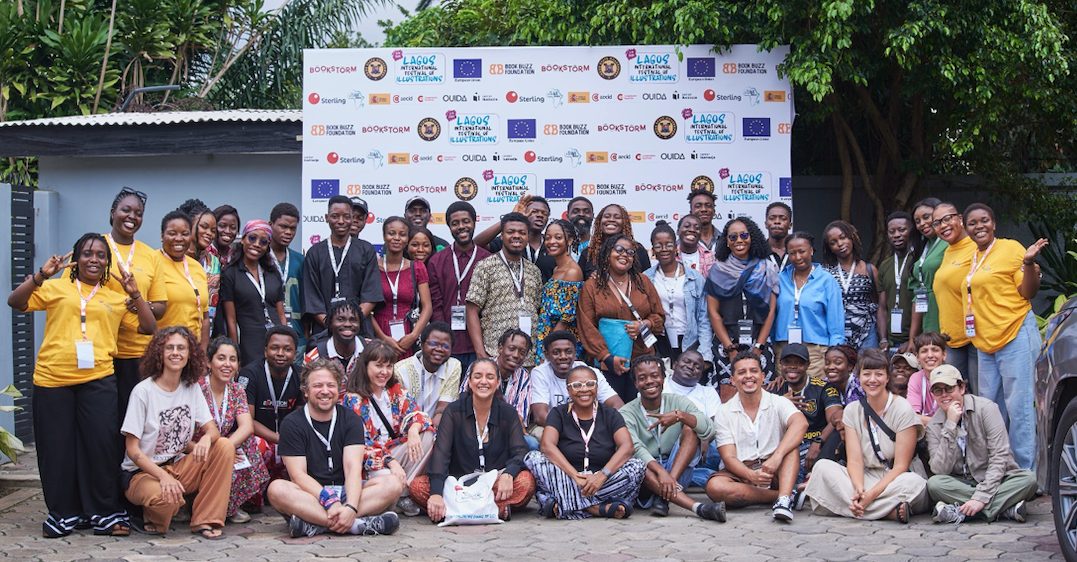
With the 2025 cohort of the Lagos International Festival of Illustration
Over the three years before 2025, one of the most visible routes into Bologna for African publishers was Spotlight on Africa , a U.K.-based program through which the fair promoted the participation of 100 African publishers. Elena Pasoli, who runs the fair with real care, had created meaningful access. I told her what a wonderful idea it was. But standing in that space, as somebody who has spent her life in publishing in Nigeria, I felt a pang of shame. Not because she had said anything that made me feel bad. It was just that creativity was the one area where we didn’t need to be persuaded. I felt like I was being persuaded to take a consolation prize.
For me, this feeling goes in one direction. I come out of irritation feeling challenged. It was embarrassing that this huge, global marketplace, this extravaganza of words and images dedicated to children could exist so comfortably without meaningful input from Africa.
The first time I visited Bologna, the world’s largest children’s book fair, I boarded my plane home with questions that were no longer about invitation, but capacity. Why were publishers from African countries not participating with stronger lists and more confidence in the rights marketplace? Why did Nigeria, with its enormous population of children and abundance of stories, appear to have so little illustration infrastructure to draw on?
I started writing at age 21, in Ibadan, within a literary community shaped by writers, dramatists, and publishers. My grounding in an industry recovering from military dictatorship was solid and deep. Thirty years on, I do much more than write. I am an editor, a publisher, a bookseller, and a festival organizer. This means I see the entire journey of a book: from idea to writing, editing, design, printing, selling, and festival curation. That breadth means I can see the gap between Africa and Europe, because I constantly find myself in the rooms where it is on display.
The publishing gap between much of Africa and Europe is not a mystery. The wall that separates these two worlds is built of money. To get to Europe for a book fair, an African publisher needs at least €1,000 for the trip. Four or five nights in a hotel at €150 a night, plus food, transfers, local transport, and registration, means attendance at any of the major fairs, London, Frankfurt, Bologna, can easily approach €2,000. For a small publisher in Africa, that’s an almost impossible proposition.
Yes, Frankfurt and Bologna have schemes that fly people in. But many of the African publishing houses have such limited capacity that there’s no way to build on what they’ve gained at the fair. These fairs run on rights. Beyond the beautiful books, innovative displays, and freebies, publishers come to buy and sell the rights to publish one another’s books. To participate confidently, a publisher needs a strong list of titles to offer. This is where fragile publishing systems become visible: many African publishers arrive without the depth of catalogue, production capacity or rights infrastructure needed to turn attendance into a sustained opportunity.
A few people have wondered why a novelist and festival organizer should suddenly prioritize illustration in children’s books. Ask anyone to name Nigerian novelists and they will give you three. Ask them to name Nigerian children’s writers or illustrators and silence is far more likely. We have extraordinary writers and talented artists, but there is a serious lack of specialist training and professional infrastructure for writing and illustrating books for children.
In many African countries, the number of high-quality children’s titles being published is painfully inadequate to the population of children they should serve. Nigeria has more than 100 million children and adolescents, and sometimes I wonder what they are reading, or whether they are reading at all.
I understood exactly how abysmal the gap was in 2024, when Slovenia was Guest of Honor at the Bologna Children’s Book Fair. I loved their stand, and bought art prints. They handed me a pack of one hundred A5 cards. On one side was a sample of a Slovenian illustrator’s work; on the other was the illustrator’s biography. Together, the cards revealed a documented tradition extending from the 1930s to the present. Slovenia has a population of two million people and a deep, decades-long tradition of children’s writing and illustration. Nigeria has a hundred times the population and almost no comparable record.
It was while standing at the Slovenia stand that the idea came to me. I understood immediately that the first capacity gap we needed to address was illustration, with our cultures, worldviews and aspirations embedded in the images themselves. Nigeria has hundreds of ethnic groups, yet many illustrations produced for children borrow heavily from the aesthetics of anime and manga rather than drawing from the visual abundance around us. There is so much diversity of color and texture, yet this is rarely reflected, recorded, or documented in our children’s books.
This is a fixable cultural loss. The answer is to plumb our heritage for artistic inspiration and improve our standards so that Nigerian children can encounter richly made books rooted in their own worlds, books that can also compete confidently in global marketplaces. A state serious about what its children read would build the pipelines and infrastructure required to sustain the production of children’s books. Instead, this work too often falls to individuals driven by passion, or, in my case, addicted to building things.
At the launch of the Nigerian Picture Book Project with Ambassador Gautier Mignot.
In 2024, I announced that Ouida Books was looking to publish one hundred children’s books by the end of 2027, under an initiative called BookStorm. The publishing commitment and the training pipeline had to grow together. I had worked with gifted artists who had not been trained in the distinct craft of illustrating for children, so I knew the first move had to be training.
Elena Pasoli introduced the Book Buzz Foundation to Mimaster Illustrazione in Milan, whose tutors ran an online course for Nigerian artists. We started with 20 applicants, but finished with 16. KR Onimole and Barbara Chukwu were invited to the Bologna Children’s Book Fair where an event was organized for them and they were presented with awards. For the Nigerian illustrators involved, this recognition mattered: it signaled that their work belonged within the international picturebook conversation.
But a single training is a spark, not a system. The deeper problem is structural: no Nigerian school of art currently offers children’s book illustration as a standalone course. So, two years ago, I spoke to the European Union delegation in Abuja about the Nigerian Picture Book Project, which would train twenty-four illustrators and twenty-four writers, drawn from all six geopolitical zones and taught over 12 weeks.
Nearly two hundred people applied, but it was important that the illustrators arrived with some grounding in art and the writers with a demonstrable appetite for children’s books. Mimaster Illustrazione and four accomplished international illustrators, Geraldine de Leon, Dapo Adeola, Maša P. Žmitek and Aditi Anand, tutored the illustrators, while I worked with a cohort of talented and enthusiastic writers from across Nigeria.
The program demanded commitment. Classes ran for four hours a week and ended with homework and written reflections. One of our participants from northern Nigeria, poet and artist Ibrahim Musa, passed away during the course. He and his loved ones remain in our thoughts.
The training produced 21 children’s book manuscripts set in different parts of the country, with memorable characters and themes ranging from mystery and nonsense to contemporary and historical fiction and anthropomorphism, of which 20 will be published and presented to the public in October: new children’s books written by Nigerians, illustrated by Nigerians and published in Nigeria, for Nigerian children and for the world.
With the nine guest illustrators from Spain, Slovenia and latin America (Venezuela, Columbia and Brazil.
The idea for the Lagos International Festival of Illustrations also grew out of my encounter with Slovenia at Bologna. While making friends with Tina Popovič at the Slovenia stand, I asked her if she knew of Slovenian illustrators who would be willing to come to Lagos to teach illustration. She said yes, and she knew the people to call.
My next question turned out to contain the whole model: if I could bring illustrators from one country, I could bring them from three, exposing participants to different traditions. We kept the first edition of LIFI small on purpose. We selected 45 participants; 39 showed up every day. Someone sneaked in from Port Harcourt and another Nigerian artist flew in from the U.S. We fed the participants three times a day and gave them transport allowances each day because access to training means little if talented people cannot afford to attend.
At the closing ceremony, we presented six awards selected by the international illustrators.
By then, the model had become clearer. Training alone would not be enough. Illustrators needed books to work on. Writers needed editors and publishers that would invest in their stories. A professional community, international exchange, and public recognition were also essential. Above all, the work needed an institution that would remain after a course ended or a festival closed its doors.
Slovenian illustrator Maša P. Žmitek , Head of the Center for Illustration in Slovenia, has since returned to work with the Book Buzz Foundation to help us establish the Center for Illustrations, Nigeria (CFIN) at our office in Opebi, Ikeja. People and training programs will pass through it, but the infrastructure will remain.
The second edition of LIFI is set to run from September 17-19, 2026. Accomplished illustrators from Italy, Poland, and Switzerland will be joining us, this time, working with 36 participants. Our aim is to change the system, one book at a time, to give the next generation of Nigerian children the kind of books that delight, intrigue and invite a child to read.
I have not simply been thinking about Bologna. I have been building the pipeline that the gaps I encountered there revealed. The fair showed me what Nigeria did not yet have enough of: trained children’s illustrators, a substantial body of picturebooks, and institutions capable of sustaining both. The books now being produced, the illustrators being trained, and the Center for Illustrations in Lagos are our beginning.
The destination is not merely a stronger Nigerian presence at an international fair. It is a living picturebook culture that Nigerian children can recognize, enjoy, and inherit.
Lola Shoneyin is a poet, novelist and the author of ten children’s books. She is the founder of Ouida Books, President of the IBBY Nigeria Section, and Director of the Aké Arts and Book Festival and the Lagos International Festival of Illustrations.
Guest contributors to Publishing Perspectives have diverse backgrounds in publishing, media and technology. They live across the globe and bring unique, first-hand experience to their writing.