Walking with spirits in Cambodia’s sacred forests
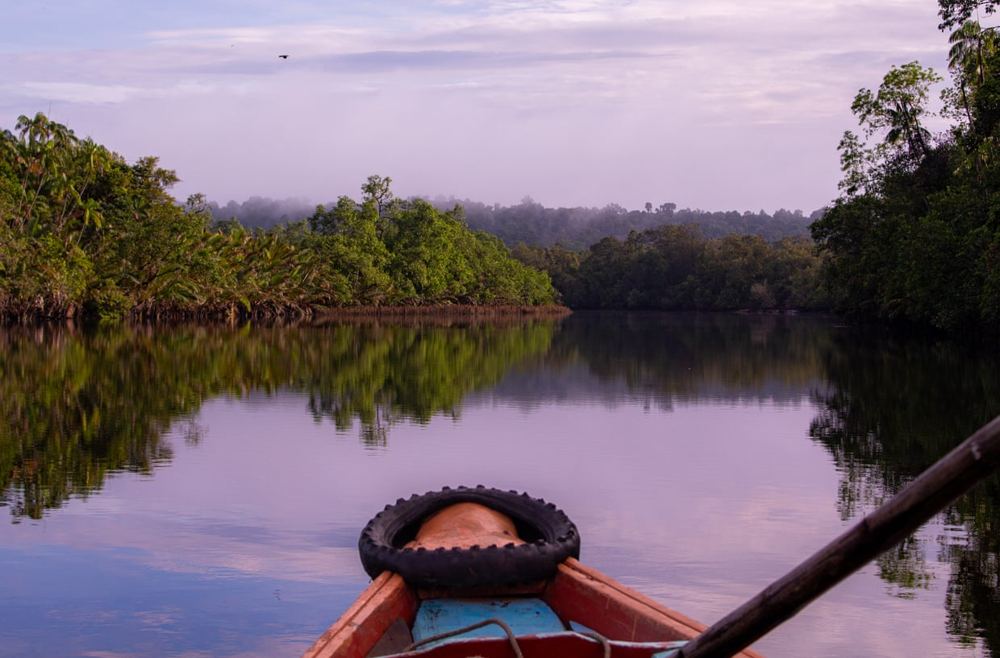
Former loggers and poachers have embraced ancient traditions to promote and protect the Cardamom Mountains’ ever-threatened natural wonders I’m two hours downriver from the Chi Phat community ecotourism camp, in the Koh Kong region of Cambodia, when my phone signal fizzles out completely. It’s dawn and we’re chugging through the snaking Preak Piphot River towards the starting point of a 9-mile (15km) overnight trek into the country’s sacred, spirit-filled Cardamom mountain range. The region, a six-hour bus ride west of the capital Phnom Penh, recently made global news for being home to a raft
Former loggers and poachers have embraced ancient traditions to promote and protect the Cardamom Mountains’ ever-threatened natural wonders
I ’m two hours downriver from the Chi Phat community ecotourism camp, in the Koh Kong region of Cambodia, when my phone signal fizzles out completely. It’s dawn and we’re chugging through the snaking Preak Piphot River towards the starting point of a 9-mile (15km) overnight trek into the country’s sacred, spirit-filled Cardamom mountain range. The region, a six-hour bus ride west of the capital Phnom Penh, recently made global news for being home to a raft of new species of fauna and a sanctuary for rare and endangered wildlife .
As well as its plant and protection initiatives, it is also known for its storied history, from ancient burial grounds to the last stronghold of Pol Pot’s fleeing Khmer Rouge fighters into the late 1980s. If trees could talk … Well, many believe these ones can.
Unlike the western way of managing belief, sealed in gated graveyards or glimpsed on infrequent Sundays, Khmer spirituality (as with the national, Buddhist faith) is as integral to daily Cambodian life as the ticking-over tuk-tuk or the churn of the streetside sugarcane crusher. The Cardamoms has long been a land I have tried to reach. I’m here for a few days, hoping to feel the spiritual power of such a sacred place, as well as check out its diverse yet elusive wildlife, from forest elephants to wild dogs (or dholes ).
Luckily, I won’t be entering the jungle alone, Chea Singhtararith, or Rith, is my tourist board chaperone, alongside a team of guides from the Chi Phat ecotourism community, including a forest cook, known simply as Mr Crab. Oh, and we’ll be joined by a host of omnipotent spirits …
In Cambodian animism, neak ta are powerful, just spirits who protect and watch over the country’s boundless, ever-threatened natural wonders: from the mighty Tonlé Sap River, one of the few in the world that reverses its flow twice yearly but is threatened by increasing pollution, to its dense, diverse, frequently devastated forests.
The Cardamom range is one of the largest unfragmented rainforest corridors in mainland south-east Asia . It has a double line of defence: armed government rangers who enforce national park law on the ground, and deep-seated animist traditions that keep vast areas of the forest untouchable, and thus a haven for wildlife.
As we float down the river, a young guide called Daro points to a small shrine balanced on a seemingly levitating stone. “Lok Ta Esey Tmar Andet [the Hermitage of the Floating Stone] protects this river.”
And what a river it is, flanked by dense, green jungle, all fortified by twisted fists of mangrove, with the fresh, young roots rising up from the riverbed sharp as spears. This spot is considered so sacred that many local people believe it to be the home of one of Cambodia’s most notorious mythic visions, the White Crocodile, a portent of death or inescapable fate.
It’s everyday crocodiles I’m more concerned about, along with venomous snakes and my own, personal nemesis: dengue fever-harbouring mosquitoes. I’ll take all the spirits’ help I can get.
In recent years, rural communities like Chi Phat have been forced, by economic and environmental pressures, to re-evaluate their dialogue with nature. Founded in 2007 by the Wildlife Alliance, the Chi Phat ecotourism community offers a range of extremely well-priced excursions, tours and activities across the area, including treks into the Cardamoms, with overnight stops at their deep-jungle base camp.
However, it’s local people like 60-year-old Mr Crab (arguably the finest forest cook in the Cardamoms) who best symbolise what the initiative set out to achieve: prior to his life in the community’s ecotourism project, he was a truck driver for the loggers, ferrying out the very trees he now works to protect. Many others in the Chi Phat community come from a similar background: loggers, poachers, hunters, all of whom have gone from exploiting their surroundings to promoting and protecting them.
On our approach to base camp, which sits by the river Stung Preat, we silence the engines and decamp into narrow row boats so as not to disturb the delicate ecosystem. This is birdland now, and the unfolding mass of jungle hisses, pops and creaks. Occasionally, a kingfisher darts in our periphery, as bright butterflies (such as the Indo-Chinese chocolate albatross) flutter through hard heat, crossing still water, disturbed only by the odd gang of scrapping monkeys waiting at every turn.
It’s 8am when we ditch the row boats and begin the steady walk into the tree line, about 2½ miles in the direction of a small river where we will take lunch. The humidity is intense. Within minutes, it feels as though all the fluid has left my body, wicked away by hiking clothes.
“Watch out,” Rith says, as we dodge curling roots and clamber over collapsed trunks. “We don’t say bad or negative things in the forest. Nor do we take anything. And when we need to pee, we ask the gods first. The smaller trees have smaller spirits, so pick one of them to pee on!”
It’s not simple superstition either, the jungle and the Cardamoms teem with wildlife best left in myth. One such beast we meet, a golden-backed spider (the giant golden orb weaver), is roughly the size of an adult hand and spins vast webs that, once hit by light, shimmer an iridescent gold.
Similarly, when we stumble across a crop of rare, yellow cap mushrooms they are so “magic kingdom” in appearance, I assume they will either kill us or transfigure us. Instead, Mr Crab bags them up for dinner, claiming them as a gift from the forest spirits.
Luckily, the spirits shine on us, with the mirage-like appearance of a fast-running stream. The heat is now so oppressive that I strip down and dive in.
Mr Crab and Daro (who gave up a lucrative life as a graphic designer in the city to live alongside nature again) spark up a fire. A welcome round of Khmer tea is brewed and half a chicken fried up for lunch, accompanied by a pan of steaming rice. It’s the start of the wet season, and when it rains it pours. Bruised clouds have gathered, and so we hit the trail again, hoping to reach our camp for the night, 2 miles away, before dark.
It’s some time later, as a Kurtz-like delirium is about to set in, that a small campsite appears amid the dense vegetation: a clearing with several hand-built covered sleeping platforms, Mr Crab’s outdoor kitchen and a small bathing pool fed by a trickling waterfall.
Night draws in, and with it the cyclic choral purr of cicadas, that, much like the forest spirits perhaps, are never seen yet all around. Dinner is served by torchlight, hung from the roof by a krama (the symbolic, all-purpose Khmer scarf). The remaining half a chicken is roasted on an open fire alongside those yellow cap mushrooms fried up with fresh garlic, all washed down with sips of “Khmer whisky”, fruit-flavoured rice wine that could strip paint.
That night, I’m lulled to sleep by a colossal downpour that hammers at the tin roof over our heads. Come morning, we head off on the final leg of the Cardamom trek, winding back into the heart of the Chi Phat community. Paths widen and the jungle begins to open up. But it’s not this that marks our return from the wilderness, it’s the cicada-like ping of all our phones coming back online.
Almost as soon as the trees open up entirely, the rain comes down, and we make it back to Chi Phat drenched and blistered. Miraculously, my flesh has survived the two-day mosquito buffet utterly unbitten. Maybe there is something to all this spirit worship after all.
The trip was facilitated by the Cambodia Tourist Board and the Chi Phat community , which offers a range of tours, excursions and activities . A five-day package, including treks, guides, food and accommodation, costs about $350 pp