The best books to read in November and December: new paperbacks from Benjamin Myers, Jeanette Winterson and John Updike
Looking for a new reading recommendation? Here are some must-read new paperbacks, from an experimental novel about a German actor to a study of how the arts can boost our health *** Continue reading...
Looking for a new reading recommendation? Here are some must-read new paperbacks, from an experimental novel about a German actor to a study of how the arts can boost our health
The German actor Klaus Kinski is known best for his testy collaboration with Werner Herzog, whose 1982 film Fitzcarraldo put Kinski in the title role, lugging a steamship over the Andes.
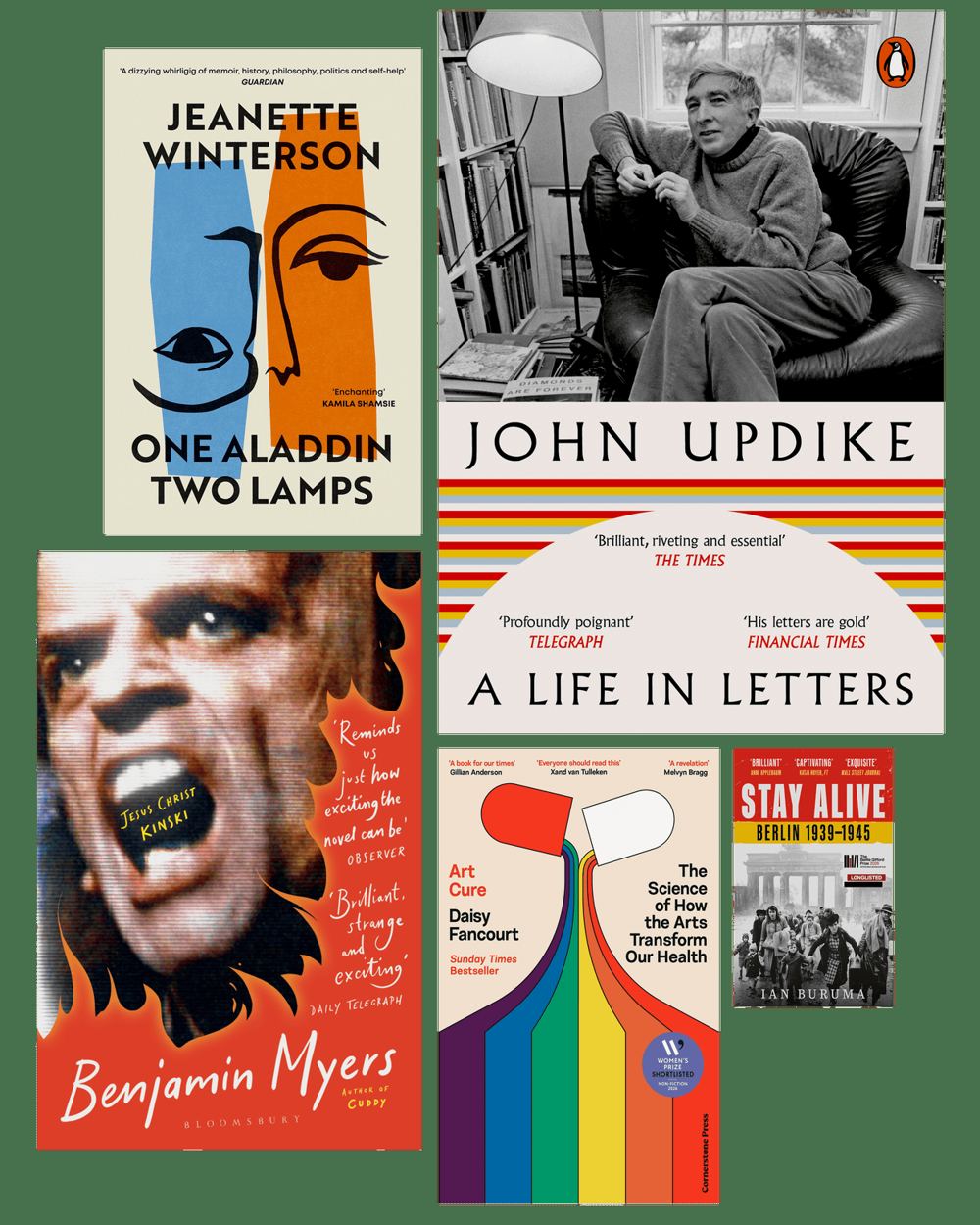
Benjamin Myers’s new novel plunges us into Kinski’s fevered mind during one of his last performances, a recorded solo stage show in West Berlin in 1971, where he delivered a ferocious monologue as Jesus. Showcased in a documentary released in 2008 by Peter Geyer, the act descended into chaos, Kinski arguing with hecklers before ending his monologue in a near-empty auditorium.
The book melds Kinski’s on-the-record words with imagined second-person recollection about, among other things, his capture by allied forces as a German conscript, a spell in a psychiatric clinic, and his innumerable sexual conquests.
Cut half a century later to West Yorkshire during lockdown, where an unnamed writer decides to write a book “about the dead German actor Klaus Kinski”. The project looks unsaleable from the off, not least because Kinski’s eldest daughter, Pola, accused him of sexually abusing her. There’s also the fact that “the writer”, let’s call him Benjamin Myers, owes his publisher a “long, era-spanning historical novel concerning an English saint”, and has already spent the advance (this is a reference to 2023’s Goldsmiths prize-winning Cuddy ). Yet the “dark and forceful energy” of Kinski’s Jesus keeps drawing him back to online footage. By the time Myers clocks that the actor was 45 in 1971, the age Myers is in 2021, “a psychic door of communication [is] opened by the key of coincidence”, and it would basically be rude not to write the book.
This fitfully engaging narrative experiment isn’t really about Kinski or even Myers so much as the 21st-century cultural marketplace. As lapel-grabbing rants give way to downbeat musings, the book exerts a strange charm, ushering us behind the scenes of its own making. “I live freely,” Kinski boasts, unlike people “stuck in … dismal jobs”. Amid the keynote disaffection, you ultimately sense contentment, even joy, that he’s not the only one able to say so. Anthony Cummins
Meet Raja, the narrator of Rabih Alameddine’s new novel. A 63-year-old gay philosophy teacher and drag entertainer, he is a stickler for rules and boundaries, living in a tiny Beirut flat with his octogenarian mother, the nosy and unfettered Zalfa. Invited to a writing residency in the US, Raja will use the occasion to relate his life.
Winner of the 2025 US National Book Award for fiction, Alameddine’s seventh novel opens and closes in 2023, but the bulk of its action takes place earlier: encompassing the lead-up to and aftermath of the Lebanese civil war (1975-1990), the Covid pandemic, Lebanon’s 2019 banking crisis, and the Beirut port explosion in 2020. If this timeline makes the book sound like a punishing tour of Lebanese history, I promise it isn’t. More than a war chronicle or national exposé, it is a queer coming-of-age tale, an exploration of the bond between a mother and a son, and a meditation on storytelling, memory, survival and what it means to be truly free. Told in a voice as irresistibly buoyant as it is unapologetically camp, this rule-breaking spin on the trauma plot holds on to its cheer in the face of sobering material. Poignant but never cynical, often dark but never dour, wise without being showy and always eager to crack a joke, this is a novel that insists that the pain of the past need overwhelm neither present nor narrative, identity nor personality. With Sartre as his guide, and a drag fabulousness all his own, Raja shows us how. Yagnishsing Dawoor
Set in the late 1970s in the Possilpark district of Glasgow, an area riven by poverty, crime and sectarianism, Crawford’s superb debut is told from two points of view: 12-year-old Janey, who is walking her dog when she stumbles upon the body of a young woman; and her grandmother Maggie, who has cared for Janey since she was rescued, as a baby, from the gas explosion that killed her immediate family. Janey is afraid to tell the police all she knows, but finds herself caught up in the machinations of the grownup world. Maggie, who has secrets of her own, is desperate to protect her granddaughter, but poverty and lack of choice make her vulnerable, and the dead woman has connections to a well-known criminal family. A well-observed, well-told account of trauma, grief and the concomitant magical thinking, this coming-of-age mystery has flashes of humour and pathos that provide fuel for real suspense. Laura Wilson
Written in the 1970s and published in English for the first time, The Madman is set in a Swedish town in the late 1940s. The country’s wartime neutrality-on-paper continues to divide: the town’s pro-Nazis want the past forgotten, but the communist sympathisers, bitter about having been interned, want a reckoning. When a letter to this effect appears in the local paper, those accused, including the director of the town’s sawmill, claim that newcomer Bertil Kras has been stirring resentment for political ends. When the sawmill burns down, Kras is blamed for that, too, and the disintegration of the life he has tried to make provokes an existential crisis. An older Mankell might have been more concise, but the slow build towards inevitable disaster makes for true emotional depth, and the theme of othering, isolating and penalising people for their opinions remains horribly topical. Laura Wilson
John Updike had the mind of a middling middle-class postwar American male, and the prose style of a literary genius. Such a lord of language was he that even the notoriously grudging Vladimir Nabokov afforded him a meed of praise. A reviewer, musing on the disproportion between the style and content of Updike’s fiction, likened him to a lobster with one hugely overgrown claw. It was a comparison Updike was to remember, for all his bland urbanity, on display from start to finish in this mighty volume of his letters, he could be prickly, and did not take slights lightly.
At the heart of this volume we find the correspondence, from the first half of the 1970s, surrounding Updike’s separation and divorce from Mary, and his affair with and marriage to Martha, the biblical resonances of the names are almost too pat. These pages make for painful reading: Updike could be cruel, to Martha: “Mary’s body (her breasts!) would delight me still, if I could dissociate it from her pinched Unitarian soul …”, but in the main they are either pained, with Mary, or passionate, with Martha. And simultaneously, of course, he was having it off with other loves, old and new.
Are his books read now? Towards the end he made a glum self-assessment: “I have fallen to the status of an elderly duffer whose tales of suburban American sex are hopelessly yawnworthy period pieces.” Perhaps so; but he wrote such prose as to make the envious seraphim sigh. John Banville
A professor of psychobiology and epidemiology at University College London, Fancourt researches how social connections and behaviours affect our health. In Art Cure, her first book for a popular audience, she aims to make a scientific case that the arts, from playing music to theatre-going to painting, aren’t a merely aesthetic aspect of life. Instead, they are deeply entwined with our mental and physical wellbeing at every level, from the workings of our cells and molecules to cognition, memory and mood. In an era of shrinking arts funding and overstretched healthcare systems, her message is urgent. But how to compile rigorous evidence for something as holistic, indefinable, and, perhaps, resolutely unscientific, as art?
Fancourt’s answer is to dissect artistic interventions and practices into their component parts. She argues that every arts experience can be broken down into “active ingredients”; could even, if we had the processing power, be converted into binary code. Singing to sick babies becomes a mix of noise buffering, neurological stimulation, human contact and stress reduction. These ingredients trigger biological mechanisms that lead to health outcomes, she explains, and we can test, refine and prescribe them just as we might any cocktail of drugs. With this approach in mind, she surveys the evidence for medical benefits, from wellbeing to brain health, chronic pain and even how long we live.
Art Cure cannot provide answers. But it does make a compelling, compassionate case for broadening how we think about medicine, to encompass people and communities, not just physical bodies, and to recognise that creativity, identity and purpose shape our biology as much as any drug. Jo Marchant
Berlin had always been a case apart. The legacy of the wild Weimar years, all that artistic and political radicalism, not to mention louche living, had continued under the Third Reich. The city remained defiantly itself and, despite the efforts of high command, mulish about being told what to do. That, at least, had been the situation in 1941.
By the time Ian Buruma’s father, a conscripted labourer from the Netherlands, arrived two years later, Berlin had begun grudgingly to toe the line. The war was going badly now, with the Russians pushing in from the east, and American and British bombs dropping from the skies. Food was scarce, Jewish citizens were being disappeared daily and Hitler and Goebbels, both frequently in the city, were getting more anxious and crueller by the day. Now whenever Berliners met each other in a food queue or a bomb shelter their most likely greeting was Bleiben sie übrig, “Stay alive”.
Nonetheless, argues Buruma, wherever you looked you could still find pockets of resistance. He isn’t referring here to well organised underground networks, but rather to ordinary men and women, not especially brave but still capable of doing the right thing. When Jews were ordered to start wearing identifying insignia, plenty of their fellow Berliners made a point of going up to them in the street and shaking hands. Young Leo Buruma, drafted in to work at a heavy engineering factory, took up with a Ukrainian girlfriend, pointedly ignoring the Nazis’ dictum that, as a “Germanic” Dutchman, he had no business consorting with an “inferior race”.
Other witnesses, such as journalists Ursula von Kardorff and Ruth Andreas-Friedrich, were careful to keep only scrappy and coded memos during the war, but subsequently reconstructed these into coherent narratives for publication. Von Kardorff could never be described as a resister, yet her memoir shows someone trying hard to remain decent in a criminal state. Her father, a successful portrait painter, had lost his teaching job thanks to his opposition to the regime, yet her mother, a textile designer, continued to kit out the homes of the Nazi grandees. Ursula herself delivers warm clothes to Jewish homes but wonders if she is merely doing it to salve her conscience. Her real anguish is reserved for her brother who is fighting for Germany on the eastern front.
None of this is morally coherent and yet, suggests Buruma in this wonderfully nuanced book, it was necessary if you wanted to stay alive, and knew yourself to be neither brave nor craven, but somewhere in the muddled in-between. Kathryn Hughes
Crowe previously fictionalised his story in the 2000 film Almost Famous , which he wrote and directed. His lyrical and compulsively readable memoir The Uncool is bookended by the opening of a musical version, which coincides with the death of Crowe’s mother Alice whose aphorisms, including “Put some goodness in the world before it blows up”, are scattered throughout the book.
Crowe’s is a world of aftershow parties filled with characters like Freddie Sessler, a drug dealer who is rumoured to have made his fortune manufacturing pencils; late-night dressing-room jam sessions (Crowe has his guitar gently removed from his hands by a roadie called Red Dog when he attempts to join in with the Allman Brothers); eager, undamaged groupies (he knows a crew called the Flying Garter Girls whose leader Pennie Lane’s credo is “only blowjobs, and that’s it”); and, as the early 70s wear on, omnipresent cocaine use, though Crowe doesn’t partake. “I couldn’t shake the image of my teacher-mother popping up,” he says. “You’re killing brain cells!”
He shadowed Bowie at parties with Ronnie Wood and in the studio with Iggy Pop; he hung out with him day and night in houses he was renting, meaning that he was there to record the heartstopping moment when Bowie suddenly jumped to his feet mid-interview because he thought he’d seen a body fall from the sky.
The Uncool captures an extraordinarily inventive period in which rock music was stretching out in all directions, whether towards country music thanks to artists like Gram Parsons, or the conceptual in albums by the likes of Yes and the Who. Crowe was part of a burgeoning music press that, as well as recommending new bands to its readers, or conveying what rock groups had to say for themselves, would interpret, celebrate and contextualise the huge creative strides some of these musicians were making. Alex Needham
Over the course of four decades, seven books and countless exquisite magazine features, especially for the New Yorker, Orlean has profiled celebrities and nobodies, followed cults and choirs, turned her eye to supermarkets and surfers. “Writers fall into two categories: there are those who have something they want to say to the world, and there are those who believe the world has something to tell them,” she observes. Orlean falls squarely into the second camp. There are two kinds of story she likes best: “hiding in plain sight” and “who knew?”.
A memoir is usually neither of these sorts of stories, but Orlean rises to the challenge of writing about her own life with grace. Joyride represents the liner notes to a career of hits. There’s the deliciously “heady, fun, surreal” experience of watching Spike Jonze’s movie Adaptation, based on her book The Orchid Thief, come to life, including being played by Meryl Streep. (Orlean’s account of flipping open Charlie Kaufman’s script for the first time to discover herself in it is laugh-out-loud funny.) A memorable Twitter thread from 2020, the result of too much rosé on an empty stomach, that made her the “patron saint of pandemic drinking”, gets its moment, too. And harder episodes: a divorce, a cancer diagnosis, the sorrow of moving her mother into a nursing home.
Orlean sees the writing life as one of constant highwire creative reinvention, “you never build equity”, is how she puts it. Her father, who wanted to be writer but became a businessman instead, might have agreed: after she published The Orchid Thief he suggested she consider finally enrolling in law school. Thank goodness she didn’t. “I felt called, I really did, to describe ordinary life in a way that revealed its complexity and poetry, to show how rewarding it is to be open to and curious about the world, and how much joy can be found in letting yourself be surprised.” Mythili Rao
In the framing device that opens the Middle Eastern folk tales collected in One Thousand and One Nights, King Shahryar avenges his wife’s infidelity by ordering her execution and marrying a new virgin every night, having each of them beheaded by sunrise so they won’t have time to cheat. When he runs out of victims, the young Persian queen Shahrazad volunteers but stalls her own murder by telling the king one captivating tale after another, and those become the stories we’re reading.
As Jeanette Winterson puts it in her new book, a dizzying whirligig of memoir, history, philosophy, politics and self-help, loosely tied to commentary on the Nights, Shahrazad’s feat of creativity “refuses the present emergency, the contrived drama of a powerful man”. The echo of life in the Trump era is deliberate; for Winterson, the means by which Shahrazad changes her predicament holds out hope for a progressive politics currently losing ground to “radical-rightwing thuggery”. “A better story starts with a better story,” she writes. “Reason will not win the day. Without imagination nothing changes.”
Each chapter opens with a pithy retelling of one of Shahrazad’s tales, spritzed with 21st-century idiom (“The Vizier … has no manosphere where he can vent”), before giving way to wide-ranging reflections on anything and everything, from the history of eugenics, to 13th-century Mali, to the awfulness of the trouser suits “preferred by some CEO types and lots of female politicians”. As opinions on matters big and small fly past, the tone evokes by turns a party political broadcast, Radio 4’s Thought for the Day, an old friend setting the world to rights. Anthony Cummins
At least two terrible ironies surround the death of Mike Lynch. One lies in the name of his superyacht, which sank off the coast of Sicily in the early hours of 19 August 2024. He had named the boat Bayesian to honour Bayes’s theorem, a mathematical rule that helps you weigh up the probability of something given the available evidence, which served as Lynch’s guiding light over the course of a tempestuous career. The theorem was “a beautiful key to our minds”, Lynch believed. But it was entirely incapable of predicting the outcome that morning, when the yacht capsized during a storm, killing seven people, including Lynch, his 18-year-old daughter Hannah and his US lawyer, Chris Morvillo.
A second irony lies in the fact that Lynch had just come through the trial of his life, one he felt was bound to end in jail, where he thought he could die. Somehow, to everyone’s astonishment, an American jury had acquitted him and his co-defendant on all 15 counts of fraud .
To celebrate their win, Mike and his wife, Angela, decided to take the Bayesian on a series of cruises around southern Italy, inviting various supporters and associates. Lynch was no sailor, but he loved the seclusion the boat offered, and was immensely proud of its a 72-metre mast, one of the tallest in the world, a feature that some have speculated made it more vulnerable in strong winds, although the yacht’s manufacturer has defended its design. Through July and into August, it pottered around Capri and the Aeolian Islands. Then, in the middle of the month, the court victors were overtaken by a sequence of near-impossible coincidences, as Prescott sets out in pacily written detail. Charlie English
Why has an organisation with huge amounts of money at its disposal, a record of recruiting the brightest and the best, and the widest of remits, failed to notch up a better record? It’s true that we may not know about many of the CIA’s successes. But we know about a lot of its failures, and some of them have marked US history ineradicably.
In The Mission , Tim Weiner, whose reporting on the CIA in the New York Times was always essential reading, and whose subsequent books on the US intelligence community have a place on the shelves of anyone interested in international affairs, provides a variety of answers to this essential question. As he showed nearly 20 years ago in Legacy of Ashes, his history of the CIA from its founding in 1947 to the end of the 20th century, the agency’s position by the end of the 90s was pretty desperate. It was starved of cash and bleeding talent. A high-flyer who had been station chief in Bucharest was revealed to be working for the Russians, handing them the names of large numbers of agents and employees. But the new US administration that came in at the start of 2001 wasn’t too worried. In March that year, Donald Rumsfeld , the defence secretary, told the joint chiefs of staff: “For the first time in decades, the country faces no strategic challenge.” Six months later came 9/11. The CIA had tried to convince the feckless George W Bush about the looming threat of Islamic ultra-fundamentalism, but no one in the administration listened. The agency was regarded as broken.
Weiner’s sources encompass several senior CIA figures from the period under discussion. These people opened up to him, and as a result the book contains many essential new details. Weiner’s account of Donald Trump’s links to Vladimir Putin in 2016 is clearly based on information from inside the agency, and it leads him to assert openly that Trump was Putin’s polezny idiot, his useful idiot. There are all sorts of other important and fascinating revelations in The Mission. No one has opened up the CIA to us like Weiner has. John Simpson