'Go to the UK, they don't deport anyone': Inside the 'travel agency' for illegal migrants in Iraqi Kurdistan fuelling Britain's small boats crisis: DAVID PATRIKARAKOS
The people-smuggler talks about Britain like a travel agent would. 'If you want to work, earn good money and have a good life, you need to go to the UK,' he says. 'They don't deport anyone.'
Published: 00:59 BST, 16 July 2026 | Updated: 10:06 BST, 16 July 2026
The people-smuggler talks about Britain like a travel agent peddling a package holiday. 'If you want to work, earn good money and have a good life, you need to go to the UK,' he tells the Daily Mail. 'They don't deport anyone.'
Dlovan runs his 'travel agency' inside a mall in central Erbil, Iraqi Kurdistan. But there are no holiday brochures, computer terminals or signs of a legitimate business in Dlovan's agency.
Instead, he sits behind a large desk littered with used coffee cups and an overflowing ashtray, chain-smoking expensive cigarettes and smelling strongly of aftershave.
Business, it seems, is good. Pointing to his decade of experience in the 'trade', Dlovan offers a 'guaranteed' route to Britain. This involves travelling through Turkey into mainland Europe, usually Greece , before flying to a small airport on one of the Greek islands, where officials don't generally bother to check if passengers have the correct visa for Schengen (the zone where European countries have abolished internal border controls).
It's then an easy flight to France , Italy or elsewhere in Western Europe, and finally on to Britain.
For wealthier clients, Dlovan provides fraudulent documents to obtain Schengen visas at a cost of $25,000. For the less wealthy he offers something else. A 'door to door' route from Erbil to London , for which he charges $18,000.
If caught, he insists, there is little to fear. 'They won't arrest you [in Britain]. They'll take you to the camp and in three days you'll be out again,' he tells the Daily Mail.
He even advises how best to claim asylum in Britain. 'Don't try political reasons or stories about [the terror group] ISIS. They don't care anymore,' he says. 'Tell them your girlfriend died in an honour killing and you fear you are next. This always works.'
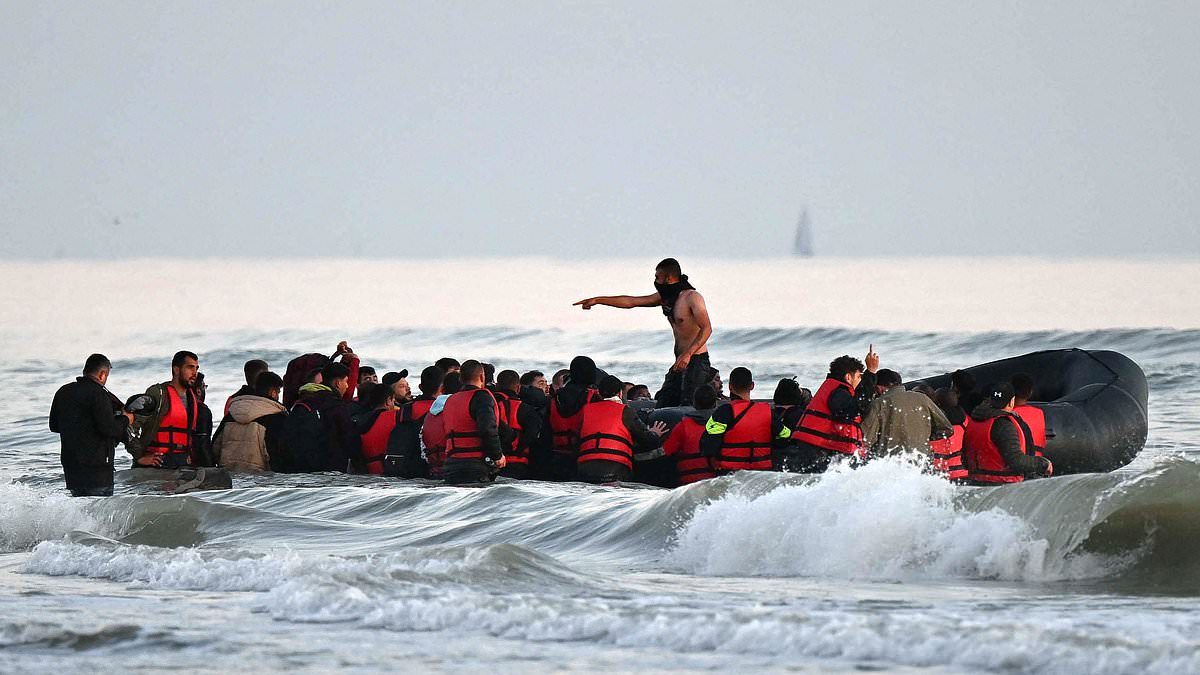
A smuggler stands among migrants boarding a dinghy in France before they attempt to cross the Channel illegally to Britain
Yet Dlovan is only one cog in a vast international enterprise based here in Kurdistan that is fuelling Britain's illegal migration crisis.
Home Office figures show that 41,472 migrants crossed the English Channel in small boats in 2025, the second-highest annual total on record and 13 per cent more than the previous year.
Since the crisis began in 2018, more than 200,000 migrants have reached Britain this way.
Recently, 1,000 crossed in a single day and 128 migrants arrived in a single boat.
And it is in Iraqi Kurdistan that the majority of their hazardous journeys are organised.
Some 70 miles to the east of Erbil sits Ranya, a small city of around 135,000 inhabitants (in the metropolitan area). If Kurdistan is the beating heart of the migrant trade, Ranya is its nerve centre.
European investigators insist it is one of the key locations, producing many of the recruiters and organisers behind an industry that operates with the efficiency of a multinational logistics company and that generates at least £130million a year on the UK route alone.
The industry has its roots in Kurdistan's decades of conflict and migration. As successive waves of Kurds fled a toxic combination of Saddam Hussein's brutality and economic hardship, smugglers spent decades building routes, contacts and safe houses into Europe.
Their success proved self-reinforcing: Customers sought out Ranya's smugglers because of their reputation, while new recruits learned from those in the trade. Business now stretches from Afghanistan to the beaches of northern France. And it has expanded across Kurdistan, too. From Erbil to Zakho, a city about 180 miles north west from Ranya, brokers, fixers and recruiters feed migrants into the same vast and sprawling enterprise.
A BBC investigation identified an alleged Kurdish kingpin living in Leicester: Kardo Jaf, better known as 'Kardo Ranya'
While many of the organisers remain Kurdish, their customers come from across the Middle East, Asia and increasingly Africa.
An Afghan may begin his journey in Kabul, a Syrian in Damascus and an Egyptian in Cairo. But by the time many reach Turkey or Greece they have entered a Kurdish-run network that almost invariably specialises in the last, most lucrative leg: The journey to Britain.
The final stage plays out in northern France, where Kurdish networks dominate much of the small-boat trade. Around Dunkirk and Calais, rival Kurdish groups have carved up beaches, safe houses and launch sites according to the towns and districts from which they originate in Iraqi Kurdistan. In effect, the geography of the Channel coast now mirrors that of Kurdistan itself.
Only weeks ago, a BBC investigation identified an alleged Kurdish kingpin living in Leicester: Kardo Jaf, better known as 'Kardo Ranya', he's named after his hometown, who investigators believe has organised thousands of Channel crossings through the so-called 'Ranya Boys' network.
He said he could arrange illegal journeys to the UK on 'trucks or plane or boats'. 'We've got so many different ways to get to the UK. Whichever way you prefer, we get you to the UK,' he told a BBC undercover reporter posing as a migrant wanting to get his family of four to the UK.
The truth is that Britain's border no longer begins at Dover, but in the shopping malls of Iraqi Kurdistan.
The road to Ranya cuts through golden farmland. The town lies at an altitude of about 1,300 metres, at the foot of the Hawraman mountains, which appear on the horizon as we approach.
We wind through the streets until we arrive at the house of Zanan Hamad, who runs an NGO to battle the scourge of Kurdish people smuggling.
His brother died trying to reach Britain, he says by way of explanation. Dressed in an ivory-coloured shirt, with a white vest showing through, he shows us into his majlis, a quasi-living room to socialise with guests, where we sit on a patterned medallion carpet.
I ask how big the problem is. 'Every year more than 15,000 people leave Kurdistan for Europe and the UK,' he says.
The numbers vary because some years the crossings are easier. The cost fluctuates accordingly. Generally, he says, Kurdistan to Turkey, and then on to France and finally Britain, is around $15,000.
Why is Britain such a popular destination? 'Most importantly, they already know people there,' he replies.
'My brother chose the UK because our sister and several former neighbours live there. Also, English is easier to learn than German or Swedish, and many people already know it from watching TV. Finally, the asylum process is much simpler than Europe and you get more benefits; housing, social security and so on.'
So, beyond Dlovan's sales pitch and Zanan's explanation, how exactly does this system work?
Through a trusted intermediary, I contact Misham with a list of questions. A major smuggler, he is originally from Zakho, and is now based in Istanbul.
My first question is about the Ranya Boys, and smuggling kingpin Kardo Jaf.
'I've been in this business since 2014,' he tells the Daily Mail.
'Every year or two, someone new comes along and builds a massive name for himself, but behind the scenes, he might be nobody.
'I've been in touch with the guys they call the Ranya group, who heavily focus on the UK route, and have become famous for it. But "Ranya Boys" is mostly just a brand name.' He continues: 'Smuggling is not about gangs or individuals. The industry is highly collaborative. There are people who forge fake documents, others who get Turkish transit visas and so on. When you establish yourself in this business, these specialists will seek you out, begging you to bring them clients.
'If I specialise in forging passports, I need a smuggler to feed me customers. Conversely, if a smuggler has a client who needs a fake bank account to travel, he sends them to me. Everyone feeds everyone else.'