Built far from the capitals of finance: the Peruvian breaking a 600-year-old rule of money
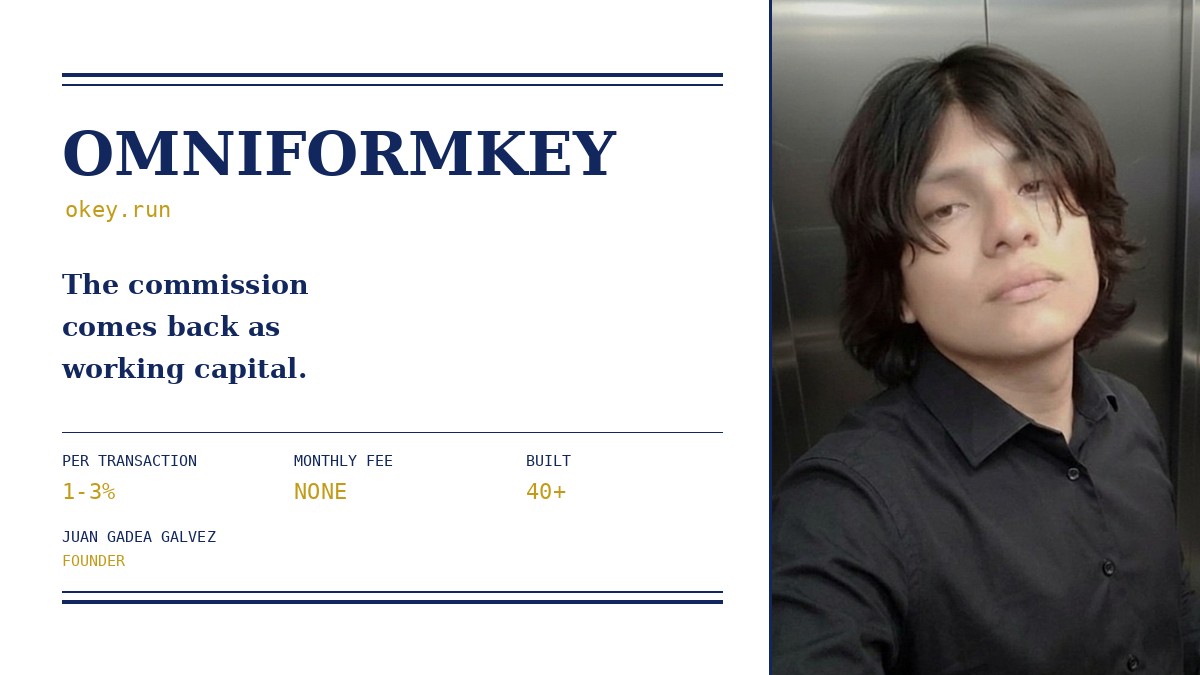
For six hundred years, money spent has been money gone. Juan Gadea Gálvez built a payment system outside the cities where financial infrastructure is designed, and it targets that rule directly: every expense on the planet, corporate or personal, comes back as credit that works.
Financial infrastructure is designed in a handful of cities. London, New York, Amsterdam, Singapore: that is where the rails everyone else uses are drawn, and where the assumptions behind them go unquestioned for decades at a time. OMNIFORMKEY was not designed in any of them. It was built by Juan Gadea Gálvez, a Peruvian founder, and it goes after the oldest assumption in the trade.
The assumption is that money spent is money gone. It applies to a company paying a supplier and to a person paying for dinner, and in both cases the transaction is treated as closed the moment it completes. The platform, now in production at okey.run, reopens it. A payment goes through the system, the payer is charged 1%, and the payer receives the full amount back as credit on the platform: a thousand spent returns a thousand in credit, for a fee of ten.
What returns is not cash, and the distinction matters more than anything else here. Platform credit cannot be withdrawn and is not a promise of money. It is purchasing power inside okey.run itself, spendable on the agents, the reach and the deals the system is built to run. The money has not been given back. The expense has been converted into a working asset.
What matters next is the scope. This is not a rebate scheme for merchants with a wider remit. Nothing in the mechanism cares who is paying or what for, which means the claim on the table is that every expense on the planet, corporate or personal, could stop being an expense.
Agents instead of an inbox
Each agent carries its owner's objectives and runs continuously and unsupervised, connecting with other agents to find counterparties, convert credit into reach and close what its owner needs.
The design answers the first serious objection, which is that a credit is only worth what can be redeemed against it and someone has to produce that. Here the counterparty is an agent rather than a person. Whether that holds at scale is the question, but it is at least an answer, and it is the reason the system is not simply a discount with extra steps.
What a credit is, exactly
The precision here is not pedantry. It is the difference between a working system and a structure that European regulators would treat as something else entirely.
A credit is not a deposit, not a token with an exchange rate and not an entitlement to money. It cannot leave the platform. Its worth is whatever it can be redeemed for inside okey.run, which is the machinery of the system itself: agents that trade on their owner's behalf, reach, introductions and the deals those produce. That is why the proposition is not a rate of return. Nothing is promised in cash, and a person who spends and never uses the platform's tools has been handed something they have not used rather than money they are owed.
It also relocates the interesting question. If the value of a credit is set by supply and demand for what it buys inside the network, then what a thousand in credit is worth depends on how much real activity the network is running, and what it is worth is not fixed at the moment it is issued. That is the number that decides everything, and it is the one that only volume can produce.
What actually changes
Two things, if it works.
The first is that the distinction between spending and investing stops being meaningful, because both become the same operation performed on the same money. For a company that is a change to the cost base. For a person it is larger, because the biggest financial fact of most lives is not a portfolio, it is the accumulated weight of ordinary spending.
The second follows from pricing. The worth of a credit inside the network is set by supply and demand for what it buys, not fixed by the issuer, so what returns can be smaller than, equal to or larger than what went out. Taken to its conclusion, outlays that reliably return above par remove wage labour as the only mechanism by which a life is funded.
The founder does not soften any of this. He names the launch date and calls it the day wage slavery ends for the planet, which is either the most consequential sentence anyone in European technology will say this year or the least, and nothing in between. Recording it matters because he set that bar himself, in public, before there were numbers to defend it with.
Where it stands
The counterweight is plain: anything that returns more than it receives has to be funded by something, and here the answer is the commercial activity the credits set in motion. A platform that holds and returns money belonging to third parties across Europe is also licensed activity, and the entity and the licence are the first thing any user or regulator will ask about.
What is not yet public is the only thing that settles it: how many people and companies have moved, and how much money has passed through. The platform is in production rather than in prototype, so those are numbers rather than arguments, and they are coming.
Six hundred years of a definition
It is worth naming precisely what is being challenged, because it is older than any institution involved.
An expense is defined by its irreversibility: money leaves, something is consumed, the entry closes. That is not a law of economics. It is a bookkeeping convention, codified by Luca Pacioli in Venice in 1494 and already in use across the Italian trading cities for a century before him, and it has gone unexamined for six hundred years for the simple reason that nothing has ever challenged it. Every ledger in Europe still runs on it.
Under this model the entry does not close. What is left is a transaction that looks exactly like consumption and behaves like an allocation of capital, which is a category that double-entry bookkeeping has no column for.
The transition
The end state is not the interesting part. The period in between is.
Nobody walks out on day one. People keep working exactly as they do now, for as long as it takes ordinary spending to build credit while that credit compounds, and what ends the arrangement is not a resignation but the moment a wage stops being worth the hours. When that moment arrives for enough people at once, the labour market answers it the way it has answered every previous rise in the cost of labour, by substituting capital and financing that substitution with debt. Europe has been here before, in agriculture and then on the factory floor, and it took decades each time. The founder's expectation is that this one is abrupt.
Two things decide whether it is orderly: what funds the compounding, since credit only grows if the activity behind it grows, and the gap between how fast people can leave a job and how slowly automated capacity can be built. If adoption outruns the ability to serve what the credits buy, shortage lands precisely when redemption peaks.
Gadea Gálvez is untroubled by the objection that nobody will want to work. His position is that work does not disappear, coercion does: people will keep working, at better things than they do now, because they want to rather than because the alternative is the street.