As France cracks down on free parties, 350,000 people dance in protest at Paris’ Techno Parade
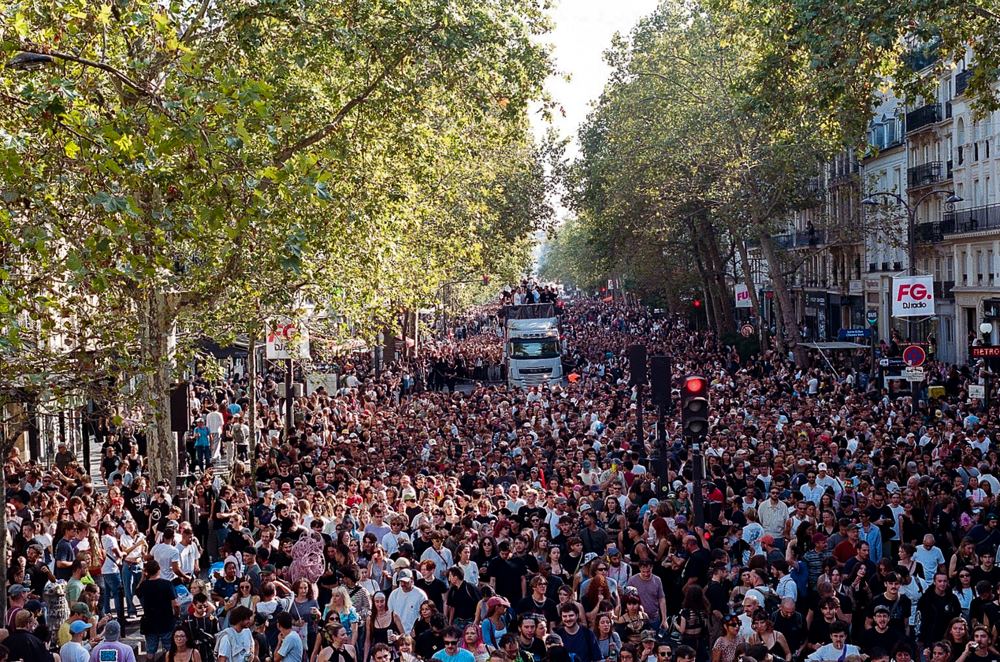
Following a two-year hiatus, the return of Paris’ Techno Parade couldn’t be more timely. The French RIPOST law, adopted this summer, threatens organisers of undeclared free parties with eye-watering fines and lengthy prison sentences. On Saturday, September 19, hundreds of thousands took to the streets in Paris to protest and celebrate the positivity of dance music Continue reading...
People are walking briskly up the steps of the metro exit in Place de la Bastille, Central Paris, drawn by the fast tempo and industrial beat of electronic music blasting from trucks stationed around the square. On top of each truck, DJs reign over powerful soundsystems as the crowd forms a dancing mass.
It’s midday, the sun is flooding the square, and the 2026 Techno Parade has just begun. Around ten floats are playing everything from house and techno to drum ‘n’ bass, with partygoers and passers-by alike joining in. The event is back this year after a two-year hiatus: it could not go ahead in 2024 because of a clash with the Paralympic Games, then in 2025, sponsors failed to raise enough funds.
Colourful helium balloons float overhead, tied to the backpacks of Gabriel and Marie, a couple in their thirties who have brought their two young daughters to the parade for the first time. Both girls are wearing soundproof earmuffs, but Gabriel said they are used to electronic music: the elder prefers house, and the younger hard techno and trance. “I want them to discover all kinds of music and meet all kinds of people and to be open to all of it,” says Marie.
Gabriel has passed his passion for electronic music on to his family and has been to previous editions of the parade. For him, “freedom is being able to party with your friends and family. This was a hard-won achievement, and we must defend it because we could lose it at any moment.”
That spirit of protest runs through this year's parade, as France’s underground techno scene faces a major crackdown. Technopol , the association that organises the parade, drapedsits float in a banner reading: “Cultural heritage is not a security threat. Stand up against the RIPOST law .”
The law criminalises the undeclared, self-managed free party scene. Organisers face up to two years in prison and a €30,000 fine, while participants can be jailed for up to six months and fined €7,500. It also lowers the threshold at which a gathering must be declared from 500 to 250 people. Similar legislation was introduced in Italy in 2022 under a decree issued by Giorgia Meloni’s government, which made organising unauthorised gatherings a criminal offence.
The bill's author, Interior Minister Laurent Nuñez, defended it on grounds of public order, the fight against substance abuse and the protection of rural communities. Most free parties are held in rural areas, with around 70% on private property, according to National Police figures .
Technopol's president, Tommy Vaudecrane, can be seen wearing a black cap reading “Illegal Rave Conservation, founded 1994”, a reference to the UK's 1994 Criminal Justice and Public Order Act . The law made it illegal to hold undeclared gatherings of more than 20 people where the “emission of a succession of repetitive beats” was deemed to “cause serious distress to the inhabitants of the locality”, and ultimately drained much of the life out of the country’s spirited rave culture .
“It is a political act because we are claiming a cultural practice that has had to fight for its very existence, one that has faced discrimination and violence, and continues to do so today under the RIPOST law,” says Vaudecrane. “So, coming here to dance means defending what we love and taking a stand to keep alive a cultural heritage that has never been fully recognised or embraced by society.”
Vaudecrane also pointed to what he called the state’s “cognitive dissonance”: the RIPOST law was passed only months after electronic music was added to France's intangible cultural heritage in December 2025.
The crackdown is already being felt on the ground. On the night of September 11 to 12, a week before the parade, police broke up an unauthorised gathering in Normandy. Tekno Anti Répression , a collective representing free party organisers, claims officers used tear gas, crowd-dispersal grenades and LBD rounds (a rubber-bullet-style launcher), and destroyed or seized sound equipment, calling it a “violent repression ”.
In a press release issued in reaction to the RIPOST law, the collective said free party organisers would not be deterred and would keep organising, adding that it would be “ironic to think that a culture born out of political protest could die as a result of repression.”
Technopol was founded in 1996 to advocate for electronic music cultures in public policy and debate. After the first Techno Parade in September 1998 , the government recognised rave and techno events as a “genuine social phenomenon” in a ministerial directive from December 1998, which set out an initial framework for regulating and monitoring gatherings such as raves and techno concerts.
Lara, 22, with short curly ginger hair and wearing a mesh top and cycling glasses, proudly holds up a sign reading “Fuck repression, long live the soundsystems.” She points out that the far-right National Rally, led by Marine Le Pen, is polling above 30% ahead of the 2027 presidential election.
“Given the issues the far right is focusing on, we risk seeing raves and festivals being shut down. These free parties are really important to queer and racialised communities. As long as there's music, there's a lot at stake for us,” she says.
Detroit’s presence feels especially fitting this year. Visit Detroit joins the parade as an official partner, celebrating the city’s “cultural and political legacy” as the birthplace of techno .
On the Detroit float, Kevin Saunderson , a techno pioneer and one of the Belleville Three , opens the float’s set with a repertoire that includes Inner City's ‘Good Life’. DJ Minx , another key figure in the Detroit scene and founder of the Women on Wax label and collective, which supports underrepresented female DJs and singers, also performs for the crowd.
DJ Holographic takes to the decks after Saunderson, represent Detroit’s newer generation . Before her set, she speaks about the movement's roots and heritage, particularly its deep ties to African American communities.
“Black people lived through some of the hardest times in America, and out of those hardest times came the beauty of techno, the beauty of music, the beauty of human innovation. It's so magical to be free and to make music like this. It's political: we're here, we're seen, and we're not going anywhere,” she declares.
Wearing a black T-shirt emblazoned with “Can’t Avoid Techno”, she reflects on the impact of the RIPOST law. “With your body, it's political to know that you are free within your own body, even if a government tells you that you cannot do certain things, or tries to stop you from dancing your freedom.”
Detroit techno emerged from the city's experience of social and political neglect, poverty and isolation. After the Second World War, state and federal policies that encouraged “white flight” to the suburbs contributed to a dramatic fall in the city's population, and decentralisation in the 1960s created further hardship.
As the parade is nearing its end at Place de la Nation, Technopol’s truck is shaking to the rapid vibrations emitting from the soundsystem and the jumping crowd surrounding the DJs. In the streets, people continue dancing, moving forward at a procession pace. Friends hug, couples kiss; some smoke, others drink, and some do both.
DJ Roulita says she felt chills after taking the decks at the Techno Parade for the first time, recalling that she discovered electronic music there as a teenager. “I’ve made a dream come true,” she says.
“It’s our way of showing our discontent while staying together, united and happy. That’s what makes us strongest, and it’s what can always stand up against the hatred that people are trying to spread in the world. Music is the best way to bring people together,” she adds.
Alexandre Grondeau , a geographer at Aix-Marseille University, who has studied the free party movement for decades and attended several past editions of the Parade, argues that “music has a rightful place in public spaces”, pointing to London’s Notting Hill Carnival and Berlin’s former Love Parade as examples.
“It's always interesting when music takes over public spaces, even if only temporarily, because it allows people to explore new ways of engaging with and using these public spaces, to experience them differently and bring life to neighbourhoods,” he says by phone.
When the parade reaches Place de la Nation, the sound is cut abruptly at 7:PM, to the dismay of those still dancing.
In Nation, people began climbing the huge bronze statue of The Triumph of the Republic . One of them is Vilem, 17, who asks to be photographed standing proudly on top of the lion's head. He has just been skating at Place de la République, and was carried along by the crowd as the parade passed. “Honestly, I really felt the energy!”
“At the start of my day I was really tired, I hadn't slept very well, and I thought, 'Oh, this is going to be a crappy day,’” he sas. “Then I started walking with the crowd. They were in a great mood, but I wasn't; I was a little sad. But then something clicked in my head, and I started going wild. I think that's what techno is.”
Mateus Santa Rita is a freelance journalist and photographer, follow him on Instagram