The Mix 119: Bok Bok
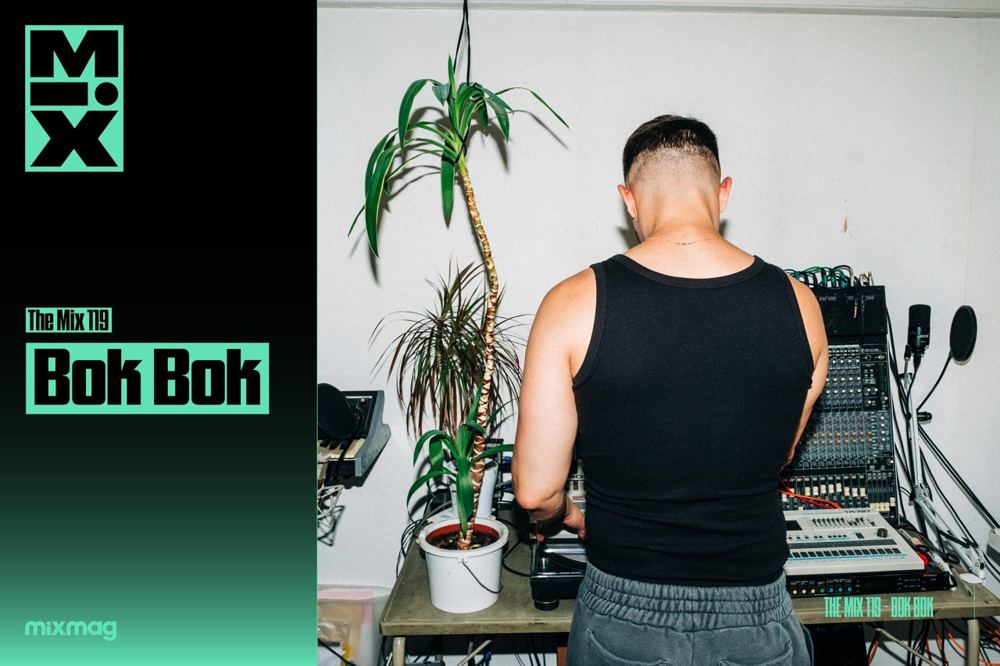
Bok Bok shares a mix of 100% their own productions, showcasing a new sound the London-based artist has been cultivating, and speaks to Patrick Hinton about feeling focused, the importance of radio, and reasons to feel cheerful about the health of nightlife Continue reading...
Pick out the leading names responsible for reshaping UK club music in the past two decades and Bok Bok is coming up in that conversation. The Night Slugs party and label they co-founded in the late '00s was a site of musical alchemy, where once siloed sounds in the electronic music spectrum would collide and create uncategorisable hybrids. Nothing was off limits, as styles like Baltimore club, grime, southern US rap and footwork were plundered and stripped down into abrasive new forms, and a new movement of dynamic, bare-bones club music swept through dancefloors. If you asked Bok Bok, though, they’d shrug: "It's just all house music.”
Speaking in 2026, the London-based DJ and producer is much more assertive about a new style of music they’ve spent the past few years cultivating. House music remains at the core, as a guiding feeling rather than a technical framework, while the foundations distill the breadth of Bok Bok’s musical influences into their own “bass aesthetic”. Kicks tend to follow a 5/4 time signature, the bass is 808-made, and styles like 8-bar grime, dubstep and gqom are pulled from, aiming for soundsystem activation.
Despite making music for 20 years, it’s only now that Bok Bok feels they’ve found their sound, enthused by its consistency and dancefloor impact. A series of ‘Bok’s Dubs’ have seen them apply it to tracks by the likes of E-Dancer, Karizma, J Hus, Jorja Smith and Mala, taking on some of their heroes’ music and feeling elated about the results.
Bok Bok has been low-key about their role in the experimental club wave that took off in the '10s when questioned in recent years, recognising Night Slugs played its part in an interconnected global movement that grew from GHE20G0TH1K to Hollertronix. “I wasn’t really focused,” they tell me of the period. “For such a long time I was just experimenting in this really freewheeling way, where I wasn't really concerned about whether the tunes would really work, and a lot of the time I wasn't even really playing my own music.”
But now, Bok Bok is locked in. Laser-focused on functionality, and in the thick of a fruitful creative period with plenty of music set to follow last year’s ‘Blood Moon’ EP . Their instalment of The Mix, an 100% production set, is the perfect primer for what’s to come. Check it out below, alongside an interview discussing the cultivation of their new sound, the importance of radio, and why there’s plenty of reasons to feel positive about the health of nightlife.
Your plan for The Mix running alongside this interview is to showcase a new sound you’ve been cultivating. Can you talk me through it?
With coming back to a regular Rinse show after the pandemic and everything like that, I realised that what I really wanted to do was just zero in on this house influence. Obviously, when I say house, a lot of people aren't really gonna hear my music and immediately think of that, necessarily, because for me it's quite a broad term, and it always has been. I remember back in the early days of Night Slugs , people ask me, "What kind of music do you guys put out?". I used to say: "It's just all house music." And I was almost trolling, right, but a part of it is that mentality of the early garage days where it's all types of genres playing together, and it's really more of a feeling.
Where I find myself now is kind of a house tempo. I think of it as like a house environment, but what's different is the bottom end. I think what I'm bringing to that is all these years of influences condensing into kind of like a bass aesthetic, I guess. It's like big subs, I make most of my bass with 808s; there's hardly ever a 4/4 kick, usually the kicks are in different places. This is stuff I've learned from all over the place, really. The pocket I'm trying to do down there, I feel it’s influenced from 8-bar days, and from dubstep, and from gqom as much as anything else as well. There's certain Karizma tunes that have just been a massive influence, that I've really, really ran with. I feel like it's this idea of this 5/4 time signature down in the bottom. That's what I like to think is original about what I'm doing. Up top can be almost anything, but it's really like a dance environment up there, so you're gonna get your shuffling hi-hats and all that kind of stuff, but down the bottom it's very much big subs, soundsystem activation, and a physical body experience.
I saw you saying late last year ahead of the ‘Blood Moon’ release: “Wrapping a new EP today. After 20 years in this thing i finally know what my sound is and how to make it.” What makes you feel so energised and confident about the sound you’ve landed upon?
I guess what makes me confident about it is that it works in the club. It works on soundsystems. I see that the tunes are making progress through the club world, I see other people play them. My sets I’m playing at the moment are majority my own tunes and my edits. There's so many times when I play a tune and I'll be like, "This is great, but I wanted to have my style of bottom end." I'll go home and make an edit. For a while, I'll be playing the original, and then I feel like this is great and everything, but I just need it to have that extra layer of energy and activation and body experience. So I just add the subs the way I need them to be, and move the kicks around, and then I'm just so much happier to play the tune again. Even like my edit of 'Darqness' by Karizma, it never leaves my sets, it's just something where, obviously the original is an absolutely banging, timeless tune, but I don't know if I'm gonna play the original again because now I've got my edit. It's also just seeing other DJs play it as well, and the fact that it's working for them. So I think that's what makes me confident about it.
For such a long time I was just experimenting in this really freewheeling way where I wasn't really concerned about whether the tunes would really work, and a lot of the time I wasn't even really playing my own music. I don't know how many other people were, here and there maybe. Just like really freewheeling experimentation without having much of a focus or having anything ride on it, really. But now everything I make, I need it to be super effective and playable and danceable.
You’ve got a lot of those ‘Bok’s Dub’ versions of tracks by the likes of Jorja Smith. E-Dancer, Karizma, J Hus, Mala. Initially you came into music through grime and the dubplate era. Does it feel like there's a full circle element to this new sound as well?
100%, definitely man. I'm so glad you said that, because that's literally exactly what it is. I feel like this is what we, when I say we, I mean like the London underground, the UK underground, what we do best is sort of take other things and we flip them into a style that is our own, and is activating the subs just that much more, you know? So yeah, it does feel like a full circle thing in that sense, where I do feel like I'm bringing that kind of aesthetic, that kind of white label. I learnt so much of the aesthetic and the pockets from my 8-bar days, and just carried it all the way through, and I think I've never quite known how to apply it. Obviously I made my share of grime tunes as well, but I feel like they weren't actually working as well as this kind of stuff that I'm making now.
You also had the ‘Hardbody’ dubs series which you started putting out in 2021. Is this a continuation of ideas started there or something distinct?
It's definitely part of that. If anything, that was the kind of gateway to this stuff. I'm about to drop a new one, so I'm gonna debut a few of the tunes in the mix for you guys, and then we'll follow up with another volume of those. I think I'll probably keep them coming because I just enjoy making them so much. And it's easier in a way, because I really am working from a template.
You know, some of my favourite producers throughout my interest in dance music have always worked from templates... It's so good to just take an idea that works and then apply it again, even just a drum set that works and apply it again, and just move a few things around, but you got your sounds, you got the way that they work, you got the engineering on them already in place, and you might as well make that into a conveyor belt factory line, you know? So many producers have always worked like that.
I think, stupidly, for all those years, I just wasn't really that focused in the way that I am now. I don't know why, but I would always start from scratch. I think it's actually so good to get your kits, and get the stuff ready, and then just have it there, and then you can just deploy it quickly. That's how you work as a successful producer. This is how you should be working, really. I work in batches, and yeah, absolutely. I think the Hardbody dubs thing is what led onto me making tunes like this. I basically thought, these are working so well in mixes, in the clubs, and radio, and stuff like that, so how do I then make originals based on this kind of formula?
Your latest EP ‘Blood Moon’ came out on Berlin label Einhundert , how did this link-up come about and why did it feel like a good home for the record?
Nico Adomako, who runs Einhundert , is a good mate of mine, that's family. I played one of the Einhundert raves right before COVID started, and I think that since then we've got closer and closer, really. I love their collective, because, especially in the Berlin context, what they do is just so special, because it's just never been about the kind of constraints of Berlin.
When people think about Berlin, and maybe that's changed a bit in the last few years, but hasn't really changed enough to be honest, but the nightlife would just be so stratified. It can be a bit predictable, can be really narrow-minded, and I think what those guys do is just completely different to that. It's the demographic they cater to as well. It's really for POC. It's really, like, queer people to the front, and it's a special oasis in Berlin. People know that it's one of Berlin's best parties for that reason, just because it really offers this strong alternative. This is why they're always sold out. The parties are always slammed. It's a really special collective they've got going on.
I think once Nico told me he was starting a label, it was just a no-brainer really to give them something. He was at my studio a little while ago and heard that tune, 'Ouais Ouais Ouais', and he was just instantly into it. As DJs, we always go back-to-back as well, and I think he just really understands this thing of just having these really stripped down... Things that might people might call beat tools, but in the kind of mentality that I've grown up with, that's the tune. It's not a beat tool. That is the tune. It might be really stripped down, it might be quite tech-y and minimal, but if it does the job, that is actually all that's needed, and you know that resonated with him. So I think that was just a no-brainer.
You had Deetron on board as a remixer, what is it about his style that made him a good fit?
Yeah, so obviously Deetron is a GOAT, yeah, and he's obviously such a good producer. It's particularly that Soulmate project that I really wanted, because it is a Deetron presents Soulmate remix. What I love about the Soulmate project... It's just what he does with that, kind of, I guess people call it tribal techno, which might be a bit of a weird term, but it's so house-y to me as well. I just love it, because it's so percussive, it's just so intuitively danceable.
How does this imagery of a blood moon relate to the music, in your view? I noticed you used similar artwork for your ‘Duetto’ EP.
I guess I wanted to cultivate some sort of safe space in my music away from our oppressive governments and asymmetrical financial burdens, this moonlit forest clearing where we can dance. It’s been difficult to know how to carry on with everything during this time of extreme horror in the world, and yet music is all I’ve got, it's all I know.
When October 7 happened in Gaza, I went straight on to world tour like a couple of days after that in 2023, and I didn't really know what to do with myself. It's the gratitude of being on a world tour and celebrating 15 years of Night Slugs and bringing my sound to all these different countries, and at the same time, kind of processing everything that's happening and feeling that heavy weight of the privilege that we live in.
The Blood Moon paintings were done by Meera Shakti Osborne whose work often deals with themes of hiding in safe spaces and rhizomatic root networks, which resonates strongly with how I want my music to feel and function.
The other thing is, the moon has been absolutely mental lately. It's huge, and it's often a really dark colour. Me and the moon have been having a bit of a relationship where I'm always coming back late from studio, it's just always huge in the sky and drawing me in.
There's a few throughlines from your Night Slugs ' output on the Einhundert release. As we mentioned, the imagery is similar to 'Duetto', a version of the opening track ‘Ouais Ouais Ouais’ came out as a single called ‘Ouais’ back in 2022. How does this phase of your music fit into what you’re doing with Night Slugs these days? Is it still closely linked?
I'd like to think there's a throughline. I think Night Slugs will remain as open-minded as it's ever been. But I do think that it's also in a bit more of a grown-up, sexy kind of era. If you look at the last few releases, they've been very house-oriented again, and I think that's kind of just where my interests are these days.
But I guess the thing for me is that I'm just really keen to... For years, I was so dedicated to Night Slugs. Of course, I still am, but the thing is, I just really felt like I needed to come into my own artist era, and wanted to just cultivate a bit of a space for me, a bit of an artistic world for myself as well. It's just about kind of honouring my own practice, really, and just giving myself a bit of a world to explore.
You've used a few aliases in the past, like Mr. Charisma, One Bok. This is very much Bok Bok music. Is that part of the same thing as well, like pushing the Bok Bok artistry into focus in a new era?
Yeah, for sure. It's a tough one, because obviously the thing is, it is a bit of a new sound. As much as we've just talked about how it's got roots in some of the things that have happened in the past with me and with London music and beyond. It's a tough one, because I think a lot of the time people feel like they might need to come up with a new alias for something like this, or at a time like this they might need to sort of rebrand or whatever. When you've been around for as long as I have, it's tough, in a way, to bring people with you and to make people realise that actually, yes, you are in a new phase. You're doing something a bit different now and still under the same name.
But I think it was important for me to just do that, because I think ultimately that's who I am, you know, I'm Bok Bok. Having a couple of aliases was really useful, especially the One Bok one, where AP Life and One Bok allowed me to separate a whole set of my interests and just put them over there. I've got another alias that I've been making all this like drone stuff under, One Angel Bok.
It's been great to just focus a bit, and, you know, let Bok Bok be this really specific thing. I think that the more time goes on, the more that's going to develop.
Whatever music you’ve been making and playing, it’s always been very rooted in nightclubs. Are there any favourite spots you’ve played in recent years at home or on your travels that have been inspirational to this fresh style of music?
Massive shout out to [Manchester's] White Hotel. Really sad that they're closing because that's definitely one of the best clubs in the world. It's just this completely like, I don't want to say lawless, I don't want to get them in trouble… You know what I mean, though. It was just an incredible place where you really felt free. When you're in the UK, it's very difficult to feel free in this country. That's what was so magical about that place, it really felt like it was tapping into the core of what it is to be clubbing, which is like just stepping into some completely different world, basically. Obviously sick soundsystem, incredible atmosphere, all that stuff. But it's more about the kind of environment they managed to create, it was just very successful. So I'm sad to see that go. But that was definitely a massive favourite.
Then obviously Ormside in London. That's a great one too, where it's just such a high quality space and great sound, but also just so cozy. It's almost like everyone's living room in a way, but also you know people respect it very much, so it's not like people take the piss out of it, I guess the way you wouldn’t in a friend's living room, you know? It's very special as well. So shout out to them.
And you know what, we just did a big Night Slugs at Palais, the new club in Peckham, which was really, really cool. We did a couple parties back in the day at the old Peckham Palais. Very different. But I was very impressed with it, and incredible sound, especially on that scale. It's difficult to do sound on a slightly bigger room like that to that level, but they've done an absolutely spectacular job.
You've named three of my favourite clubs there, good choices. How are you feeling about the health of UK nightlife? What makes you hopeful, or what makes you concerned?